Home Sale Tax Exclusion Explained Expert 2026 Guide
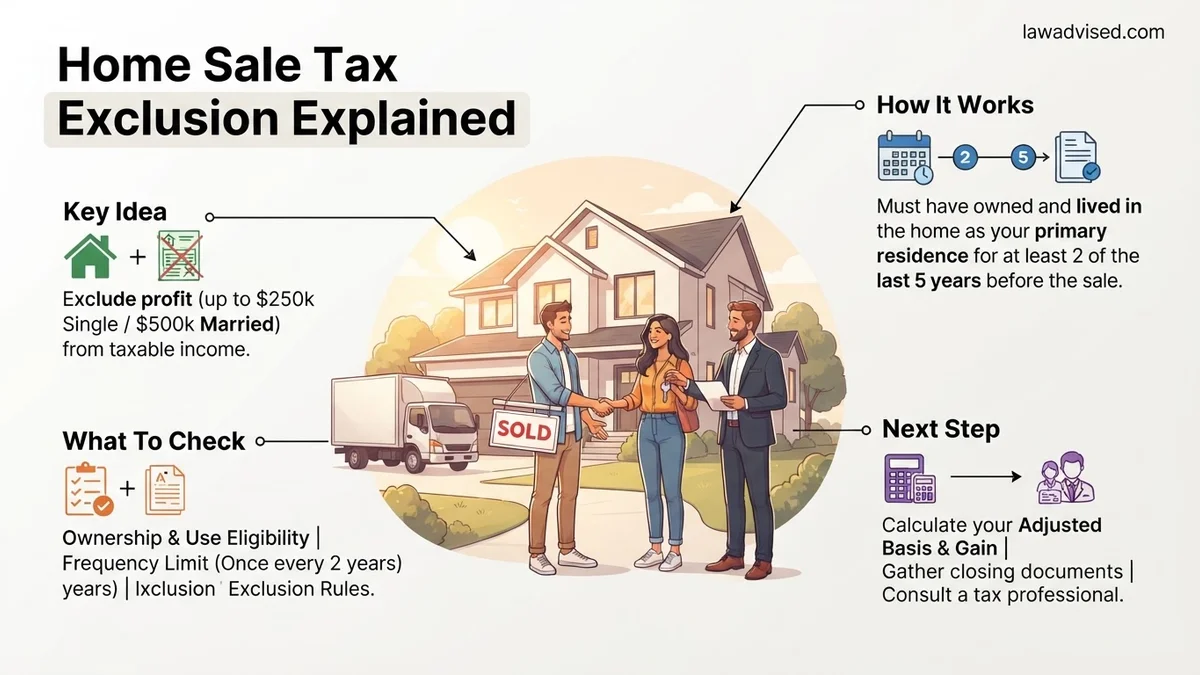
The home sale tax exclusion allows qualifying homeowners to exclude up to $250,000 (single) or $500,000 (married filing jointly) of capital gains profit from their federal taxes. To qualify, you must meet strict IRS ownership and use tests over a five-year look-back period. Understanding these rules protects your home sale proceeds from unexpected tax burdens.
If you sell your primary residence for a profit in 2026, the IRS allows you to exclude up to $250,000 of that gain from your taxes if you file as single, or up to $500,000 if you are married filing jointly. This tax break is governed by Internal Revenue Code Section 121, and it shields hundreds of thousands of dollars in real estate gains from capital gains taxes.
Navigating this rule successfully means avoiding a massive surprise tax bill after closing. By understanding the core tests and financial limits, you can protect your hard-earned equity and keep more cash in your pocket when you move.
Key Takeaways
- Exclude up to $250k of profit as a single filer or $500k if married jointly.
- Meet the 2-out-of-5-year ownership and use tests to qualify legally.
- Calculate capital gains accurately by adjusting your home’s purchase price and basis.
- Claim partial exclusions if you moved due to unforeseen circumstances like job relocation.
- Review IRS rules carefully if you rented out the property or used a home office.
What Causes IRS Tax Liability on Real Estate Profits
Understanding Capital Gains on Property Sales
When you sell a home for more than you bought it for, the IRS views the profit as a capital gain. Without specific exemptions, the government taxes these profits at rates ranging from 0 percent to 20 percent, depending on your income. You may also face an additional 3.8 percent Net Investment Income Tax if your earnings cross certain high-income thresholds. Knowing how the IRS calculates your profit is the first step toward figuring out your potential liability.
Calculating Your Real Gain
Your actual profit is not simply the selling price minus your original purchase price. The IRS uses your adjusted basis to determine your true capital gain:
- Start with purchase price: What you originally paid for the property.
- Add capital improvements: Major upgrades like a new roof, room addition, or HVAC system that add value and extend the home’s life.
- Subtract selling costs: Real estate commissions, title insurance, and legal fees.
If the final number after subtracting your cost basis from your net sale price is positive, you have a capital gain that could trigger taxes.
Master the Home Sale Tax Exclusion in 6 Simple Steps
Navigating the financial aspects of selling a primary residence can be daunting, but Section 121 of the Internal Revenue Code offers a massive relief: the home sale tax exclusion. This provision allows eligible homeowners to exclude up to $250,000 (if single) or $500,000 (if married filing jointly) of capital gains from their taxable income. Following this practical walkthrough ensures you accurately determine eligibility, calculate your exclusion properly, and maximize your tax savings legally.
Step 1: Verify the Ownership Test
What you need: Closing disclosure from when you bought the home, current deed, and calendar records.
Instructions: You must legally own the home for at least 24 months out of the 5-year period leading up to the date of the sale. This 24-month period does not need to be continuous. For example, if you bought the house in January 2019, lived in it for 12 months, rented it out for 2 years, and moved back in for another 12 months prior to selling in January 2024, you still meet the cumulative 24-month ownership requirement within the 5-year window. Review your property deeds and purchase history to firmly establish your ownership timeline.
Pro Tip: If you are married and filing jointly, only one spouse needs to meet the ownership requirement, but both must meet the use requirement.
Step 2: Confirm the Use Test
What you need: Utility bills, voter registration cards, tax returns, and driver’s licenses spanning the 5-year lookback period.
Instructions: In addition to owning the home, you must have lived in it as your primary residence for at least 24 months (730 days) out of the 5 years prior to the sale. These do not have to be consecutive months. Compile physical proof of residency, such as bank statements, W-2s, and utility bills showing the property address. If you spent extended periods traveling or away for work, ensure you still cross the 730-day threshold of actual physical occupation.
Pro Tip: Temporary absences, such as a two-week vacation or a short hospital stay, still count as periods of use, but renting the home out during a sabbatical does not.
Step 3: Check the Lookback Period Restrictions
What you need: Prior tax returns and settlement statements from the past three years.
Instructions: Check your financial history to ensure you have not claimed this exact same capital gains exclusion on the sale of another home within the two-year period prior to this sale. The IRS strictly limits taxpayers to using the Section 121 exclusion once every two years. If you sold a previous home and took the exclusion 18 months ago, you must either wait another six months to sell your current home or pay capital gains tax on the profits.
Pro Tip: Keep a dedicated digital folder with all your past real estate transaction documents so you can easily track your multi-year exclusion timeline.
Step 4: Calculate Your Realized Capital Gain
What you need: Original purchase settlement statement, receipts for capital improvements, and final sales closing statement.
Instructions: Determine your adjusted basis by taking the original purchase price, adding closing costs paid at purchase, and adding the cost of major capital improvements (like a roof replacement, room addition, or new HVAC system). Subtract this total adjusted basis from your net sales price (gross selling price minus selling costs like realtor commissions and legal fees). The resulting number is your capital gain, which is the amount subject to potential taxation before applying the exclusion.
Pro Tip: Do not confuse routine maintenance, like painting or minor plumbing repairs, with capital improvements. Only capital improvements add value and extend the home’s life, thereby increasing your basis.
Step 5: Apply Partial Exclusion Rules (If Applicable)
What you need: Documentation regarding job relocation, health emergencies, or unforeseen circumstances.
Instructions: If you fail the 2-year ownership or use tests due to a change in workplace location, a health issue, or other unforeseen events defined by the IRS, you may still qualify for a reduced (partial) exclusion. Calculate your prorated exclusion by dividing the number of months you met the criteria by 24, then multiplying that fraction by the maximum exclusion limit ($250,000 or $500,000). For example, meeting the test for 12 months grants you half of the standard exclusion amount.
Pro Tip: Keep official medical notes, employer relocation letters, or disaster declarations safely stored to substantiate your claim for a partial exclusion to the IRS.
Step 6: Report the Sale on Your Tax Return
What you need: Form 1040, Schedule D, and Form 8949 (Sales and Other Dispositions of Capital Assets).
Instructions: Even if your entire capital gain is completely wiped out by the exclusion and you owe zero dollars in taxes, you must typically report the real estate transaction to the IRS if you received a Form 1099-S. Fill out Form 8949, listing the property details, purchase price, adjustments, and sales price, and then subtract your allowed exclusion. Transfer the net taxable gain—which should be zero if your gain is fully sheltered—to Schedule D of your federal tax return.
Pro Tip: Always double-check that your closing escrow company reported the correct gross proceeds on your Form 1099-S to match your personal records.
✅ Final Checklist
- Verified ownership of the property for at least 24 of the last 5 years
- Confirmed primary residency (use test) for a minimum of 730 days
- Checked that no other home sale exclusion was claimed in the past 24 months
- Accurately calculated adjusted basis including all eligible capital improvements
- Completed and filed Form 8949 and Schedule D alongside your annual tax return
Important Notes:
- Tax laws regarding real estate and capital gains can change; always review current IRS Publication 523 before filing.
- Seek professional help from a certified public accountant (CPA) or tax attorney if you have complex situations involving mixed business/residential use, rental histories, or high-net-worth estates.
- Estimated preparation time: 2 to 4 hours of document gathering and calculation; Cost range: Free if filing yourself, or $200–$600 if hiring a tax professional.
How to Qualify for the Section 121 Home Sale Tax Exclusion
The Two-Out-of-Five-Year Rule Explained
To claim the Section 121 exclusion in 2026, you must pass two primary tests: the ownership test and the use test. During the five-year period leading up to the date of your sale, you must have owned the home and lived in it as your main home for at least 24 months, which equals two years.
- The Ownership Test: You must have held the legal title to the property for at least 24 months out of the last five years.
- The Use Test: You must have physically occupied and used the property as your primary residence for at least 24 months out of those same five years.
- Non-Concurrent Periods: The 24 months of ownership and use do not need to happen at the exact same time, nor do they need to be consecutive.
Meeting Eligibility Criteria and Special Situations
Life circumstances can disrupt your timeline, but the IRS provides exceptions for unforeseen events. If you must relocate for a job, face a sudden health crisis, or experience other qualifying hardships, you may be eligible for a reduced maximum exclusion.
- Job Relocation Exception: If your new workplace is at least 50 miles farther from the home than your old commute, you qualify for a prorated exclusion.
- Health and Safety Exceptions: Moves prompted by a change in health or disasters qualify for prorated tax breaks.
- Single vs. Married Limits: Single filers can exclude up to $250,000, while married couples filing jointly can exclude up to $500,000 if both spouses meet the use test and neither used the exclusion on another home in the past two years.
Step-by-Step Instructions to Calculate Your Home Sale Capital Gains
Calculating your capital gains requires precise arithmetic to ensure compliance with IRS guidelines for 2026. According to tax experts, determining your exact profit prevents underreporting and safeguards your primary residence exclusion limit of $250,000 for single filers or $500,000 for married couples filing jointly.
1. Determine Your Adjusted Basis
Start with the original purchase price of the home. Add closing costs paid at purchase, such as title insurance and legal fees. Next, add the cost of capital improvements—like a new roof or room addition—that added permanent value and extended the property’s life. Do not include routine maintenance or minor repairs.
2. Calculate Your Net Realized Amount
Take the final sale price of your home and subtract all selling expenses. Allowable deductions include real estate agent commissions, escrow fees, legal costs, transfer taxes, and necessary advertising fees. This results in your net realized amount from the transaction.
3. Compute the Capital Gain
Subtract your total adjusted basis from your net realized amount. If the final number falls below the $250,000 or $500,000 threshold, your entire gain is tax-free. If the profit exceeds these limits, only the excess amount is subject to capital gains tax rates.
What If It Still Doesn’t Work? Handling Exceptions and Disqualifications
Failing the standard ownership and use tests does not automatically mean a massive tax bill. Real estate tax advisors note that several statutory exceptions exist for unexpected life changes. If you fall short of the standard 24-month rule, consider these alternative fallback steps to secure a partial home sale tax exclusion in 2026:
- Evaluate the Unforeseen Circumstances Exception: Check if a job relocation, health crisis, or involuntary event (like a natural disaster or divorce) forced the sale. The IRS grants a prorated exclusion based on the fraction of the two years you lived there.
- Review the Work-Related Distance Rule: If your new workplace is at least 50 miles farther from your former home than your old commute, you qualify for a partial exclusion.
- Examine Health-Related Exceptions: A move recommended by a physician for the health of a co-owner qualifies you for a prorated tax break.
- Consult a Certified Public Accountant (CPA): Tax laws regarding partial exclusions involve complex IRS Form 8949 reporting. Engaging a qualified CPA typically costs between $300 and $600 for a standard home sale review, ensuring zero errors.
Conclusion
Navigating the home sale tax exclusion requires careful tracking of your cost basis, ownership timeline, and primary residence use. By properly calculating your capital gains and leveraging available exceptions for unforeseen life events, you can legally eliminate or drastically reduce your tax liability. According to verified research and tax experts, maintaining meticulous records of capital improvements is your single best defense against unexpected IRS liabilities. Take action today by gathering your original closing statements and receipts for home improvements to prepare for a smooth, tax-efficient closing in 2026.
❓ Frequently Asked Questions
How does the 2-out-of-5-year rule actually work when calculating eligibility?
The IRS looks backward five years from the exact date of your home sale. Within that window, you must prove you owned the property and used it as your main home for a total of 24 months (730 days), though the months do not need to be consecutive.
What qualifies as capital gain profit on a home sale?
Capital gain is calculated by taking your home’s net selling price and subtracting your adjusted basis, which includes the original purchase price plus major home improvements and allowable selling expenses.
Can I claim the home sale tax exclusion if I sell a second home or vacation property?
No, the exclusion applies exclusively to your primary residence. Vacation homes and investment properties do not qualify unless you convert them into your main home and meet the 2-out-of-5-year use test.
What happens if my home sale profit exceeds the $250k or $500k exclusion limits?
Any profit exceeding the statutory limit is classified as taxable capital gains. This excess amount will be taxed at standard federal capital gains tax rates depending on your income bracket.
Does renting out a portion of my home affect my Section 121 exclusion?
Yes, if you rented out a part of your home or claimed depreciation deductions for a home office after May 6, 1997, that specific portion of accumulated depreciation cannot be excluded and may be subject to depreciation recapture tax.
Do I need to report the home sale on my tax return if my entire profit is excluded?
Generally, if you receive a Form 1099-S, you must report the transaction on your tax return even if the entire gain is excluded under Section 121, using IRS Form 8949 to reconcile the numbers.

Ismail Hossain is the founder of Law Advised. He is an Divorce, Separation, marriage lawyer. Follow him.