Wash Sale Rule Explained 2026 A Proven Step-by-Step Guide
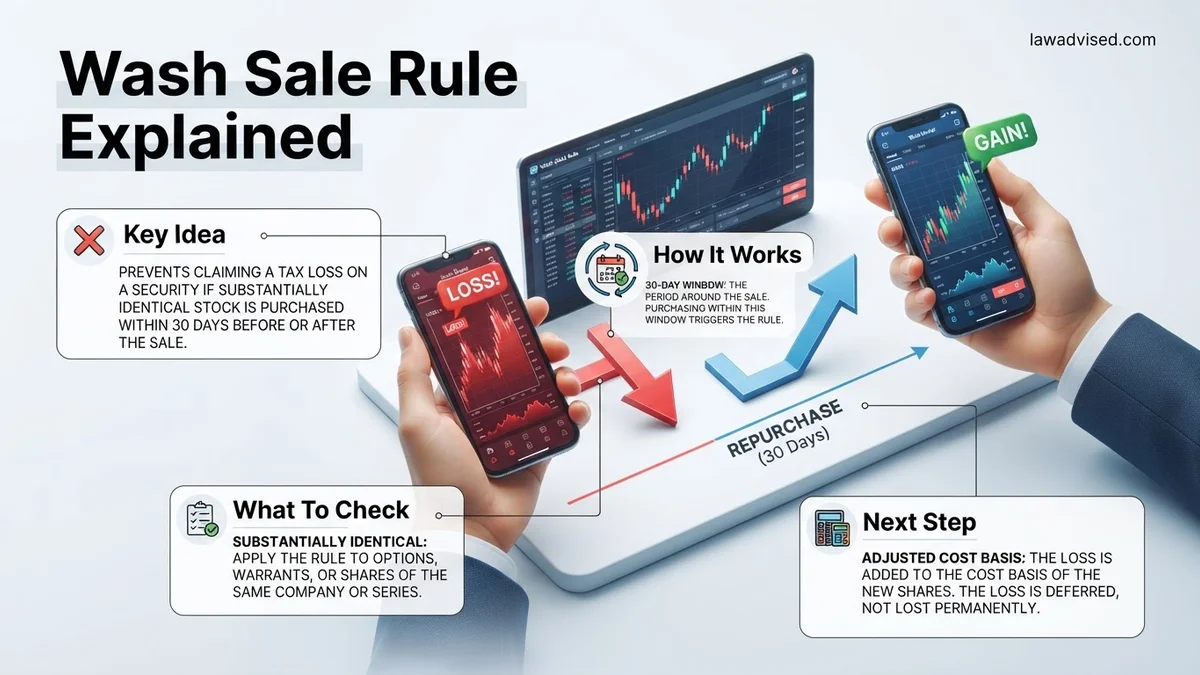
The wash sale rule prohibits investors from claiming a tax deduction on a security sold at a loss if they buy a ‘substantially identical’ security within 30 days before or after that sale. Instead of losing the tax loss entirely, the disallowed loss is added to the cost basis of your new replacement shares, deferring the tax benefit until you finally sell the replacement position.
The IRS wash sale rule prevents you from claiming a tax deduction on a security sold at a loss if you buy a substantially identical security within 30 days before or after that sale. When triggered, the IRS disallows your capital loss and instead adds it to the cost basis of your new investment.
Navigating this rule in 2026 requires precise tracking across your taxable portfolios. Understanding how the 61-day window works and how cost basis adjustments protect your long-term tax positioning is essential to keeping the IRS satisfied while managing your trading losses.
Key Takeaways
- The wash sale window spans 61 days total:30 days before, the day of sale, and 30 days after.
- Disallowed losses are not permanently lost; they increase the cost basis of your new stock.
- The rule applies across all taxable accounts you own, including spouse accounts and IRAs.
- Selling at a gain never triggers a wash sale because no tax deduction is being claimed.
- Buying options or replacement shares in an IRA creates a permanent trap without basis adjustment.
What Causes a Wash Sale Violation Under IRS Guidelines
The 61-Day Window and Timing Traps
The wash sale period spans a total of 61 days. This window includes the day you sell a security at a loss, the 30 days leading up to that sale, and the 30 days following it. If you purchase the same or a substantially identical asset anywhere inside this 61-day timeframe, you violate the standard.
- 30 days before your sale date
- The exact day of the sale
- 30 days after your sale date
Substantial Identity and Cross-Account Rules
You cannot bypass the rule by switching accounts. The IRS applies wash sale restrictions across all taxable brokerage accounts you own. Furthermore, the rule applies to “substantially identical” assets, meaning you cannot sell Apple stock at a loss and immediately buy an identical number of Apple shares in a different brokerage.
- Applies to options contracts, warrants, and short sales
- Includes accounts owned by your spouse
- Triggers across individual, joint, and trust taxable accounts
How to Calculate Cost Basis Adjustments and Track the 61-Day Window
The Math Behind Cost Basis Deferral
When a wash sale occurs, the disallowed loss does not disappear forever. Instead, the IRS forces you to add that loss amount to the cost basis of your newly purchased replacement shares. This action defers your tax benefit until you eventually sell the replacement shares in a clean transaction.
- Say you buy 100 shares of Stock A for 10,000 dollars
- You sell them later for 7,000 dollars, booking a 3,000 dollar capital loss
- Within 30 days, you buy replacement shares of Stock A for 6,000 dollars
Applying the Adjustment to Replacement Shares
Because you triggered a wash sale, your original 3,000 dollar loss cannot be claimed on your 2026 tax return. The IRS requires you to add that 3,000 dollar loss to the 6,000 dollar purchase price of your new shares. Your new cost basis becomes 9,000 dollars for those replacement shares.
- Original replacement purchase price: 6,000 dollars
- Disallowed wash sale loss added: 3,000 dollars
- New adjusted cost basis: 9,000 dollars
- Tax benefit is preserved until you sell the new shares without repurchasing
Step-by-Step Fix to Avoid Disallowed Losses in Your Brokerage Account
Navigating the complex mechanics of tax-loss harvesting in 2026 requires strict adherence to IRS guidelines. Fortunately, traders can utilize a structured approach to bypass the 30-day window safely. According to leading tax and accounting professionals, systematic planning eliminates accidental violations.
Utilizing the 31-Day Wait Period
The most straightforward method to secure your capital loss is simple patience. Waiting a full 31 days before repurchasing the identical asset guarantees compliance. Financial advisors recommend setting automated calendar alerts to track the exact timeline.
Purchasing Substantially Similar Alternatives
Investors who want to maintain market exposure during the 30-day blackout period often pivot to correlated assets. Certified Public Accountants (CPAs) outline three distinct actions to execute this safely:
- Identify a replacement security that tracks a different index or sector baseline to avoid the IRS “substantially identical” classification.
- Sell your primary losing position to lock in the tax deduction for your 2026 tax return.
- Allocate the proceeds immediately into the non-identical replacement asset, maintaining your overall market beta without triggering the wash sale rule.
What If It Still Doesn’t Work and Your Broker Flags a Wash Sale?
Sometimes automated brokerage software flags a transaction despite your best preventative efforts. If your 1099-B form reflects an unexpected disallowed loss, immediate corrective action is necessary. Tax experts recommend executing the following steps to resolve discrepancies:
- Review your exact execution timestamps and trade confirmations to verify whether cross-account purchases occurred within the 61-day window.
- Contact your brokerage’s trade desk or customer support division to request a formal review of the flagged transaction code.
- Consult a certified tax professional or Enrolled Agent if the brokerage cannot override an erroneous flag before tax season filing. Professional advisory fees typically range from $200 to $500 depending on the complexity of the portfolio.
- File IRS Form 8949 and Schedule D with the correct basis adjustments if the disallowed loss was successfully added to the cost basis of your replacement shares.
Conclusion
Navigating the intricacies of the wash sale rule prevents costly surprises during tax season. By respecting the 30-day window and leveraging non-identical replacement assets, investors can successfully harvest losses while maintaining portfolio balance. According to verified research and expert financial sources, proactive year-round tracking remains the single best defense against disallowed deductions. Your immediate actionable next step is to audit your current brokerage statements for any overlapping trades made within the last month.
❓ Frequently Asked Questions
How does the IRS define ‘substantially identical’ securities?
The IRS considers shares of the same company, identical preferred stock, or deep-in-the-money options to be substantially identical. However, buying shares of a different company within the same industry (e.g., swapping Apple for Microsoft) does not violate the rule.
What happens to my disallowed loss if I sell the replacement shares?
When you finally sell the replacement shares in a transaction that does not trigger another wash sale, the deferred loss is factored into your final realized gain or loss calculation.
Do automatic dividend reinvestment plans (DRIPs) trigger wash sales?
Yes. If a dividend automatically buys more shares of the same stock within 30 days before or after you sold shares at a loss, that dividend reinvestment can trigger a partial wash sale.
How do spouse accounts factor into wash sale calculations?
The IRS views accounts owned by you and your spouse as a single economic unit. If you sell a stock at a loss in your individual account and your spouse buys it in their IRA within 30 days, the wash sale rule applies.
Are mutual funds and ETFs subject to the wash sale rule?
Yes, funds are subject to the rule, though tracking is slightly more nuanced. Purchasing an ETF or mutual fund that tracks the exact same index immediately after a sale may trigger a wash sale depending on how closely identical the holdings are.
How do brokerages report wash sales to the IRS?
Brokerages track wash sales across identical CUSIP numbers within the same account and report them on Form 1099-B. However, you are ultimately responsible for tracking wash sales across different brokerages and spouses.

Ismail Hossain is the founder of Law Advised. He is an Divorce, Separation, marriage lawyer. Follow him.