Form 1098 T Explained 2026 Step-by-Step Tax Guide
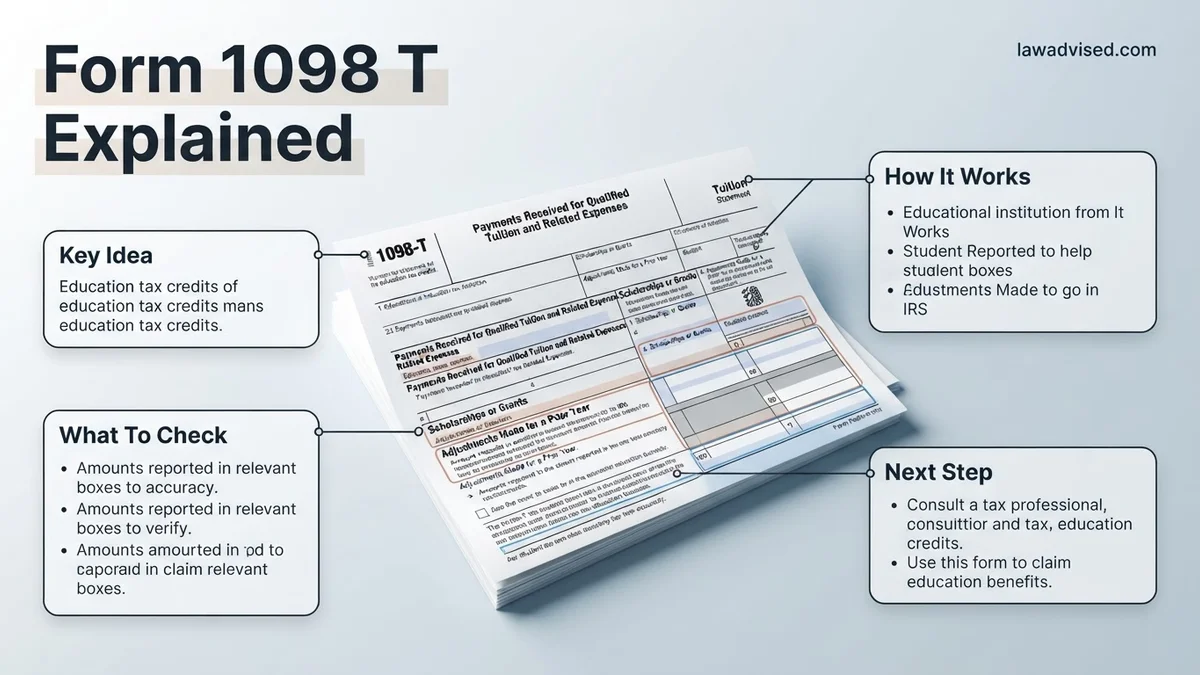
Form 1098-T is an official tax document issued by eligible educational institutions to report tuition payments, billing amounts, and scholarships received during the tax year. You need the information on this form to accurately calculate and claim valuable higher education tax credits like the American Opportunity Tax Credit (AOTC) or the Lifetime Learning Credit.
Form 1098-T is an informational tax document issued by your college or university that reports the tuition, fees, and scholarships you paid or were billed for during the 2026 tax year. The Internal Revenue Service uses this document to help determine if you qualify for major education tax benefits, specifically the American Opportunity Tax Credit or the Lifetime Learning Credit.
Receiving this form does not automatically mean you can claim a credit, nor does it guarantee you will owe taxes. Instead, it provides the raw financial data you need to complete your 2026 tax return accurately. If you paid out-of-pocket for higher education expenses or received financial aid, understanding how to read the specific numbers on this document is the key to lowering your overall tax liability.
Key Takeaways
- Box 1 shows the total payments received for qualified tuition and related expenses.
- Box 5 reports total scholarships and grants, which can reduce your eligible education expenses.
- Compare your personal receipts with Box 1 and Box 5 numbers to ensure accuracy.
- Use Form 8863 with your tax return to claim the AOTC or Lifetime Learning Credit.
- Contact your school’s bursar office immediately if you never received your 1098-T.
What Causes Confusion With Form 1098-T
Taxpayers often struggle with Form 1098-T because the numbers reported by the school rarely match what you actually paid out of your own bank account. Schools report accounting transactions, but tax credits rely strictly on cash flow. Knowing the difference stops you from leaving money on the table or triggering an IRS audit.
Box 1 Versus Box 2 Reporting Methods
The biggest point of confusion stems from whether your school reports payments received or amounts billed. You need to know which method your institution uses to avoid miscalculating your deductions for 2026.
- Box 1 (Payments Received): Shows the total amount of qualified tuition and related expenses you actually paid during the calendar year.
- Box 2 (Amounts Billed): Historically showed what the school billed your account. Note that the IRS largely phased out Box 2 for most institutions, making Box 1 the primary figure for 2026.
- The Timing Trap: Spring semester tuition paid in December 2025 often shows up on your 2025 form, even though classes take place in early 2026. Always rely on your own financial records to cross-reference what you paid within the calendar year.
The Missing Book and Supply Expenses
Many students assume Form 1098-T lists every single dollar spent on their education. It does not.
- Exclusion of Books: Required textbooks, software, and supplies usually do not appear on the form, even though they count as qualified education expenses.
- Room and Board: Housing and meal plans are vital for living at school, but the IRS does not consider them qualified tuition and fees for tax credits.
- Personal Records: You must keep your own receipts for books and equipment to add them to the totals reported on the official form.
How to Read and Interpret Box 1, Box 2, and Box 5
When you look at your 2026 Form 1098-T, three specific boxes demand your attention. Mastering these fields ensures you calculate your eligible expenses correctly without double-counting your financial aid.
Decoding Box 1 and Box 5
These two boxes interact directly to reveal your net out-of-pocket costs for the year.
- Box 1 (Payments Received for Qualified Tuition and Related Expenses): This is the anchor number. If you paid 10,000 dollars in tuition out-of-pocket or via student loans in 2026, this box should reflect that total.
- Box 5 (Scholarships or Grants): This lists the total of all tax-free grants, scholarships, and employer-provided educational assistance you received.
- The Net Calculation: You generally subtract Box 5 from Box 1 to find your adjusted qualified education expenses. If your scholarships exceed your tuition, that excess might be taxable income.
Understanding Adjustments and Restrictions
The remaining boxes on the lower half of the form fine-tune the initial numbers.
- Box 4 (Adjustments Made for a Prior Year): If you received a tuition refund in 2026 for a course billed or paid in 2025, it shows up here. This can reduce your prior year tax credit and may require an amended return.
- Box 6 (Adjustments to Scholarships or Grants for a Prior Year): Similar to Box 4, this reflects reductions in financial aid from previous tax periods.
- Box 7, 8, and 9 Checkboxes: These indicate if payments covered an academic period starting in the first three months of 2027, whether you were at least a half-time student, and if you were enrolled in a graduate program.
Step-by-Step Guide to Claiming Education Tax Credits
Filing for the American Opportunity Tax Credit (AOTC) or the Lifetime Learning Credit (LLC) requires careful alignment between your Form 1098-T and your personal financial records. According to IRS guidelines and tax compliance research from the National Consumer Law Center, utilizing your 1098-T correctly can save families up to $2,500 per eligible student annually through the AOTC.
To successfully claim your credits for the 2026 tax year, follow these precise procedural steps:
- Cross-reference Box 1 with personal receipts: Verify that the payments you made for qualified tuition and related expenses match or account for the figures reported by your institution.
- Review Box 5 for taxable scholarships: Subtract any tax-free grants or scholarships from your total out-of-pocket educational expenses to determine your true net cost basis.
- Complete IRS Form 8863: Attach this specific form to your Form 1040 tax return to formally calculate and claim either the AOTC or the LLC.
- Retain supporting documentation: Keep your Form 1098-T, bank statements, and book receipts for at least three years in the event of an IRS audit.
What to Do If Your Form 1098-T Is Missing or Incorrect
Educational institutions are legally required to issue Form 1098-T by January 31, 2026. However, processing delays or outdated mailing addresses frequently lead to missing or inaccurate tax documents. Catching these errors early prevents processing rejections from the IRS.
Handling Missing Forms
If February arrives and your form has not arrived in your mail or student portal, log into your university’s billing dashboard directly. Most institutions host an electronic PDF version that you can download immediately. If the portal lacks the document, contact your bursar’s office to request an immediate reissue.
Correcting Erroneous Data
Should Box 1 or Box 5 contain inaccurate numbers, do not attempt to alter the official IRS form yourself. Instead, submit a formal correction request through your university’s financial aid or bursar department, providing your personal ledger and canceled checks as proof of the actual amounts paid.
What If It Still Doesn’t Work?
If your institution fails to provide a corrected 1098-T, or if complex dependency rules make your 2026 filing ambiguous, you must utilize fallback measures to remain compliant with federal tax laws.
- File using institutional ledgers: The IRS allows you to claim education credits using official itemized school billing statements if your 1098-T is permanently unavailable, provided you maintain rigorous documentation.
- Consult a certified tax professional: Engage a Certified Public Accountant (CPA) or Enrolled Agent (EA) to navigate complex multi-year credit allocations or dependency status disputes. Professional tax preparation fees typically range from $200 to $500 depending on regional market rates and the complexity of your return.
- Utilize IRS Volunteer Income Tax Assistance (VITA): Qualifiying taxpayers with moderate to low incomes can access free, authorized tax assistance through IRS-certified community programs.
- Submit a protective IRS inquiry: If institutional unresponsiveness persists past the April filing deadline, contact the IRS taxpayer assistance line to document your good-faith effort to secure the required data.
Conclusion
Navigating Form 1098-T for the 2026 tax season requires careful verification of Box 1 payments against your personal financial records to maximize valuable credits like the AOTC. According to verified research and expert sources from the IRS and higher education compliance boards, resolving discrepancies before filing prevents costly processing delays and IRS audits. Your immediate actionable next step is to log into your student financial portal today to download your official 1098-T and cross-verify every reported dollar.
❓ Frequently Asked Questions
How do scholarships and grants reported in Box 5 affect my tax credits?
Scholarships and grants are tax-free if used for qualified education expenses, but they reduce the amount of out-of-pocket expenses you can use to calculate your education tax credits.
Why does the amount in Box 1 not match what I actually paid?
Discrepancies often happen because Box 1 only includes payments applied to qualified tuition and related expenses, excluding charges like housing, meal plans, and parking fees.
Can parents claim the education tax credit if the student is a dependent?
Yes, if you claim the student as a dependent on your tax return, you are generally the one eligible to claim the education tax credits using their Form 1098-T data.
What should I do if my school refuses to issue a corrected 1098-T?
Keep detailed records, such as bank statements and student account ledgers, and file your taxes based on your actual out-of-pocket payments rather than the incorrect form.
Are international students eligible to receive Form 1098-T?
Nonresident alien students generally do not receive Form 1098-T unless they request it and meet specific tax residency exceptions for filing a U.S. return.
What qualifies as a qualified tuition and related expense?
Qualified expenses include tuition and required fees enrolled at an eligible educational institution, while books and equipment may also qualify depending on the specific credit claimed.

Ismail Hossain is the founder of Law Advised. He is an Divorce, Separation, marriage lawyer. Follow him.