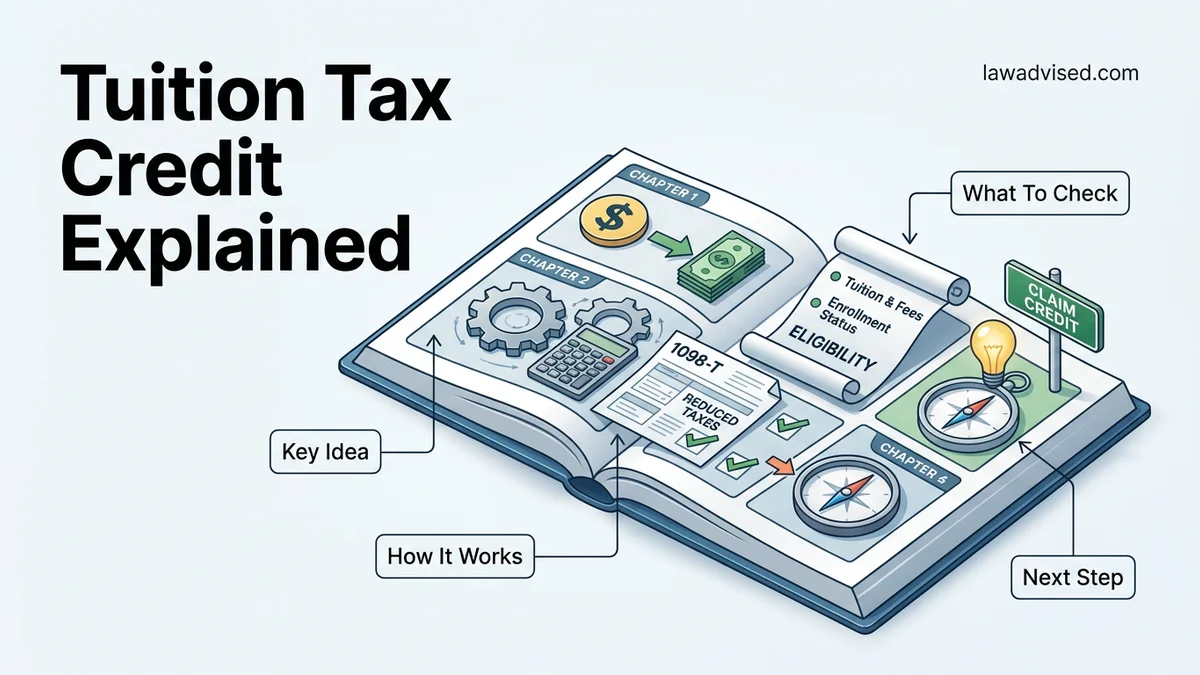
Tuition Tax Credit Explained 2026 Step-by-Step Guide
Navigating education tax breaks can be confusing, but tuition tax credits directly reduce your federal income tax liability dollar-for-dollar. The two main options—the American Opportunity Tax Credit (AOTC) and the Lifetime Learning Credit (LLC)—offer significant savings depending on your degree program and income level.
The tuition tax credit includes two primary IRS programs—the American Opportunity Tax Credit (AOTC) and the Lifetime Learning Credit (LLC)—that directly reduce your federal income tax dollar-for-dollar. Unlike deductions that lower your taxable income, tax credits put money right back into your pocket, potentially resulting in a refund of up to $2,500 per eligible student.
Navigating these tax breaks for the 2026 tax year requires understanding strict income phase-outs, qualifying expenses, and enrollment statuses. Getting this right means you avoid leaving hundreds or thousands of dollars on the table when you file your return.
Key Takeaways
- The AOTC provides up to $2,500 per eligible student for the first four years of higher education.
- The LLC offers up to $2,000 per tax return for undergraduate, graduate, and professional courses.
- A tax credit reduces your tax bill directly, which is more valuable than a tax deduction.
- You must receive Form 1098-T from your eligible educational institution to claim either credit.
- Income phase-outs apply to both credits based on your Modified Adjusted Gross Income (MAGI).
What Causes Confusion With Tuition Tax Credits and Eligibility
Taxpayers frequently struggle with tuition tax credits because the IRS maintains rigid definitions for eligible expenses, student status, and income thresholds. Mixing up these rules leads to rejected claims or missed savings.
Qualifying Expenses Versus Personal Costs
You cannot write off every college-related bill. The IRS draws a sharp line between required educational costs and general living expenses. Eligible expenses typically include:
- Tuition and required enrollment fees paid to an eligible educational institution.
- Course materials like books, supplies, and equipment needed for a class.
- Fees paid directly to the school, such as tech or student activity fees.
Room and board, transportation, insurance, and medical expenses never qualify for tuition tax credits, even if the university bills you for them directly.
Income Limitations and Phase-Outs
Your modified adjusted gross income (MAGI) determines whether you can claim these credits for 2026. If your income exceeds the statutory limits, your credit amount drops or disappears entirely.
- For single filers, the AOTC phases out between $80,000 and $90,000 of MAGI.
- For married filing jointly, the AOTC phase-out range sits between $160,000 and $180,000.
- The LLC uses slightly lower phase-out thresholds, making income verification critical before you file.
How to Choose Between the American Opportunity Tax Credit and Lifetime Learning Credit
You cannot claim both the AOTC and the LLC for the same student in the same tax year, making your choice a high-stakes decision. The right credit depends entirely on your current academic workload and how many years you have spent in higher education.
When to Claim the American Opportunity Tax Credit
The AOTC is designed for students pursuing a first undergraduate degree or recognized credential. It offers the highest financial return of the two options. You should choose the AOTC if you meet these criteria:
- The student is enrolled at least half-time for at least one academic period during 2026.
- They are in their first four years of higher education.
- They have not been convicted of a felony drug offense.
This credit maxes out at $2,500 per student. Best of all, up to 40 percent of the AOTC (maximum $1,000) is refundable, meaning you get the money even if you owe zero federal income tax.
When to Claim the Lifetime Learning Credit
The LLC is far more flexible, making it the default choice for graduate students, certificate seekers, and part-time learners. You should choose the LLC if:
- You are taking a single college course to upgrade job skills, regardless of degree status.
- You are enrolled in graduate or professional school.
- You have already exhausted your four years of AOTC eligibility.
The LLC provides a maximum credit of $2,000 per tax return (not per student). Unlike the AOTC, the LLC is non-refundable, meaning it can reduce your tax liability to zero, but any remaining credit amount does not turn into a cash refund.
Step-by-Step Guide on How to Claim Tuition Tax Credits Using Form 1098-T
Claiming your education credits for the 2026 tax year requires careful coordination between your educational institution and your tax preparation software. The process begins long before you file, relying primarily on official documentation provided by your college or university.
Gathering Your Form 1098-T
By January 31, 2026, eligible institutions are required to issue Form 1098-T (Tuition Statement) to enrolled students. This document outlines the amounts paid for qualified tuition and related expenses in Box 1, which tax software uses to calculate your credit eligibility.
- Log into your student portal to download an electronic copy of your 2026 Form 1098-T, or wait for the physical copy to arrive via mail.
- Cross-reference the figures in Box 1 against your personal bank statements, student account ledger, and loan disbursement records to ensure total accuracy.
- Locate your independent records of out-of-pocket expenses for required textbooks, course materials, and equipment that may not appear on the official 1098-T form.
- Select an IRS-approved tax filing software or certified public accountant that supports IRS Form 8863 (Education Credits).
- Input the precise Employer Identification Number (EIN) of your school and the financial figures from your verified 1098-T into the designated education credit section of your tax return.
What If Your Credit Is Denied or You Still Owe Taxes After Filing
Receiving an IRS notice regarding a disallowed education credit or facing an unexpected tax bill after claiming the credit can be stressful. According to IRS compliance data, missing documentation or mismatched 1098-T data triggers the vast majority of credit adjustments.
If your claim is rejected or fails to reduce your tax liability as expected, execute these fallback steps:
- Review the specific IRS adjustment notice or rejection letter to identify whether the discrepancy stems from a missing student taxpayer identification number or a Box 1 data mismatch.
- Contact your university’s bursar or financial aid office immediately to request a corrected Form 1098-T (checked as “Amended” on the document) if the original figures omitted qualified payments.
- File an amended tax return using Form 1040-X, attaching the newly corrected 1098-T and Form 8863 to substantiate your revised education credit claim.
- Consult a certified public accountant (CPA) or Enrolled Agent if the dispute involves complex dependency rules or lifetime learning credit phase-outs, with professional remediation typically costing between $200 and $500 depending on complexity.
Conclusion
Navigating the nuances of tuition tax credits for the 2026 tax year ensures you do not leave hundreds or thousands of educational dollars unclaimed. By accurately reconciling your Form 1098-T and properly executing Form 8863, you optimize your financial return safely within IRS guidelines. According to verified research and expert tax sources, proactive documentation review remains the single most effective defense against credit denials and processing delays. Take your next actionable step today by logging into your student portal to download and verify your latest 1098-T statement.
❓ Frequently Asked Questions
What expenses are considered qualified tuition and related expenses?
Qualified expenses include tuition and fees required for enrollment or attendance at an eligible educational institution. Books, supplies, and equipment are also included for the AOTC, but generally must be purchased directly from the school for the LLC.
What are the income limits for the American Opportunity Tax Credit?
To claim the full AOTC, your Modified Adjusted Gross Income (MAGI) must be $80,000 or less ($160,000 or less for married filing jointly). The credit phases out completely for singles making over $90,000 and couples making over $180,000.
What are the income limits for the Lifetime Learning Credit?
For 2026, the LLC phase-out range for single filers typically begins around $80,000 of MAGI, with the credit phasing out completely at $90,000. For joint filers, the phase-out starts at $160,000 and ends at $180,000.
Can parents claim the tuition tax credit for their dependent child?
Yes, if you claim the student as a dependent on your tax return, you are eligible to claim the education tax credit for their qualified education expenses, provided you meet the income requirements.
What if the student is a nonresident alien for tax purposes?
Generally, a nonresident alien cannot claim the education credits unless they are married and choose to file a joint return with a U.S. citizen or resident alien. Check IRS guidelines for specific exception rules.
How do I actually claim the credit on my federal tax return?
You must file IRS Form 8863, Education Credits (American Opportunity and Lifetime Learning Credits), along with your Form 1040. You will need the information reported on the Form 1098-T sent by the school to complete Form 8863.

Ismail Hossain is the founder of Law Advised. He is an Divorce, Separation, marriage lawyer. Follow him.