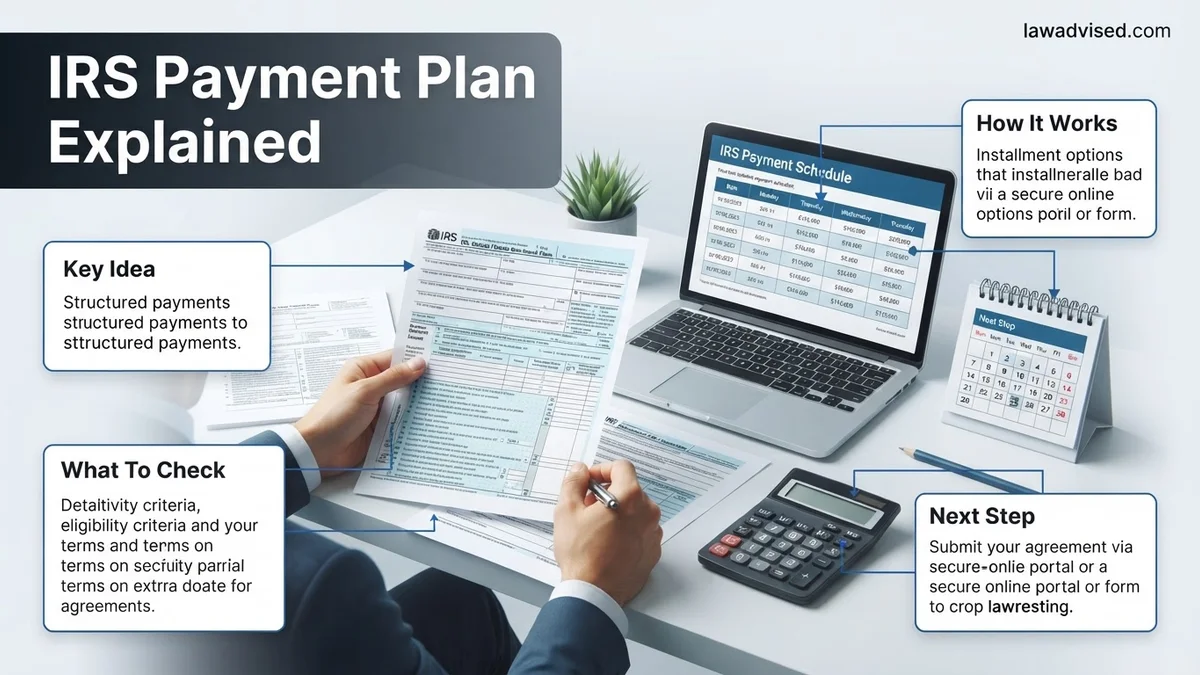
IRS Payment Plan Explained Step-by-Step Guide for 2026
An IRS payment plan allows taxpayers who cannot pay their tax liability in full to break the balance into manageable monthly payments or short-term extensions. Choosing the right option—such as a short-term plan or a streamlined installment agreement—depends on your total debt and financial situation. Setting up a plan helps avoid harsher collection actions like levies and wage garnishments.
An IRS payment plan allows you to pay off your federal tax debt over time when you cannot afford a lump-sum payment. If you owe money for the 2025 tax year or earlier, the IRS provides structured options ranging from short-term extensions to multi-year monthly installments.
Facing a tax bill can feel overwhelming, but setting up a formal agreement stops aggressive collection actions like levies and wage garnishments. Knowing the exact types of plans available in 2026 helps you choose the right path without paying unnecessary fees or interest.
Key Takeaways
- Assess your total tax liability to choose between short-term extensions and monthly installment agreements.
- Apply online via the IRS Online Payment Agreement tool to secure faster approval and lower fees.
- Short-term plans give you up to 180 days to pay without setup fees, though interest still accrues.
- Streamlined installment agreements allow automated monthly payments for debts under $50,000 without financial disclosure.
- Keep making payments and file all future tax returns on time to prevent default.
What Causes Tax Debt and Why You Need an IRS Payment Plan
Tax debt typically accumulates when your tax withholdings or estimated quarterly payments fall short of your actual liability. Common triggers include freelance income without proper deductions, unexpected capital gains, or early withdrawals from retirement accounts.
The Real Cost of Ignoring the IRS
Waiting to address your tax liability only makes the total balance grow larger. The IRS charges statutory interest and failure-to-pay penalties every month until your account hits zero.
- Failure-to-pay penalty: Usually 0.5% of your unpaid taxes per month, capped at 25%.
- Interest charges: Compounded daily on both the unpaid tax and accumulated penalties.
- Collection enforcement: Unresolved debt can lead to federal tax liens or seized bank accounts.
How a Payment Plan Protects Your Finances
Setting up an official payment plan immediately alters your status with the IRS. While penalties and interest still accrue, entering an agreement reduces your monthly failure-to-pay penalty rate by half.
- Lowers your monthly penalty rate from 0.5% to 0.25% while the plan is active.
- Provides predictable monthly budgeting so you can chip away at the balance.
- Keeps collection agencies and automated levies at bay as long as you make your payments on time.
How to Choose the Right IRS Payment Plan Option
The IRS structures payment solutions based on how much you owe and how long you need to pay it off. Choosing the correct track saves you money on setup fees and keeps your administrative hurdles to a minimum.
Short-Term Payment Plans (Up to 180 Days)
If you just need a brief extension to gather funds, a short-term payment plan is your fastest option. This choice works best if you can pay your total liability within six months.
- Eligibility: Available for individuals who owe less than $100,000 in combined tax, penalties, and interest.
- Setup Fees: There is zero setup fee for this option.
- Cost Factor: Interest and standard penalties continue to accrue until the balance is fully cleared.
Installment Agreements for Monthly Payments
For balances that require more than six months to resolve, a formal installment agreement breaks your debt down into manageable monthly payments for up to 72 months.
- Streamlined Installment Agreements: Available if you owe $50,000 or less, requiring no detailed financial disclosures or asset checks.
- Non-Streamlined Options: Required if your debt exceeds $50,000, which involves submitting Form 433-F to detail your monthly income and living expenses.
- User Fees: Setup fees vary depending on whether you apply online, set up automatic debit payments, or use a low-income waiver.
Step-by-Step Guide to Applying for an IRS Payment Plan
Applying for an IRS payment plan requires careful preparation to ensure your request is approved without unnecessary delays. According to recent tax administration guidelines, utilizing online self-service tools remains the fastest and most efficient method for establishing a 2026 tax agreement.
Applying Online via the IRS Online Payment Agreement Tool
The online portal is recommended for individuals who owe $50,000 or less in combined tax, penalties, and interest, or businesses that owe $25,000 or less. Follow these procedural steps to complete your application:
- Navigate to the official IRS.gov website and access the “Online Payment Agreement” tool.
- Log in securely using your existing ID.me account or create a new verified credentials profile.
- Enter your specific tax return information to verify your identity and review your current balance due for 2026.
- Select your preferred payment plan type, such as a short-term payment plan or a monthly installment agreement.
- Choose your monthly payment amount and select a preferred payment withdrawal date between the 1st and the 28th of the month.
- Submit the application and save the immediate electronic confirmation notice for your permanent financial records.
Applying by Mail or Phone
If you do not qualify for the online application system or prefer traditional methods, you can apply using Form 9465 (Installment Agreement Request). Mail the completed form along with your tax return or notice to the address specified in your correspondence. Alternatively, call the IRS customer service telephone number listed on your bill to speak with a representative directly, though wait times may vary significantly during peak filing seasons.
What If It Still Doesn’t Work or You Can’t Afford the Plan?
If your payment plan application is rejected, or if your financial situation worsens to the point where you cannot afford the approved monthly installment amount, alternative relief options exist. According to verified research and tax resolution experts, taxpayers should act quickly to avoid forced collection actions such as tax liens or levies.
- Request a Currently Not Collectible (CNC) Status: If you prove complete financial hardship where paying the tax leaves you unable to cover basic living expenses, the IRS can temporarily suspend collection activity.
- Apply for an Offer in Compromise (OIC): This agreement allows qualifying taxpayers to resolve their total tax liability with the IRS for a lower amount than what they originally owed, based on asset equity and monthly disposable income.
- Seek Professional Representation: If your tax debt exceeds $10,000 or involves complex audit results, consult a Certified Public Accountant (CPA), Enrolled Agent (EA), or tax attorney. Professional representation fees typically range from $1,500 to $4,500 depending on the complexity of the case.
- Contact the Taxpayer Advocate Service (TAS): This independent organization within the IRS helps taxpayers resolve severe financial problems and ensures that the IRS treats them fairly.
Conclusion
Navigating tax debt can feel overwhelming, but establishing an IRS payment plan provides a structured, manageable path to compliance and financial peace of mind. By proactively selecting the right agreement type and utilizing online tools, taxpayers can minimize penalties and avoid aggressive collection actions. According to verified research and expert sources, taking early action significantly improves your long-term financial outcomes with the federal government. Take your next actionable step today by logging into the IRS portal to review your account balance and submit your payment agreement application.
❓ Frequently Asked Questions
What is the difference between a short-term payment plan and an installment agreement?
A short-term payment plan gives you up to 180 days to pay your liability with no setup fee, while an installment agreement sets up structured monthly payments spanning several years, which typically involves setup fees.
How much does it cost to set up an IRS installment agreement?
Setup fees range from $31 for online direct debit setups to $131 for standard non-direct debit applications. Low-income taxpayers may qualify for reduced or waived fees.
What happens if I miss a payment on my IRS installment agreement?
Missing a payment can cause the IRS to default your agreement, meaning the full balance may become immediately due and the IRS may begin enforced collection actions.
Can I change my monthly payment amount after the plan is approved?
Yes, you can modify an existing installment agreement online or by calling the IRS, though you may need to submit updated financial information if changing terms significantly.
What is a streamlined installment agreement?
A streamlined installment agreement is a simplified option for taxpayers who owe $50,000 or less, requiring no detailed financial disclosures and allowing up to 72 months to pay.
Are there alternatives if I cannot afford any monthly IRS payment plan?
If you genuinely cannot afford a payment plan, you may qualify for Currently Not Collectible (CNC) status or an Offer in Compromise (OIC) to settle your tax debt for less than you owe.

Ismail Hossain is the founder of Law Advised. He is an Divorce, Separation, marriage lawyer. Follow him.