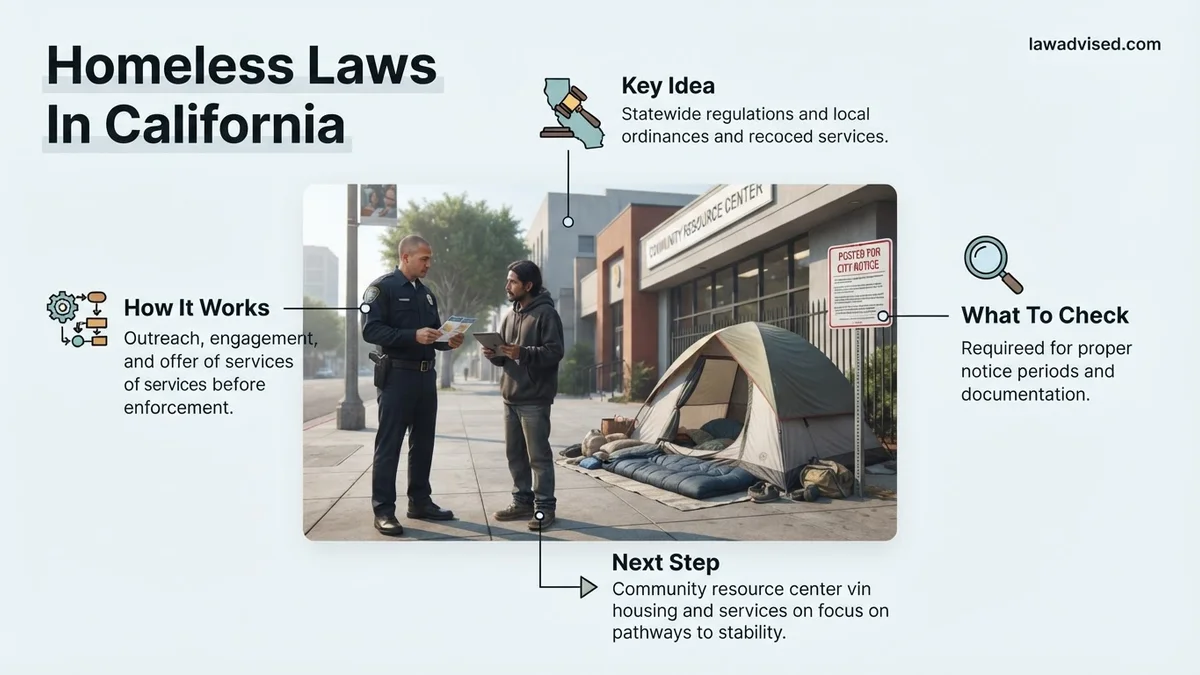
Homeless Laws in California 2027 Real Legal Guide
Navigating homeless laws in California requires understanding recent landmark Supreme Court rulings and state executive orders. Cities now possess expanded authority to enforce public camping bans and clear encampments without the strict requirement of offering alternative shelter first.
California’s legal framework governing public camping, loitering, and homelessness has shifted dramatically. If you live, work, or local-govern in the state, navigating the web of statewide executive orders, local municipal codes, and federal court precedents is essential. Public spaces, sidewalks, and parks are now subject to aggressive enforcement mechanisms that were legally barred just a few years ago.
The rules governing homelessness directly impact public safety, property values, and the civil rights of unhoused populations. By 2027, the legal pendulum has swung away from hands-off policies toward strict accountability. Understanding these regulations helps you know your rights, your city’s enforcement powers, and the exact legal boundaries facing communities across the state.
Key Takeaways
- The Supreme Court Grants Pass decision empowers local governments to enforce public camping bans.
- Governor Newsom’s executive orders pressure municipalities to accelerate encampment clearings.
- Local ordinances vary significantly across different California cities and counties.
- Shelter space availability is no longer a strict statewide prerequisite for clearing public spaces.
- Violators of anti-camping ordinances face municipal fines, citations, or misdemeanor charges.
What Causes Homeless Laws in California to Change So Rapidly
The Evolution of Statewide Mandates and Executive Directives
California policy changes fast because public pressure and executive authority collide constantly. In the wake of Governor Gavin Newsom’s 2024 executive order directing state agencies to aggressively clear encampments, local governments faced intense scrutiny to follow suit. By 2027, state funding for homelessness is directly tied to municipal compliance and visible results. If cities fail to clear dangerous public spaces, state grants vanish. This top-down financial pressure forces mayors and city councils to draft tighter anti-camping ordinances almost overnight.
Constitutional Pushback and Civil Rights Challenges
Rapid legal shifts also stem from constant litigation driven by civil rights attorneys. Every time a city drafts a new loitering ban or sleeping restriction, advocacy groups file injunctions. These lawsuits create a moving target for local law enforcement.
- State agencies push for faster, broader removal powers to clear public thoroughfares.
- Federal courts frequently weigh in on whether specific ordinances cross the line into cruel and unusual punishment.
- Elected officials amend municipal codes continuously to survive these ongoing legal challenges.
This perpetual cycle of litigation and executive intervention means yesterday’s legal sidewalk sweep might violate today’s updated injunction.
How to Fix Encampment Issues Under 2027 Supreme Court Rulings
The Impact of Grants Pass v. Johnson on Local Enforcement
The legal landscape transformed permanently following the United States Supreme Court’s decision in City of Grants Pass v. Johnson. For years, the Ninth Circuit’s Martin v. Boise ruling prevented cities from ticketing or arresting people for sleeping on public property unless municipalities could prove adequate shelter beds were immediately available. The 2027 reality is completely different. The Supreme Court dismantled that shelter-availability requirement, handing broad authority back to local governments.
Practical Steps for Municipalities and Property Owners
With the federal hurdle removed, cities no longer need to conduct complex shelter bed audits before clearing a public park or sidewalk. If you are dealing with an encampment near your business or residence, the enforcement playbook is straightforward:
- File a formal public nuisance or obstruction complaint with your local code enforcement or police department.
- Reference updated local ordinances that ban camping within specific distances of schools, daycares, and critical infrastructure.
- Request immediate 24-hour notice postings for removal, which are now legally permissible without proving alternative shelter availability.
Police and sanitation crews can now seize property and clear tents much faster, provided they follow strict chain-of-custody rules for stored personal items.
Step-by-Step Guide to Municipal Enforcement and Local Ordinances
Navigating California’s complex legal landscape regarding unsheltered populations requires understanding how local municipalities enforce municipal codes. Following the landmark Supreme Court decision in Grants Pass v. Johnson, cities across the state possess broader authority to clear public spaces. However, proper legal protocols must be followed to avoid civil rights litigation.
1. Verification of Available Shelter Beds
Before local law enforcement can issue citations or clear an encampment, municipal protocols generally require documenting the availability of shelter beds. City outreach teams must conduct a formal assessment to prove that shelter options were offered and rejected, complying with regional Ninth Circuit precedents that govern involuntary displacement.
2. Issuance of Notice and Posting
Cities must provide advance notice before conducting a sweep or clean-up operation. Standard municipal ordinances in major urban centers like Los Angeles and San Francisco mandate a 24-to-72-hour physical posting near the encampment site detailing the exact date and time of enforcement.
3. Property Storage and Retrieval Protocols
Law enforcement and sanitation crews must catalog and store personal property collected during an encampment clearance. According to municipal standards updated for 2027, cities are required to hold confiscated items in a secure facility for a minimum of 90 days, providing an accessible mechanism for individuals to retrieve identification, medications, and personal belongings.
What If It Still Doesn’t Work?
When standard municipal reporting methods, local camping bans, and routine code enforcement fail to resolve persistent public encampments, property owners and community advocates must escalate their approach. If initial municipal requests stall or yield no operational results, consider the following fallback steps:
- File a Formal Writ of Mandate: If a local government consistently fails to enforce its own public nuisance codes, property owners can petition the superior court for a writ of mandate to compel municipal action. Legal counsel fees for this process typically range from $5,000 to $15,000 depending on the jurisdiction.
- Engage Specialized Legal Counsel: Retain a land-use or municipal law attorney specializing in California property rights and public nuisance law to issue formal legal demand letters to city administrators. Professional legal consultation fees generally start at $350 to $650 per hour.
- Coordinate Inter-Agency Task Forces: Escalate chronic encampment issues directly to county-level departments of public health and behavioral health services rather than relying solely on city code enforcement, as public health hazard declarations can trigger expedited state intervention.
- Utilize Private Security and Environmental Design: Implement Crime Prevention Through Environmental Design (CPTED) strategies, such as upgraded industrial lighting, perimeter fencing, and professional private property patrol services. Private security measures can cost between $35 and $75 per guard hour.
Conclusion
Managing public encampments under California’s evolving homeless laws requires balancing strict local enforcement with constitutional housing mandates. According to verified research and expert legal sources from the Public Policy Institute of California, sustained compliance relies on coordinated municipal outreach backed by clear, enforceable local ordinances. The most actionable next step is to document specific public health violations on your property and submit a formal, trackable service request through your local city hall portal today.
❓ Frequently Asked Questions
How did the Grants Pass v. Johnson Supreme Court ruling impact California homeless laws?
The ruling determined that enforcing public camping bans does not constitute cruel and unusual punishment under the Eighth Amendment, giving California cities the legal green light to penalize public sleeping when shelter is declined or unavailable.
What authority do local police have to clear homeless encampments?
Local law enforcement can issue warnings, cite individuals, and dismantle tents or temporary structures in public spaces, parks, and near critical infrastructure based on local municipal codes.
Are property rights respected during California homeless sweeps?
Agencies generally must follow specific notice procedures before a sweep and are legally required to store collected personal property for a designated period so owners can retrieve it.
How does state funding interact with local enforcement mandates?
California ties certain state homelessness funding grants to local accountability metrics, pushing cities to demonstrate active progress in reducing visible street encampments.
Can private citizens take legal action against cities over unaddressed encampments?
Some residents and business groups have successfully filed lawsuits against municipalities for failing to maintain public spaces, compelling local governments to enforce public health and safety laws.
What resources are provided to individuals displaced by encampment clearings?
While mandatory shelter bed prerequisites have shifted, outreach workers are typically deployed during sweeps to offer available housing services, addiction treatment, and social support programs.

Ismail Hossain is the founder of Law Advised. He is an Divorce, Separation, marriage lawyer. Follow him.