Strange Laws in California Real Guide for 2027
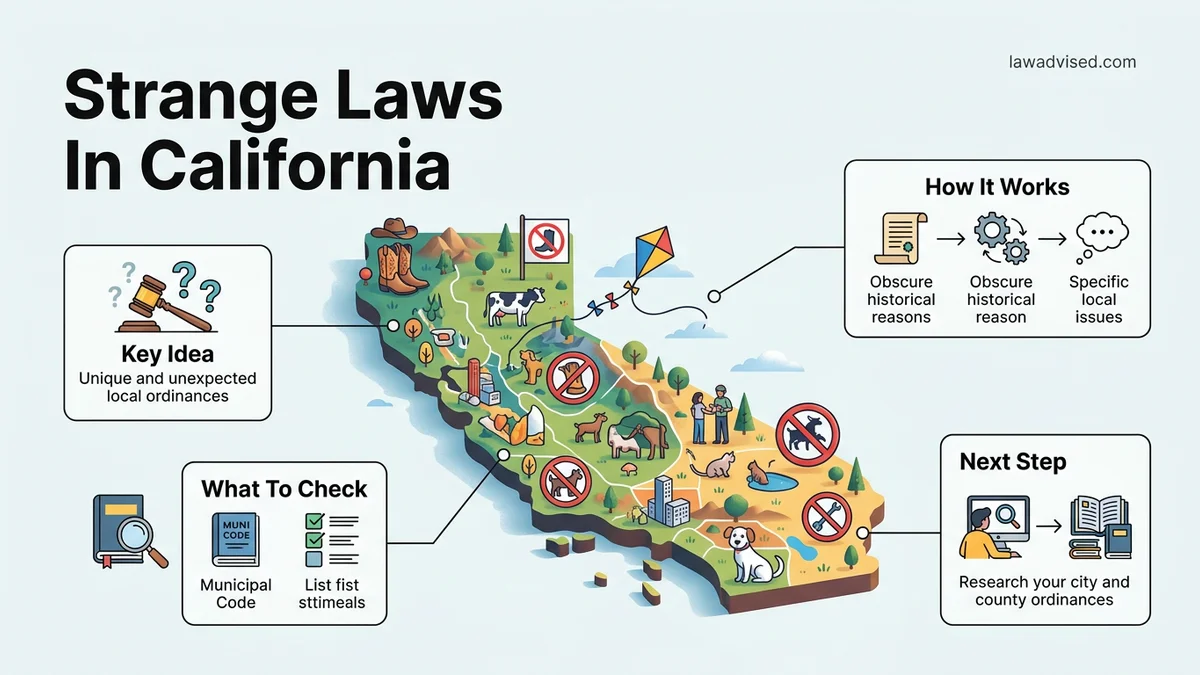
California features some of the most bizarre and outdated local ordinances in the country, many of which still technically exist on municipal books. From banned animal behaviors to strange vehicle restrictions, these laws offer a hilarious glimpse into the past. This guide highlights the weirdest rules you won’t believe are real.
California is famous for sunshine, tech innovation, and a legislative body that loves to pass rules. Looking ahead to 2027, the Golden State still retains a massive backlog of bizarre, hyper-specific municipal codes and outdated state statutes. While you will not be arrested for most of these quirks, they remain officially on the books across various city halls.
Understanding these weird regulations is more than just a trivia game. If you are launching a business, moving to a new municipality, or just traveling through, knowing the difference between an active local ordinance and a dead-letter law keeps you out of awkward social situations—and occasionally saves you from an overzealous parking enforcement officer.
Key Takeaways
- Many strange California laws are outdated municipal ordinances that are no longer enforced.
- Cities like Los Angeles and San Francisco have unique local bans on specific animal actions.
- Unusual traffic and transportation rules still linger from early automotive history.
- Some bizarre laws were created to solve very specific 19th-century public safety problems.
- Urban legends often exaggerate real local codes, but many funny statutes are officially documented.
What Causes Strange Laws in California to Exist Today
The Legislative Overreaction of Past Decades
Many strange California laws are born from a specific historical panic or local incident. When a city council faces a sudden surge of complaints about a bizarre nuisance, they often rush to pass a permanent ordinance. Over time, society changes, but the law stays quietly embedded in municipal code databases.
- Municipalities historically passed emergency bans to address ultra-specific behavior rather than broad statutes.
- Once a localized crisis passed, repealing the code was rarely prioritized by busy city councils.
- State-level laws often accumulated broad phrasing that led to unintended, humorous restrictions.
The Bureaucratic Inertia of Municipal Codebooks
Updating thousands of pages of local law is expensive and time-consuming. In 2027, many California cities still rely on digitized versions of codes that date back to the early 1900s. Unless a law actively violates modern constitutional rights or gets challenged in court, local governments have little incentive to clean house.
- City legal departments focus their limited resources on housing, zoning, and public safety budgets.
- Outdated ordinances remain harmlessly dormant until an internet sleuth or local journalist uncovers them.
- Legislators sometimes leave old laws intact because removing them requires a formal public vote.
How to Fix and Identify Real California Ordinances From Urban Legends
Cross-Referencing Official Municipal Code Databases
The internet is full of fake legal trivia claiming you cannot eat ice cream while walking backward on Tuesdays in Los Angeles. To verify whether a strange law is real, you need to bypass clickbait blogs and search official municipal repositories like Municode or American Legal Publishing.
- Search the exact city name followed by the code topic to find primary government sources.
- Look at the history notes at the bottom of the statute to see the exact year the ordinance was enacted.
- Verify if the section has been explicitly repealed or superseded by state preemption laws.
Understanding State Preemption and Enforcement Reality
Just because a rule appears in a city codebook does not mean it is legally enforceable today. California state law frequently supersedes local ordinances, meaning a city cannot enforce a strange local ban if it contradicts broader state legal frameworks or constitutional protections.
- Police officers and code enforcement agents prioritize active public safety threats over archaic trivia.
- State preemption laws regularly invalidate hyper-local bans on common-sense activities.
- Courts generally rule against the enforcement of vague laws that reasonable citizens cannot easily interpret.
Step-by-Step Guide to Finding Local Municipal Codes
Verifying whether an internet rumor about a California oddity holds any legal weight in 2027 requires checking municipal codes directly. State statutes rarely contain bizarre local ordinances, meaning most strange laws hide in city or county records. Follow this procedure to trace a regulation to its official source.
1. Identify the Exact Jurisdiction
Pinpoint the specific city or county where the ordinance supposedly applies. Laws regarding noise levels, animal ownership, or public attire often vary drastically between neighboring municipalities like Los Angeles and West Hollywood.
2. Access the Official Municipal Code Repository
Navigate to standard legal hosting platforms utilized by California local governments, such as Municode, American Legal Publishing, or Codification. Most California cities host their current 2027 codes directly through searchable web portals linked from official city websites.
3. Use Targeted Keyword Searches
Input specific terms related to the alleged law into the platform search bar. Avoid broad terms and use precise nouns like “frogs,” “skateboards,” or “apparel” combined with section numbers if known. Review the exact chapter and subsection to determine if the provision remains active or was recently repealed.
What If It Still Doesn’t Work and You Can’t Verify a Weird Law
When official databases yield no results for a viral legal claim, navigating ambiguous restrictions requires expert intervention. Apply these fallback steps if online research fails to provide clarity by 2027.
- Contact the City Clerk: Call or email the municipal clerk’s office for the specific jurisdiction in question. City clerks maintain the definitive records of all active local ordinances and can confirm if a statute exists.
- Consult a Local Attorney: Reach out to a California-licensed municipal law attorney to interpret obscure or conflicting statutes. Professional legal consultations typically range from $250 to $500 per hour depending on firm specialization.
- Review State Preemption Rules: Check if state-level legislation supersedes local authority under the California Constitution. State law frequently invalidates conflicting or outdated municipal restrictions automatically.
- Consult Public Law Libraries: Visit a county public law library to access comprehensive historical archives and annotated codes not always indexed on public-facing internet portals.
Conclusion
Separating urban legends from actual California statutes prevents unnecessary confusion and protects public compliance. According to verified research and expert legal sources, most viral bizarre laws are either outdated anomalies, misinterpretations of standard safety codes, or complete fabrications. Always verify local municipal portals directly before altering daily behavior based on internet claims. Take the next step today by bookmarking official municipal code databases for your local California city to ensure absolute legal accuracy.
❓ Frequently Asked Questions
What is the most famous strange law in California?
A widely cited Los Angeles ordinance supposedly prohibits hunting moths under a street lamp, though its modern enforcement is nonexistent.
Are there weird driving laws specific to California cities?
Yes, various cities have historical restrictions regarding vehicle speeds, parking angles, and even what you can transport in a truck.
Did California really outlaw nuclear weapons in certain cities?
Several California cities passed symbolic ordinances in the 1980s declaring themselves nuclear-free zones, though federal law supersedes them.
How do obsolete laws get removed from city books?
City councils must formally vote to repeal or amend outdated municipal codes during routine legislative updates.
Are animal-related laws common in California municipalities?
Many older towns created specific restrictions on livestock, pet mating, and animal noise to manage early agrarian communities.
Where can travelers learn more about funny state laws?
State archives, local historical societies, and municipal legal libraries offer the best documentation of old statutes.

Ismail Hossain is the founder of Law Advised. He is an Divorce, Separation, marriage lawyer. Follow him.