Life Jacket Laws in California 2027 Expert Safety Guide
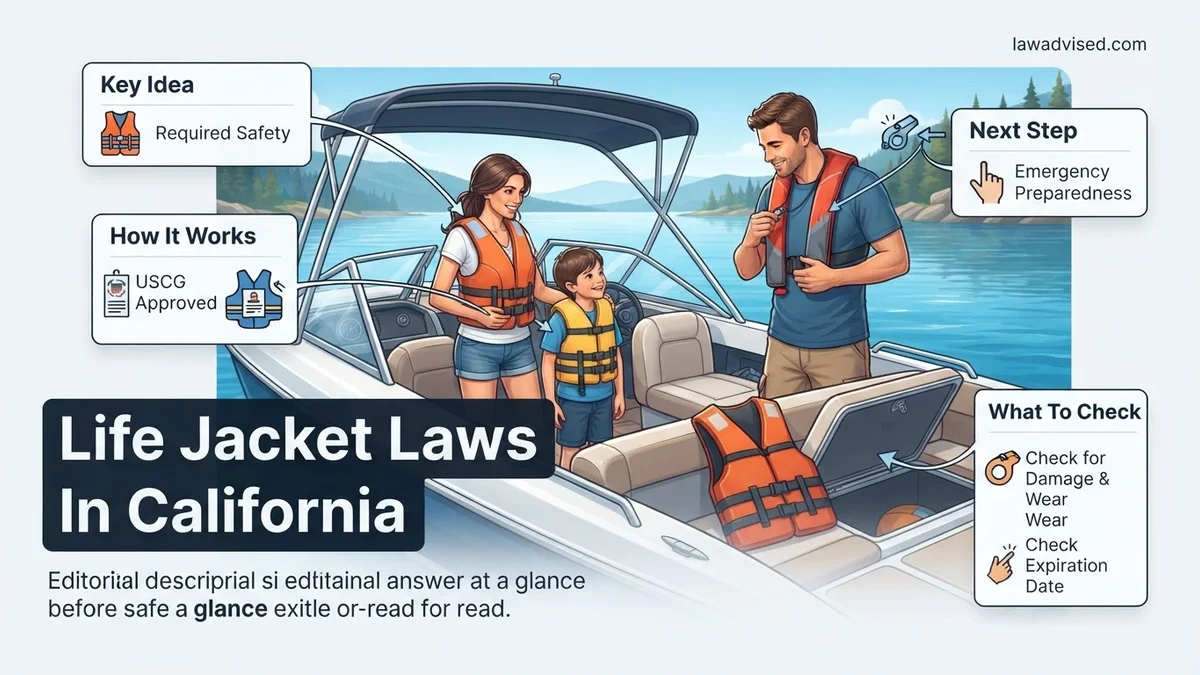
Navigating life jacket laws in california requires understanding mandatory requirements for children, specific watercraft, and general PFD carriage rules. All children under 13 years old must wear a Coast Guard-approved life jacket while underway on any vessel. Every boat must have a wearable PFD of the correct size for every person on board to ensure legal compliance and water safety.
California law requires all children under the age of 13 to wear a Coast Guard-approved personal flotation device (PFD) whenever they are on a moving vessel of any length. Furthermore, every single vessel operating on California waterways in 2027 must carry at least one properly sized, wearable life jacket for every person on board, and boats measuring 16 feet or longer require an additional throwable device.
Navigating these regulations is essential for avoiding hefty fines from the California Department of Parks and Recreation Division of Boating and Waterways (DBW), but more importantly, it keeps you and your passengers safe. Knowing the precise age mandates, vessel-specific exceptions, and equipment carriage rules prevents costly mistakes on the water.
Key Takeaways
- Children under 13 years old must wear an approved life jacket while underway on any vessel.
- Personal Watercraft (PWC) operators and passengers must wear a USCG-approved life jacket at all times.
- Vessels 16 feet and longer must also carry at least one throwable device (Type IV PFD).
- All life jackets must be USCG-approved, in good condition, and properly sized for the wearer.
- Stand-up paddleboards (SUPs) used outside swimming zones require a wearable PFD for each person.
What Causes Compliance Failures with California Life Jacket Laws
Boaters frequently run afoul of California law due to misunderstandings about vessel classifications and passenger age limits. Enforcement officers regularly issue citations because operators assume certain watercraft are exempt from standard PFD mandates.
Misunderstanding PWC and Paddlecraft Rules
Many people incorrectly assume that human-powered vessels like kayaks and stand-up paddleboards operate under different safety rules than motorboats. In California, anyone operating a Personal Watercraft (PWC) like a Jet Ski must wear a PFD at all times, with no exceptions for age or swimming ability. For paddleboards operating beyond the surf zone, California law dictates that a wearable life jacket must be on board for each person, and children under 13 must wear theirs continuously.
Ignoring General Carriage and Sizing Mandates
Another major compliance failure involves having the wrong type or number of life jackets on board. Having life jackets stowed away in hard-to-reach storage lockers or carrying child-sized PFDs for adult passengers violates state and federal requirements. Your gear must match the weight and chest size of the intended wearer.
- Wearable PFDs must be readily accessible, meaning you can grab them instantly in an emergency.
- The jacket must fit snugly and match the US Coast Guard approval rating for the user’s weight class.
- Boats 16 feet and longer need a throwable Type IV device (like a ring buoy or buoyant cushion) in serviceable condition.
How to Fix PFD Deficiencies and Meet California Boating Requirements
Correcting life jacket violations before you leave the dock protects you from citations and ensures your vessel is genuinely prepared for an emergency. Establishing a pre-departure safety checklist is the most effective way to eliminate gear deficiencies.
Upgrading and Organizing Your Onboard Safety Gear
If your current PFD inventory includes torn fabric, degraded foam, or missing straps, you must replace those units immediately. California law states that damaged or unserviceable life jackets do not count toward your legal carriage requirements. Store your wearable PFDs in open, clearly marked bins rather than zipped compartments so law enforcement and passengers can see them instantly.
Implementing a Strict Family and Guest Protocol
Accountability is your best tool for maintaining total compliance with the under-13 rule and adult carriage mandates. Designate a crew member to verify PFD sizes before the boat leaves the slip or launch ramp.
- Conduct a mandatory headcount and match each passenger with an appropriately rated PFD.
- Ensure all children wear their life jackets the moment they step onto the deck, regardless of whether the engine is running.
- Check that your throwable device is un-stowed and resting within arm’s reach of the helmsman.
Step-by-Step Guide to Verifying USCG Approval and Proper PFD Sizing
Ensuring your life jacket complies with California regulations for 2027 requires verifying both official certification and physical fit. The United States Coast Guard (USCG) enforces strict manufacturing standards, and wearing an unapproved device during a California Department of Boating and Waterways inspection carries statutory fines starting at $250. Follow this sequential compliance protocol to verify your equipment.
Step 1: Locate the USCG Approval Stamp
Examine the interior label of the life jacket for the official USCG approval number. The label must explicitly state that the device is approved for use on recreational motorboats or uninspected commercial vessels. Modern PFDs categorized under the new performance-based labeling system will display specific buoyancy ratings and turning characteristics rather than traditional Type I through V classifications.
Step 2: Measure Chest Circumference for Sizing
Accurate sizing dictates whether a life jacket will perform correctly in cold California waters. Use a flexible tape measure to measure around the fullest part of the chest. Match these measurements directly against the manufacturer specifications printed on the tag, keeping in mind that winter layers can alter sizing requirements.
Step 3: Conduct the Fit and Lift Test
Secure all buckles, zippers, and straps, then have a partner pull straight up on the shoulders of the life jacket. If the jacket rides up above the wearer’s nose or ears, the device is too large or the straps are improperly adjusted. According to marine safety experts, a properly fitted PFD should feel snug without restricting normal breathing mechanics.
What If Your Vessel Still Fails Coast Guard or Sheriff Inspection
Failing a California Sheriff or Coast Guard safety inspection due to non-compliant life jackets requires immediate remediation to avoid voyage termination or vessel impoundment. If your onboard PFDs are rejected for wear, tear, or improper sizing, execute the following fallback procedures:
- Purchase Temporary Compliant Replacements: Immediately visit a local marine chandlery or dockside retail partner to acquire USCG-approved Type I, II, or III life jackets that match your exact passenger manifest count. Local marine supply retail prices range from $30 for basic foam vests to $150 for high-end inflatable models.
- Rent Certified Equipment: Many California harbor districts and rental marinas offer emergency safety gear rentals to bring non-compliant vessels up to standard before re-inspection, with daily rental fees averaging $15 to $25 per device.
- Request a Re-Inspection Window: Ask the inspecting officer for a signed discrepancy notice, which typically allows a grace period of 48 hours to correct minor safety violations without incurring escalating court penalties.
- Consult a Certified Marine Surveyor: If complex equipment classifications or commercial vessel requirements are in dispute, hire a National Association of Marine Surveyors (NAMS) professional to formally evaluate your safety inventory. Professional marine surveyor consultations typically cost between $150 and $300 per hour.
Conclusion
Navigating California waterways in 2027 requires strict adherence to updated life jacket laws, proper sizing protocols, and mandatory USCG approvals to protect passengers and avoid hefty municipal fines. By proactively inspecting your PFD inventory and replacing damaged gear immediately, you ensure absolute compliance before launching. According to verified research and maritime safety experts from the California Division of Boating and Waterways, proper life jacket utilization reduces drowning risks by over 70 percent. Take action today by auditing your vessel’s safety gear against current 2027 standards to guarantee a secure, penalty-free boating season.
❓ Frequently Asked Questions
What are the exact age requirements for children wearing life jackets in California?
California law mandates that all children under 13 years of age must wear a USCG-approved life jacket while underway on any vessel, unless they are inside an enclosed cabin or enclosed room.
Are life jacket laws different for personal watercraft like Jet Skis?
Yes, anyone operating or riding on a Personal Watercraft (PWC) such as a Jet Ski or Waverunner must wear a USCG-approved life jacket at all times, regardless of their age.
Do inflatable life jackets count toward legal requirements in California?
Inflatable life jackets are legal for adults (aged 16 and older) provided they are USCG-approved, worn continuously, and maintained in proper working order with a charged CO2 cylinder.
What constitutes ‘readily accessible’ for adult life jackets?
Readily accessible means the life jackets must be stored where they can be reached quickly in an emergency, meaning they cannot be locked in trunks, kept in plastic packaging, or buried under heavy gear.
Are there specific life jacket rules for towed watersports like wakeboarding?
Yes, anyone being towed behind a vessel on waterskis, wakeboards, or inner tubes must wear a USCG-approved life jacket designed specifically for water sports impact.
What are the penalties for violating life jacket laws in California?
Failing to comply with California life jacket and PFD regulations can result in citations, boating safety infraction fines, and termination of voyage by law enforcement officers.

Ismail Hossain is the founder of Law Advised. He is an Divorce, Separation, marriage lawyer. Follow him.