Lunch Break Laws in California 2027 Real Rules & Guide
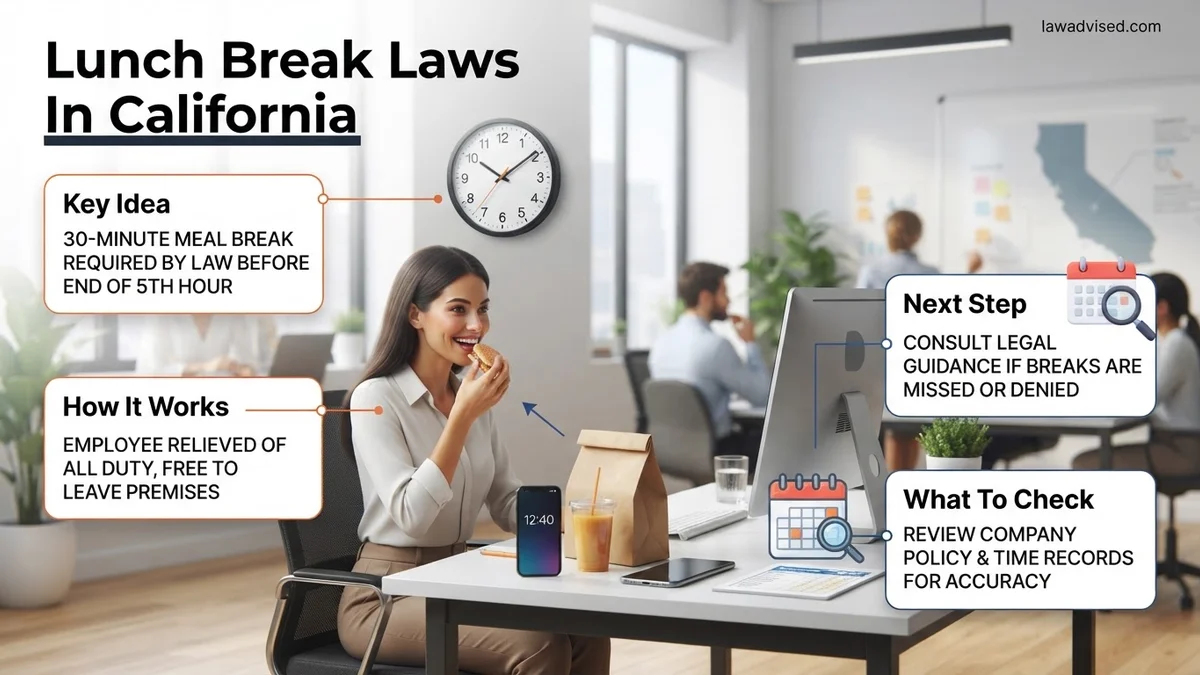
Employers in California must follow strict labor standards that mandate unpaid 30-minute meal breaks for shifts over five hours and paid 10-minute rest breaks for every four hours worked. Violating these timing and duration mandates triggers mandatory one hour of premium pay penalties for the employer.
California labor standards mandate that non-exempt employees receive a 30-minute unpaid meal break for shifts exceeding five hours, plus paid 10-minute rest breaks for every four hours worked. Failing to provide these legally compliant breaks triggers a strict “premium pay” penalty, requiring employers to pay one extra hour of regular pay for every workday a violation occurs.
Navigating these rules in 2027 requires absolute precision from both employers and workers. Because California ignores federal FLSA laxity regarding short breaks, understanding the exact timing requirements and financial penalties keeps your workplace compliant and protects you from costly wage-and-hour lawsuits.
Key Takeaways
- First meal break must start before the end of the fifth hour of work.
- A second 30-minute meal break is required for shifts exceeding 10 hours.
- Rest breaks are 10 minutes long, paid, and required every four hours.
- Missed or shortened breaks result in one hour of penalty pay per violation.
- Employees can only waive meal breaks on shifts lasting six hours or less by mutual consent.
What Causes Compliance Failures with Lunch Break Laws in California
Missing the Five-Hour Threshold
The most common employer misstep involves timing. California law requires your first 30-minute meal break to start before the end of your fifth hour of work. If an employee clocks in at 8:00 AM, their meal break must begin no later than 1:00 PM. Pushing that break to 1:15 PM constitutes a violation, even if the employee takes the full 30 minutes.
Ignoring the Second Meal Period on Long Shifts
Shifts stretching beyond 10 hours trigger a mandatory second 30-minute meal break. Employers often assume employees can voluntarily skip this second break to leave early. Unless the total workday is under 12 hours and both parties agree in writing to waive the first break, skipping the second break without a signed waiver results in automatic penalties.
- First meal break required: Shifts over 5 hours (must start before the end of the 5th hour).
- Second meal break required: Shifts over 10 hours (must start before the end of the 10th hour).
- Rest breaks required: One paid 10-minute break for every major fraction of 4 hours worked.
How to Fix Meal and Rest Break Scheduling Errors
Implementing Strict Timekeeping Systems
To eliminate scheduling errors by 2027, you must upgrade your timekeeping software. Modern point-of-sale and clock-in systems should automatically lock out registers or flag employee profiles when a break window approaches. If an employee hits the 4.5-hour mark without clocking out for lunch, automated manager alerts prevent missed deadlines.
Auditing and Correcting Rest Break Compliance
Unlike meal breaks, rest breaks generally cannot be logged automatically because they are paid and employees typically remain on the clock. Fix this blind spot by requiring employees to acknowledge their rest breaks on electronic timesheets. If operational demands force a missed rest break, management must proactively pay the one-hour penalty on that week’s paycheck rather than waiting for a labor audit.
- Automate shift tracking to alert managers before the 5-hour meal deadline hits.
- Require explicit electronic sign-offs for missed or interrupted rest breaks.
- Disburse the mandatory one-hour penalty immediately during the corresponding pay period.
Step-by-Step Guide to Calculating Premium Pay Penalties
When an employer in California fails to provide a compliant meal break, the Labor Code dictates strict financial penalties known as premium pay. In 2027, enforcement by the Division of Labor Standards Enforcement (DLSE) remains rigorous regarding these violations. Understanding the exact mathematical formula protects both payroll accuracy and worker rights.
Step 1: Determine the Regular Rate of Pay
The penalty is calculated using the employee’s regular rate of pay, not their base hourly wage. This rate includes shift differentials, non-discretionary bonuses, and piece-rate earnings averaged over the workweek. According to California Supreme Court precedent, employers must factor in all applicable compensation components when calculating meal period violations.
Step 2: Apply the One Hour Rule
For every workday that a compliant meal break is not provided, the employer owes exactly one additional hour of pay at the regular rate. This applies whether the break was missed entirely, cut short, or delayed past the five-hour threshold. If an employee suffers both a missed meal break and a missed rest break on the same calendar day, the employer owes two hours of premium pay.
Step 3: Track the Three-Year Statute of Limitations
California labor law allows workers to recover unpaid premium penalties for up to three years prior to filing a formal claim or lawsuit. Payroll audits conducted in 2027 frequently review historical timecard data across this entire statutory window. Accurate recordkeeping prevents compounding financial liabilities for businesses.
What If Industry Exceptions and Employee Waivers Still Apply
Standard California meal break mandates do not apply universally across every occupation or agreement. Certain industries operate under specialized Industrial Welfare Commission (IWC) wage orders that permit specific operational flexibility. Additionally, voluntary employee agreements can legally alter standard break schedules under tightly regulated conditions.
Understanding Valid Meal Period Waivers
An employee may voluntarily waive their right to a meal break only if the total workday does not exceed six hours. For shifts lasting up to 12 hours, a second meal break can be waived, but only if the first meal break was not waived. Crucially, these waivers must be executed in writing and can be revoked by the employee at any time with one day notice.
Special Industry Exceptions
Unionized motion picture employees, commercial drivers operating under specific hours-of-service rules, and certain healthcare workers often follow distinct scheduling frameworks. For instance, healthcare employees subject to valid collective bargaining agreements may agree in writing to work “on-duty” meal periods. Employers must verify that their specific IWC wage order explicitly authorizes these alternative structures before implementing them.
What If It Still Doesn’t Work?
If internal payroll disputes or informal requests fail to resolve missed meal break violations, escalation to state regulatory bodies becomes necessary. Workers and employers navigating persistent compliance deadlocks should consider the following structured fallback options:
- File a Wage Claim with the DLSE: Submit a formal DLSE Form 1 (Report of Labor Law Violation) online or via mail, including all supporting timecards and pay stubs covering the disputed period.
- Consult an Employment Law Attorney: Seek specialized legal counsel for complex class-action or Private Attorneys General Act (PAGA) claims. Initial consultations typically range from free to 300 dollars, with many labor attorneys operating on a contingency fee basis taking 33 to 40 percent of recovered penalties.
- Request a Formal Payroll Audit: Engage a certified public accountant or human resources consultant specializing in California labor compliance to review historical records. Professional audit services generally cost between 1,500 and 5,000 dollars depending on company size.
- Initiate Mandatory Binding Arbitration: Review employment contracts for mandatory arbitration clauses that require resolving wage disputes outside of traditional state court systems.
Conclusion
Navigating California lunch break laws requires strict adherence to timing mandates, accurate calculation of regular rates of pay, and careful handling of statutory exceptions. Failing to provide compliant meal periods triggers costly premium pay penalties that accumulate rapidly over a three-year statutory window. According to verified research and expert labor compliance sources, proactive timecard auditing and transparent waiver management remain the most effective defenses against costly litigation. The recommended next step for any organization or worker is to conduct an immediate internal review of current shift schedules and digital timekeeping logs against 2027 DLSE enforcement standards.
❓ Frequently Asked Questions
What are the exact timing requirements for California meal breaks?
The first 30-minute meal period must begin no later than the end of the employee’s fifth hour of work. For shifts over 10 hours, a second 30-minute meal break must begin before the end of the tenth hour.
Are rest breaks different from meal breaks under California law?
Yes. Rest breaks last 10 minutes, must be uninterrupted, are counted as paid time, and are required for every four hours or major fraction thereof worked.
How is the meal break penalty calculated?
The penalty equals one hour of pay at the employee’s regular rate of compensation for each day that a meal or rest period is missed, late, or cut short.
Can employers require workers to remain on-site during unpaid lunch breaks?
If an employer restricts an employee’s movements during a meal break such that they remain under employer control, the break must be paid as on-duty time.
Do unionized employees have different break rules?
Employees covered by valid collective bargaining agreements may have different meal and rest break rules if the agreement explicitly addresses shift lengths and break provisions.
What should an employee do if their employer refuses to provide breaks?
Employees can file a wage claim with the California Labor Commissioner’s Office or consult with a labor attorney to recover owed penalty pay.

Ismail Hossain is the founder of Law Advised. He is an Divorce, Separation, marriage lawyer. Follow him.