Dog Laws in California Car Expert 2027 Safety Guide
Navigating dog laws in California car travel requires strict adherence to vehicle codes regarding pet placement and safety. Drivers face severe penalties for leaving pets in hot cars or allowing unsecured dogs to create distracted driving hazards.
California takes pet safety and animal welfare very seriously behind the wheel. If you drive with your dog in the Golden State, you face strict legal requirements governed by specific vehicle and penal codes. These laws are designed to prevent horrific accidents, animal cruelty, and distracted driving.
Violating these regulations in 2027 carries heavy financial consequences, potential misdemeanor charges, and even jail time depending on the severity of the offense. Whether your dog rides in the cabin or the back of a truck, knowing the letter of the law protects both your furry friend and your wallet.
Key Takeaways
- California Vehicle Code 23117 strictly regulates dogs riding in open truck beds.
- Penal Code 597.7 makes leaving a dog unattended in a hot car illegal.
- Unrestrained pets can lead to distracted driving citations under VC 23500.
- Properly harness or crate your dog to avoid safety and legal issues.
- Bystanders have legal protections to rescue animals from dangerously hot vehicles.
What Causes Legal Violations Involving Dogs in California Cars
Unattended Pets in Hot Vehicles (PC 597.7)
Leaving your dog unattended in a vehicle is one of the most strictly enforced animal laws in California. Under Penal Code 597.7, it is illegal to leave an animal in any unattended motor vehicle under conditions that endanger their health or safety. This includes extreme heat, cold, lack of ventilation, or lack of water.
If you violate this law, you face serious penalties:
- First Offense: Infraction fines starting at 100 dollars, which can escalate significantly based on local city ordinances.
- Subsequent Offenses: Fines up to 500 dollars and up to six months in county jail if the animal suffers great bodily injury.
- Good Samaritan Protection: California law protects private citizens, law enforcement, and animal control officers who break into a vehicle to rescue a distressed animal, provided they follow specific notification protocols first.
Riding in the Bed of Pickup Trucks (VC 23117)
Many drivers let their dogs ride in the open bed of a pickup truck, but California Vehicle Code 23117 regulates this practice tightly. To legally transport a dog in a truck bed, you must properly secure the animal to prevent it from falling, jumping, or being thrown from the vehicle.
The law requires you to meet at least one of these exact conditions:
- Crosstied System: The dog must be safely secured with cross-tethering or a harness system that prevents it from reaching the sides of the truck bed.
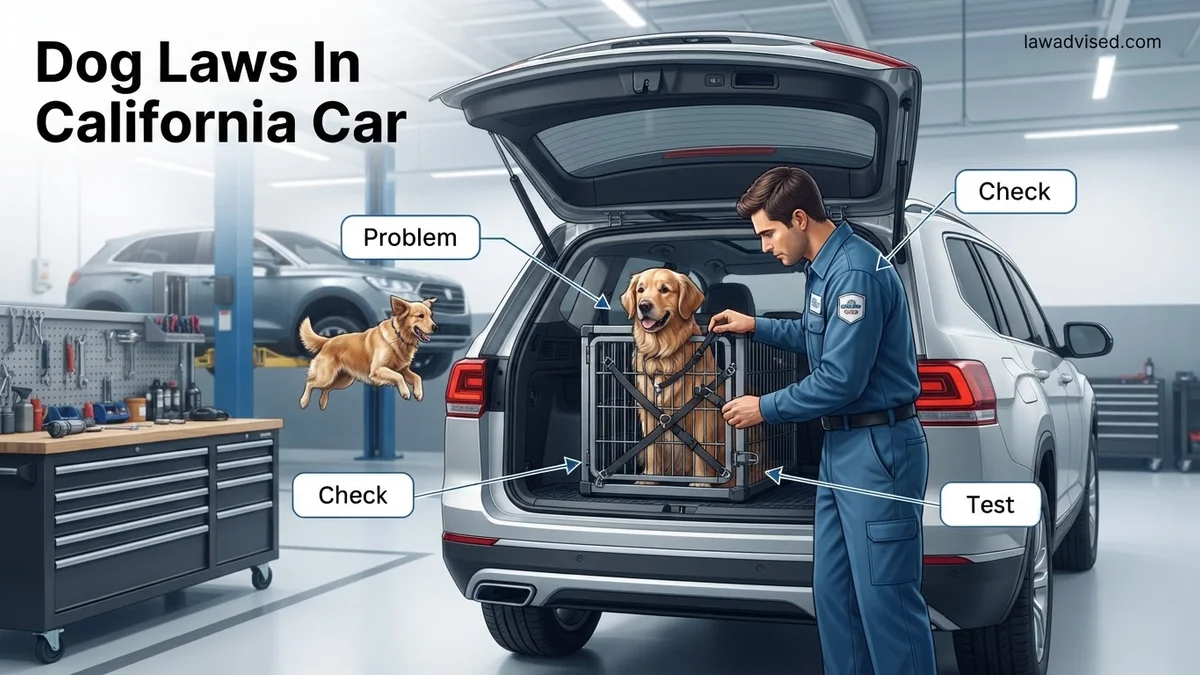
- Enclosed Enclosure: The animal must be housed in a secure, well-ventilated kennel or container bolted or anchored to the truck bed.
- Direct Supervision: The rule does not apply if the truck is being used for farming or ranching operations under specific agricultural exemptions.
How to Fix Unsafe Pet Travel and Comply with California Vehicle Codes
Preventing Driver Interference and Distracted Driving
While California does not have a single statute that explicitly says “dogs cannot sit on laps,” you can still be heavily penalized under broader distracted driving laws. California Vehicle Code 23100 (Reckless Driving) and VC 23123.5 (Distracted Driving) give law enforcement the power to cite you if your pet compromises your ability to safely operate the vehicle.
To stay completely compliant and avoid costly tickets:
- Keep Them Off Your Lap: A dog sitting on the driver’s lap blocks steering wheel movement and pedal access. Police can pull you over and issue a distracted driving citation.
- Use Crash-Tested Restraints: Invest in certified pet seat belts, travel crates, or vehicle barriers. These items keep your dog securely in the back seat and prevent them from becoming dangerous projectiles during sudden stops.
- Train for Calm Travel: Acclimate your dog to a backseat harness so they do not pace, whine, or distract you by demanding attention while you navigate heavy 2027 traffic.
Securing Truck Beds and Ensuring Proper Ventilation
If your dog must travel in a pickup truck bed, you must upgrade your setup to pass highway patrol inspections. Standard leashes tied to the center of the bed are illegal because a dog can still jump over the side and hang themselves.
Follow these compliance steps for truck bed travel:
- Invest in a Multi-Point Harness: Use a certified truck-bed harness attached to secure anchor points that limit movement to the center of the floor bed.
- Monitor Ambient Temperatures: Metal truck beds heat up rapidly in the California sun. Lay down protective mats and ensure your dog has shade and adequate airflow at all times.
- Verify Crate Security: If using a kennel, ensure heavy-duty straps anchor it to the truck’s factory tie-down hooks so it cannot slide or flip during sharp turns.
Step-by-Step Guide to Securing Your Dog and Avoiding Hot Car Penalties
Complying with California transportation codes and preventing heat-related tragedies requires a systematic approach. By establishing a routine every time you travel with your pet, you eliminate the risk of distracted driving citations and deadly cabin temperatures.
Sub-Step 1: Choose and Install the Correct Restraint
- Measure your dog while sitting and lying down to select a crash-tested harness certified by the Center for Pet Safety (CPS).
- Anchor the restraint system securely using the vehicle’s established seatbelt latch or a dedicated ISOFIX-compatible tether.
- Adjust the strap length so your dog cannot reach the driver’s seat or jump out of rolled-down windows, limiting movement to a safe zone.
Sub-Step 2: Implement Thermal Protection Protocols
- Park in shaded areas whenever possible, utilizing high-quality, UV-blocking windshield sunshades to reduce ambient cabin heat absorption.
- Leave the vehicle’s electronic climate control system running if your modern EV or hybrid features a dedicated pet mode or remote temperature lock.
- Limit all errands to under five minutes if leaving the vehicle unattended, noting that California asphalt temperatures can exceed 125°F even on mild days.
What If Your Pet Resists Restraints or Emergency Situations Arise
Many dogs experience severe anxiety or outright panic when first introduced to automotive safety harnesses or crating systems. Forcing a resistant animal into a restraint creates a dangerous distraction hazard for the driver.
Handling Resistance and Emergency Scenarios
- Desensitize your dog to the restraint system indoors for ten-minute intervals using high-value treats before ever attempting to use it inside a moving vehicle.
- Consult a certified professional animal behaviorist or positive-reinforcement dog trainer if severe vehicular phobia persists, with specialized training sessions typically ranging from $100 to $250 per consultation.
- Contact emergency veterinary services immediately if your dog displays signs of heatstroke—such as excessive drooling, bright red gums, or lethargy—even if cabin temperatures registered below 80°F.
- Know your legal rights under California’s “Right to Rescue” laws (AB 2790), which protect Good Samaritans and animal control officers from civil liability if they forcibly enter a locked vehicle to rescue a distressed animal facing imminent danger.
What If It Still Doesn’t Work?
If standard harnesses and behavioral conditioning fail to keep your dog calm and safely secured inside the vehicle, alternative strategies are required to maintain compliance with California law.
- Switch from a harness-and-tether setup to a crash-tested, anchored travel kennel that completely encloses the animal, reducing visual stimulation and travel anxiety.
- Install rigid metal or mesh vehicle pet barriers that separate the cargo area or back seat entirely from the front cabin, preventing driver interference.
- Investigate prescription-strength veterinary anti-anxiety medications or calming pheromone sprays specifically formulated for automotive travel, with veterinary consultations averaging $75 to $150.
- Hire a professional mobile pet transport service or avoid bringing the animal along on non-essential vehicle trips entirely if safety measures prove ineffective.
Conclusion
Navigating California dog car laws in 2027 requires strict adherence to safety restraints and vigilant temperature monitoring to protect your pet and avoid severe financial penalties. Securing your animal properly eliminates distracted driving risks and heatstroke dangers. According to verified research and expert sources from the Center for Pet Safety and automotive safety boards, taking proactive steps today ensures a safe journey for everyone on board. Make crash-tested restraints and strict temperature checks a non-negotiable part of your daily routine.
❓ Frequently Asked Questions
What are the exact legal requirements for dogs in truck beds under California law?
According to California Vehicle Code 23117, dogs riding in the back of an open vehicle must be cross-tethered, protected by a fitted enclosure, or confined in a secure cage to prevent them from jumping or falling out.
How does California Penal Code 597.7 protect animals in vehicles?
This law prohibits leaving an animal in any unattended motor vehicle under conditions that endanger their health or safety, such as extreme heat, cold, lack of ventilation, or lack of water.
Can law enforcement pull you over solely for having an unrestrained dog?
While a loose dog isn’t an explicit primary offense unless it violates truck bed rules, officers can issue a citation if the pet actively distracts the driver or compromises safe vehicle operation.
What are the fines associated with hot car violations in California?
Fines start at $100 for a first infraction, but penalties escalate significantly up to $500 or more if the animal suffers great bodily injury or requires veterinary intervention.
Are police officers allowed to break car windows to rescue a distressed dog?
Yes, peace officers, animal control officers, and firefighters have the legal authority to take all steps reasonably necessary to remove an animal from a dangerously hot vehicle.
What is the safest way to transport a dog inside a passenger vehicle in California?

Ismail Hossain is the founder of Law Advised. He is an Divorce, Separation, marriage lawyer. Follow him.