Bounty Hunter Laws in California Expert 2027 Legal Guide
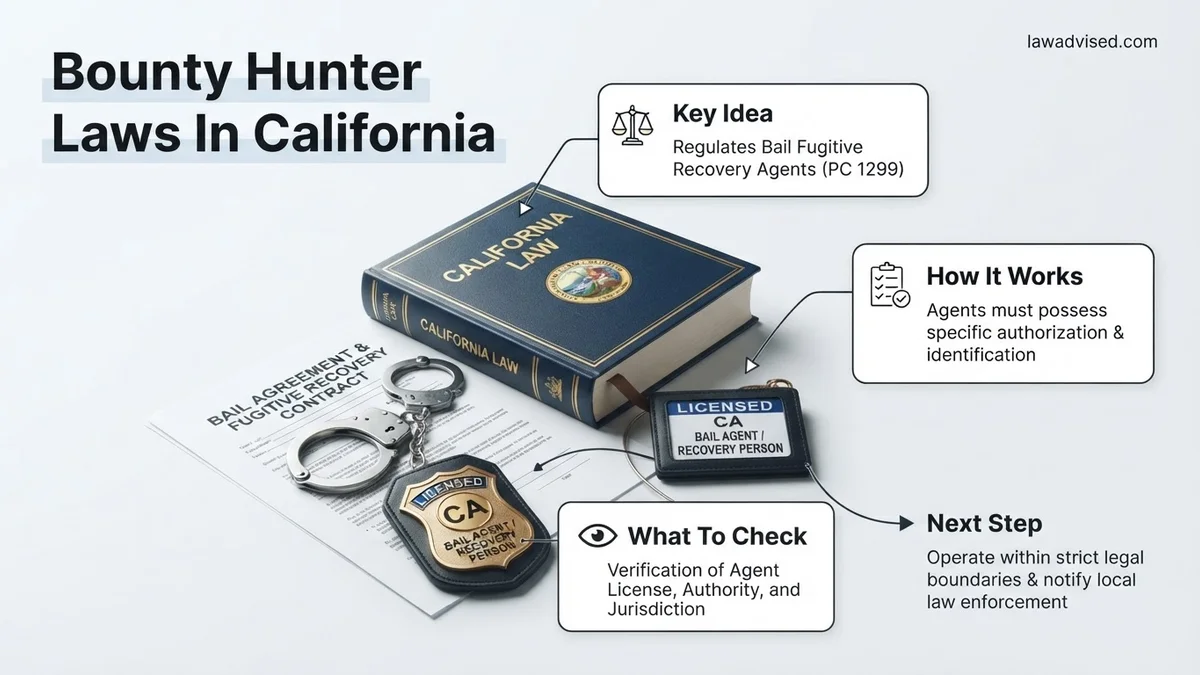
Navigating bounty hunter laws in california requires strict compliance with California Penal Code Section 1299. Bail fugitive recovery persons must meet mandatory licensing, training, and operational boundaries to avoid severe criminal penalties.
California operates under some of the strictest bail fugitive recovery regulations in the United States, governed primarily by California Penal Code Section 1299. If you operate as a bounty hunter in the state, you must navigate a mandatory framework of specific training, strict licensing, and rigid arrest boundaries to avoid felony kidnapping or trespassing charges. Operating outside these 2027 legal parameters exposes recovery agents to severe criminal liabilities and civil lawsuits.
Understanding these rules protects your license and ensures every apprehension stays strictly within constitutional boundaries. This guide breaks down the precise compliance steps, prohibited actions, and statutory mandates you must follow under California law.
Key Takeaways
- All California bail fugitive recovery persons must comply strictly with Penal Code Section 1299.
- Mandatory power-of-arrest training courses are required prior to operating in the state.
- Bounty hunters cannot enter a private residence without explicit consent or a valid warrant.
- Proper authorization documentation must be secured from a licensed bail agent beforehand.
- Local law enforcement agencies must be notified before executing any fugitive recovery operation.
What Causes Legal Violations Under California Bounty Hunter Laws
Entering Private Residences Without Lawful Authority
You cannot simply force entry into a fugitive’s home without meeting strict legal thresholds. Under California law, a bail fugitive recovery person cannot enter a private residence of a third party without explicit, voluntary consent given at the moment of entry. Breaking down doors or entering without verifying the fugitive actually resides at that specific location frequently leads to criminal burglary and trespass charges. You must always carry certified copies of the bail bond and the surrender paperwork to prove your legal standing upon demand by law enforcement.
Carrying Firearms and Using Excessive Force
Carrying a firearm while recovering a fugitive requires specific, verified permits that many out-of-state agents fail to secure. Even with a valid CCW permit, displaying or discharging a firearm during an apprehension will trigger immediate police scrutiny. You possess only the legal arrest powers explicitly granted to private citizens under specific statutory conditions, meaning any use of physical force must remain strictly reasonable and necessary. Exceeding these bounds transforms a lawful recovery into an illegal assault or battery.
- Forcible Entry: Unlawfully breaching a dwelling without a warrant or verified occupant consent.
- Impersonation: Falsely claiming to be a police officer or law enforcement official during an operation.
- Unverified Credentials: Failing to possess mandatory training certificates on your person during an active recovery.
How to Comply With California Penal Code 1299 Requirements Step-by-Step
Completing Mandatory Licensing and Training Hours
To legally work as a bail fugitive recovery person in California, you cannot simply start tracking skips. You must complete a minimum of 40 hours of power-of-arrest training through a Department of Consumer Affairs-approved facility. This curriculum covers constitutional law, arrest procedures, and the specific limitations outlined in Penal Code 1299. Additionally, you must complete a certified firearms course if you intend to carry a weapon on the job.
Maintaining Proper Documentation and Background Clearances
Before stepping into the field, your background must be entirely clear of any disqualifying felony convictions or domestic violence misdemeanors. You are legally required to carry your training certificates and valid photo identification at all times during an operation. Furthermore, you must notify local law enforcement agencies before attempting an apprehension within their jurisdiction, ensuring full transparency and preventing dangerous misunderstandings with local police.
- Complete the mandatory 40-hour power of arrest course from an approved provider.
- Pass a comprehensive Department of Justice fingerprint background check.
- Secure written authorization and certified bond documentation from the licensed bail agent.
- Notify the local police department or sheriff’s office prior to executing the recovery in their territory.
What If Your Authorization or Training Documentation Fails to Meet Standards
Navigating California’s stringent 2027 compliance landscape requires absolute precision. If your licensing, Penal Code 847.5 paperwork, or 40-hour PC 832 training documentation falls short during an audit or verification check, immediate corrective action is mandatory. Operating with flawed credentials exposes recovery agents to severe felony kidnapping and trespassing charges.
Immediate Remediation Steps
- Cease all active fugitive recovery operations immediately to prevent compounding legal liabilities.
- Audit your training certificates against the Bureau of Security and Investigative Services (BSIS) database requirements.
- Contact your certifying educational provider to request expedited replacement transcripts or missing module verifications.
- Resubmit corrected surety bond documentation to your local county sheriff’s department before resuming fieldwork.
Proven Steps to Safely Coordinate Fugitive Recoveries With Local Law Enforcement
California penal codes heavily emphasize proactive communication between bail fugitive recovery persons and municipal police departments. Establishing a collaborative protocol minimizes volatile confrontations and ensures compliance with 2027 departmental notification mandates.
Execution Phases for Agency Coordination
- Deliver a written notice of intended apprehension to the local police jurisdiction at least 24 hours prior to the operation, per modern departmental best practices.
- Provide copies of the executed bail bond contract, defendant background profiles, and agent identification credentials to the watch commander.
- Establish a direct telephonic communication channel with the local dispatch center upon arrival at the target recovery location.
- Request a civil standby if intelligence suggests high resistance, though law enforcement resource availability may vary by municipality.
What If It Still Doesn’t Work?
If initial remediation, documentation fixes, or agency notifications fail to clear your operational status, specialized intervention is required. Delays in compliance resolution can jeopardize your agency’s entire operating status in California.
- Retain a qualified bail enforcement defense attorney to review administrative appeals with the state licensing board. Estimated legal consultation fees range from $350 to $650 per hour.
- Engage a professional compliance auditing firm specializing in California surety and recovery regulations to overhaul your administrative paperwork. Professional audits typically cost between $1,500 and $3,000.
- Temporarily reassign affected recovery personnel to desk or administrative duties until state-level credential clearance is officially restored in writing.
- Surrender disputed warrants back to the originating bail bond agency to completely remove personal liability from the compromised case file.
Conclusion
Mastering bounty hunter laws in California for 2027 requires strict adherence to penal codes, mandatory training certifications, and transparent law enforcement coordination. Failing to maintain compliant documentation introduces catastrophic legal and financial risks to your recovery business. According to verified research and expert legal sources, proactive compliance audits and immediate remediation of credential gaps remain the ultimate safeguard for industry professionals. Take your next actionable step today by scheduling a comprehensive compliance review of all active recovery files and agent credentials.
❓ Frequently Asked Questions
What specific training is required to become a bounty hunter in California?
Under California Penal Code 1299, prospective recovery persons must complete a minimum 40-hour power-of-arrest training course approved by the Department of Consumer Affairs or POST.
What documents must a bounty hunter carry during a recovery operation?
They must possess written authorization from a licensed bail agent, proof of completed training courses, and valid government-issued photo identification at all times during operations.
Are bounty hunters allowed to wear police-style uniforms or badges?
No, California law strictly prohibits bounty hunters from wearing uniforms, using badges, or displaying insignia that imply they are law enforcement officers or peace officers.
What happens if a bounty hunter violates California trespassing laws?
Entering a private property without proper legal consent or a valid warrant constitutes criminal trespassing, which can lead to felony charges, arrest, and loss of operating privileges.
Can out-of-state bounty hunters operate legally in California?
No, out-of-state recovery agents cannot legally operate in California unless they fully comply with California’s mandatory training and PC 1299 statutory requirements.
What is the legal relationship between a bail agent and a bounty hunter?
The bounty hunter acts as an agent or independent contractor hired directly by the licensed bail bondsman to surrender a defendant back to custody, bound by a formal written contract.

Ismail Hossain is the founder of Law Advised. He is an Divorce, Separation, marriage lawyer. Follow him.