Squatter Laws in Arizona 2027 Step-by-Step Guide
Navigating squatter laws in Arizona requires understanding the critical distinction between trespassers, squatters, and holdover tenants. Property owners can utilize fast-track police intervention laws to remove unauthorized occupants quickly, provided they meet strict statutory requirements.
Property owners in Arizona face strict legal hurdles when unauthorized occupants take over a home, but modern statutes provide clear remedies. If you are dealing with an illegal occupant in 2027, your timeline and removal strategy depend entirely on whether the individual is a simple trespasser or a legal squatter.
To reclaim your property efficiently, you must navigate fast-track police intervention laws and understand the rigid timelines of adverse possession. Knowing the exact legal definitions and procedural steps prevents costly delays and protects your real estate investment.
Key Takeaways
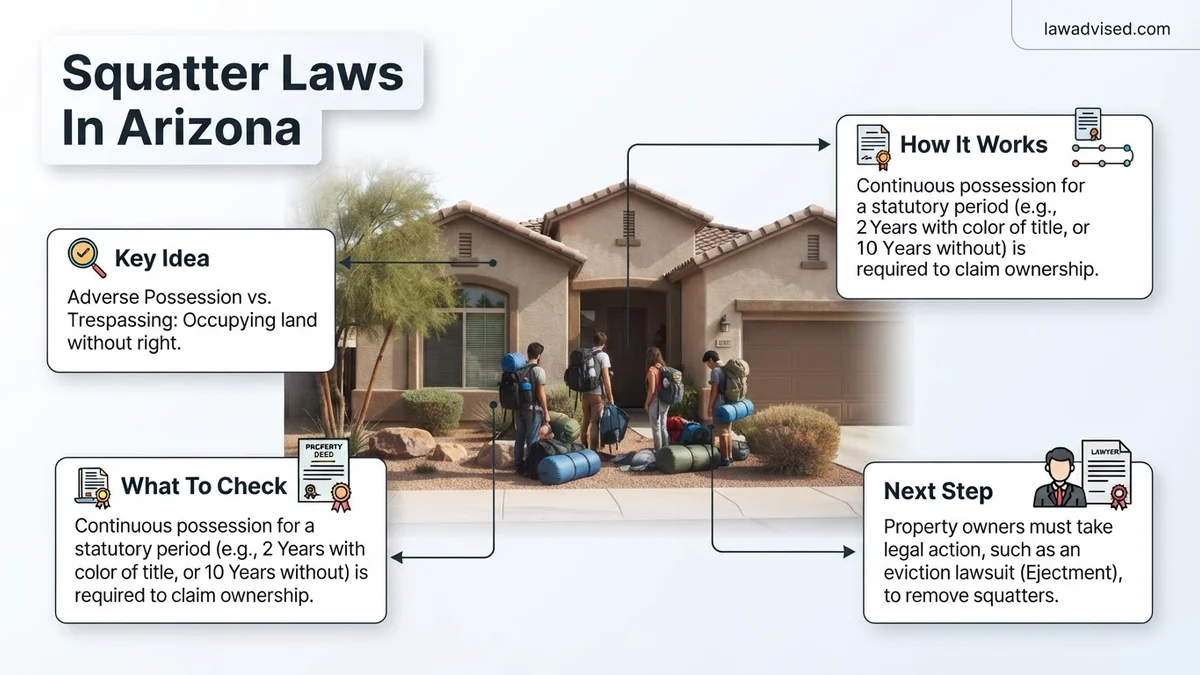
- Arizona adverse possession standardly requires 10 years of continuous, hostile occupation.
- Color of title reduces the adverse possession timeframe to just 3 years.
- House Bill 2843 allows homeowners to request immediate police removal of unauthorized squatters.
- Property owners are strictly prohibited from using self-help eviction methods like utility shutoffs.
- Holdover tenants must go through formal eviction proceedings rather than squatter removal.
What Causes Squatter Issues and How to Identify Trespassers
Squatter situations usually arise in vacant, foreclosed, or second homes left unmonitored for extended periods. When vacant properties lack security, unauthorized individuals move in and attempt to establish residency by moving furniture or utilities into their names.
Trespasser Versus Squatter Distinctions
- Trespassers: Individuals who break into a property or enter without permission, committing a criminal offense that allows for immediate law enforcement removal.
- Squatters: Individuals who occupy a property openly without legal title, often attempting to exploit civil property laws to delay eviction.
- Holdover Tenants: Former renters who refuse to leave after their lease expires, requiring formal landlord-tenant eviction proceedings rather than squatter laws.
Identifying Vulnerabilities in Your Property
Properties left vacant for seasonal use or flipping projects are prime targets in Arizona’s housing market. Criminals often forge lease agreements or utility bills to present fake documentation to police officers, making civil verification necessary before physical removal can proceed.
How to Fix Squatter Occupancy Using Arizona Fast-Track Laws
Property owners no longer have to endure months of standard eviction court processes thanks to targeted state legislation. House Bill 2843 and Arizona Revised Statute section 12-1181 provide a streamlined mechanism for immediate police assistance.
Using ARS 12-1181 for Immediate Removal
- Submit an Affidavit: You must sign a sworn statement under penalty of perjury declaring that you are the lawful owner of the property.
- Define Unlawful Occupancy: The affidavit must state that the occupant is not a current or former tenant and entered the property without your permission.
- Police Action: Presenting this verified document to local law enforcement obligates officers to remove the unauthorized occupants immediately without waiting for a civil court order.
Steps to Take When Enforcement Fails
If local police hesitate due to fraudulent paperwork presented by the squatter, you must immediately file an expedited complaint in the local justice court. Providing proof of ownership and the verified affidavit forces the court to prioritize your case for rapid resolution in 2027.
Step-by-Step Guide to Legal Eviction and Adverse Possession Defense
When unauthorized occupants refuse to leave voluntarily, Arizona property owners must navigate the formal legal eviction process. Resorting to self-help measures like shutting off utilities or changing locks is strictly illegal under Arizona landlord-tenant laws and can result in severe financial penalties for the owner.
Filing for Formal Eviction
- Serve a formal written notice to quit or vacate, providing the statutory timeframe required based on whether the occupant is classified as a trespasser or a holdover tenant.
- File a Forcible Entry and Detainer (FED) action at the local precinct justice court if the occupant fails to vacate the premises.
- Attend the court hearing scheduled by the judge, bringing property deeds, identity verification, and police reports as primary evidence.
- Obtain a Writ of Restitution from the court if the judgment rules in favor of the property owner.
- Coordinate with the local county constable or sheriff to execute the writ and physically remove the unauthorized occupants.
Defending Against Adverse Possession Claims
To successfully defeat an adverse possession claim in 2027, property owners must disrupt the statutory timeline. Legally interrupting the continuous ten-year possession period resets the clock. Owners can grant permissive entry via a formal lease, physically halt unauthorized occupation through legal action, or pay back taxes before the adverse possessor claims them. Documenting all property visits and issuing annual formal notices of ownership serves as critical evidence in Arizona civil courts.
What If It Still Doesn’t Work?
Property owners facing complex legal hurdles or uncooperative law enforcement agencies must utilize advanced escalation strategies. According to legal experts specializing in Arizona real estate disputes, resolving stubborn squatters requires a multi-layered approach when standard procedures stall.
- Hire a specialized real estate litigation attorney to file an expedited injunction, which bypasses standard delays in congested county courts.
- Engage private professional eviction services or licensed security firms specializing in vacant property recovery to manage volatile on-site handoffs safely.
- Escalate the case to the state attorney general or local municipal code enforcement if structural hazards or illegal modifications are occurring on the property.
Retaining a qualified real estate attorney in Arizona typically ranges from $2,500 to $6,000 depending on the complexity of the litigation and whether a jury trial is demanded. Professional property recovery services generally cost between $1,000 and $3,500.
Conclusion
Navigating unauthorized occupants requires swift, legally compliant action to protect property rights and avoid costly delays. According to verified research and real estate legal experts, utilizing Arizona’s 2027 expedited removal statutes combined with meticulous documentation remains the most effective defense against extended squatting. The single most important next step is to secure vacant properties immediately with robust physical security measures and smart monitoring systems to prevent illegal entry entirely.
❓ Frequently Asked Questions
What are the exact legal requirements for adverse possession in Arizona?
To successfully claim adverse possession in Arizona, the occupant must prove actual, open, notorious, exclusive, continuous, and hostile possession for 10 years. They must also have paid property taxes for that duration.
How does House Bill 2843 protect Arizona property owners?
HB 2843 provides a streamlined affidavit process allowing property owners to bypass lengthy court evictions. Homeowners sign a sworn statement claiming unauthorized entry, prompting police to remove the occupants swiftly.
What steps must a homeowner take to file an affidavit for fast-track police removal?
The owner must fill out a specific statutory form stating they are the legal owner, that the person is an unauthorized squatter, and that the owner did not give them permission to stay. This document is handed to local law enforcement for action.
What happens if a squatter claims they have a lease?
If a squatter presents a fraudulent lease to law enforcement, police may hesitate to use fast-track removal, requiring the owner to initiate a formal civil eviction hearing to prove the lease is invalid.
Can property owners legally lock out squatters without a court order?
No self-help evictions are permitted under Arizona law. Changing locks, removing doors, or shutting off essential services can lead to severe civil penalties and damages awarded to the occupant.
How can property owners prevent squatters from targeting vacant homes?
Owners should regularly inspect vacant properties, secure all entry points, post clear ‘No Trespassing’ signs, maintain landscaping, and install smart security cameras or lighting systems.

Ismail Hossain is the founder of Law Advised. He is an Divorce, Separation, marriage lawyer. Follow him.