PTO Laws in Arizona 2027 A Practical Guide & Rules
Arizona does not require employers to provide paid vacation or paid time off (PTO), but the state does mandate earned paid sick leave for most workers. Understanding how vacation time and sick leave interact is essential for managing workplace policies effectively. Employers must clearly outline their PTO payout and accrual rules in writing.
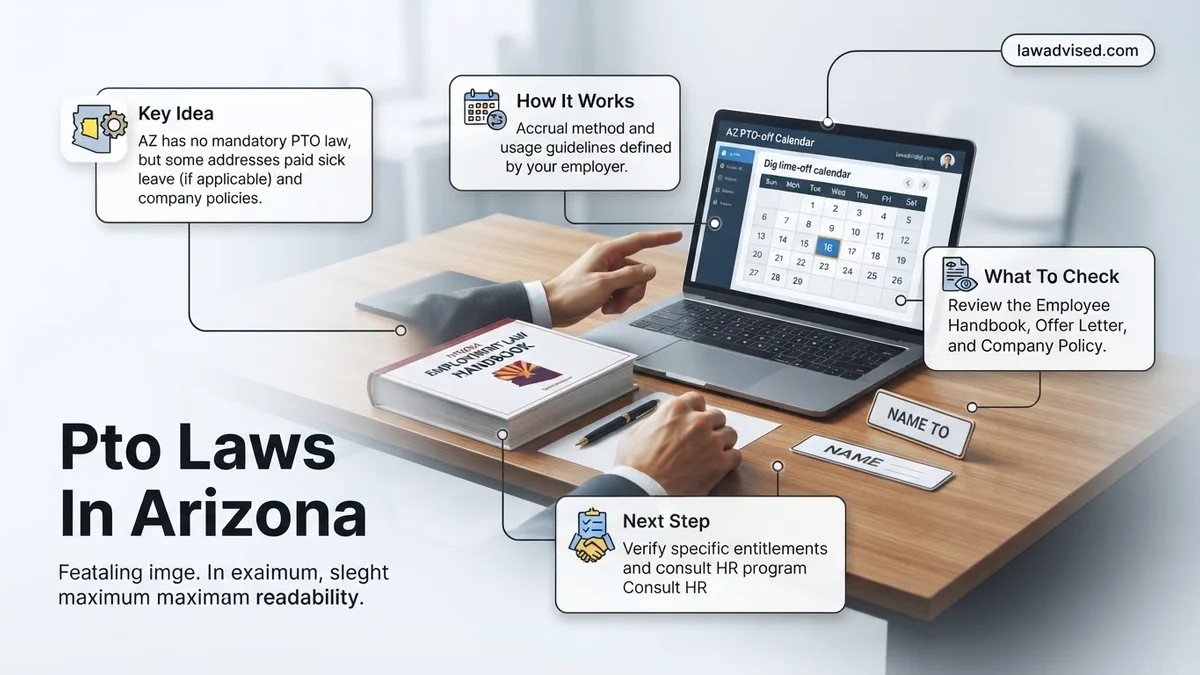
Arizona does not mandate general paid time off (PTO) or vacation time for private employers. However, the state does enforce strict mandatory paid sick leave rules under the Fair Wages and Healthy Families Act. If you combine sick leave and vacation into a single PTO bank, that combined policy must fully comply with all state sick leave mandates.
Navigating these regulations in 2027 requires a clear understanding of state statutes versus company policy. Getting this wrong exposes your business to steep financial penalties or triggers costly employee disputes over unpaid time.
Key Takeaways
- Arizona law does not mandate paid vacation time for private employers.
- Eligible employees accrue at least one hour of paid sick leave for every 30 hours worked.
- Unused vacation time payout upon separation depends strictly on company policy or employment contracts.
- Employers can cap annual sick leave usage and accrual under state guidelines.
- Written PTO policies prevent disputes regarding accrual, rollover, and termination payouts.
What Causes PTO Policy Confusion and Legal Disputes in Arizona
Legal disputes usually arise when employers fail to separate general vacation time from legally protected sick leave. Employees often assume all accrued time is guaranteed money upon separation, which creates friction during terminations.
The Danger of Combined PTO Banks
Many businesses use a single bucket for vacation, personal days, and sick time to simplify tracking. In Arizona, this convenience creates a major legal trap. Because sick leave is strictly regulated, your entire combined PTO bank inherits those strict rules. You cannot easily deny sick time usage if an employee has a balance in their combined pool. If you enforce traditional vacation-style blackout dates on a combined PTO policy, you might inadvertently violate state sick leave laws.
Unclear Payout Rules at Termination
Arizona law does not require employers to pay out unused vacation or PTO upon termination unless you establish a written contract or company policy promising it. Confusion spikes when employee handbooks use vague phrasing like accrued time will be handled appropriately upon separation. If your policy fails to explicitly state whether PTO is paid out, the Arizona Industrial Commission often rules in favor of the employee. You need absolute clarity in your documentation to prevent expensive wage claims.
- Vague handbook language leads directly to wage claims with the Industrial Commission of Arizona.
- Employees frequently mistake discretionary vacation time for a legally mandated benefit.
- Failing to define forfeiture rules results in mandatory payouts you never budgeted for.
How to Fix and Align Your PTO Policy with Arizona Sick Leave Laws
Fixing your PTO policy starts with aligning your terms directly with Arizona sick leave thresholds. You must ensure your accrual rates meet or exceed the state minimums for protected leave.
Structuring Compliant Accrual Rates
Under Arizona law, employees earn at least one hour of paid sick leave for every 30 hours worked. Businesses with 15 or more employees must allow workers to use up to 40 hours of paid sick leave per year. Smaller businesses with fewer than 15 employees face a 24-hour annual cap. If you offer a general PTO plan, it must grant at least these minimum hours immediately or accrue them at a compliant pace right from day one of employment.
Practical Example: If you run a 20-person office in 2027, your standard PTO policy must let full-time staff accumulate and use a minimum of 40 sick hours annually without unreasonable waiting periods.
Drafting Bulletproof Policy Language
Revise your employee handbook to eliminate ambiguous terms regarding PTO usage and separation payouts. State explicitly whether unused vacation time is forfeited or paid out when an employee leaves the company. Separate your sick leave tracking from your vacation policy if you want to apply strict forfeiture rules to vacation time. Clear documentation protects your bottom line and keeps your operations legally compliant.
- Explicitly state in writing whether accrued vacation is paid out upon termination.
- Define clear notification procedures for employees requesting planned PTO versus emergency sick leave.
- Review and update your handbook annually to reflect current 2027 employment standards.
Step-by-Step Guide to Managing Vacation Payouts and Accruals
Implementing a compliant paid time off structure under Arizona law requires strict adherence to internal policy agreements and state guidelines for 2027. According to labor analysts, structured tracking systems minimize costly wage disputes between employers and staff members.
Establish Clear Accrual Metrics
Employers must define whether employees earn time continuously per pay period or receive a lump sum annually. Precise formulas protect both parties from confusion regarding earned benefits.
- Define the exact accrual rate per hour worked or per pay period.
- Specify caps on maximum yearly accruals and overall rollover limits.
- Document these terms explicitly inside the company handbook.
Process Final Payouts Accurately
Arizona law dictates specific timelines for dispersing final wages, which directly impacts accrued leave balances. Reviewing employment agreements ensures that promised vacation payouts are distributed legally upon termination.
- Verify whether your company policy explicitly treats accrued vacation as wages.
- Calculate total unused hours remaining at the time of separation.
- Issue the final paycheck including these funds within the statutory deadline of seven business days or the next regular pay period.
What If It Still Doesn’t Work and You Need Legal Compliance Support
If internal resolution fails between an employee and employer regarding accrued leave disputes, systematic escalation steps are necessary. Navigating complex labor regulations in 2027 often requires structured intervention to achieve a fair resolution.
- Review Signed Documentation: Gather all employment contracts, company handbooks, and recent pay stubs to verify written vacation policies.
- File an Administrative Claim: Submit a formal wage claim through the Industrial Commission of Arizona if unpaid vacation qualifies as earned wages under company policy.
- Consult an Employment Attorney: Reach out to a licensed professional specializing in Arizona labor law when informal negotiations stall. Initial consultations generally range from $150 to $350, depending on the firm.
- Engage Formal Mediation: Utilize professional dispute resolution services to settle discrepancies without proceeding to costly litigation.
Conclusion
Mastering paid time off regulations in Arizona requires careful attention to written employment contracts, accurate accrual tracking, and timely wage disbursement. According to verified research and expert legal sources, proactive policy documentation prevents most payroll conflicts before they escalate. Take the actionable next step today by auditing your current employee handbook or consulting a qualified labor professional to guarantee complete compliance for 2027.
❓ Frequently Asked Questions
What are the core PTO laws in Arizona for private employers?
Arizona law leaves vacation PTO policies to the discretion of the employer. However, employers must comply with state-mandated paid sick leave rules if they combine PTO into a single bank.
How does the Arizona paid sick leave law affect a combined PTO policy?
If an employer uses a single PTO bank for vacation, sick, and personal days, that bank must satisfy all minimum requirements of the Arizona earned paid sick leave law.
Can an employer take away accrued vacation time in Arizona?
Employers can establish use-it-or-lose-it policies or caps on accrual, but they must clearly communicate these rules to employees in writing beforehand.
What happens to earned sick leave when an employee is terminated?
Arizona law does not require employers to pay out unused, accrued paid sick leave when an employee leaves the company.
Are small businesses exempt from Arizona sick leave requirements?
No, all employers in Arizona must provide earned paid sick leave regardless of size, though the maximum cap on usage may vary based on the number of employees.
What recourse do employees have if denied earned sick leave?
Employees can file a labor complaint with the Industrial Commission of Arizona (ICA) if their employer violates the state’s paid sick time statutes.

Ismail Hossain is the founder of Law Advised. He is an Divorce, Separation, marriage lawyer. Follow him.