Leash Laws in Arizona 2027 Expert Guide to Regulations
Navigating leash laws in Arizona requires understanding that while state statutes establish broad animal control guidelines, specific leash mandates are strictly enforced at the county and municipal levels. Dog owners must comply with local restrictions across major metro areas like Phoenix, Tucson, and Mesa to avoid costly citation fines and legal liability.
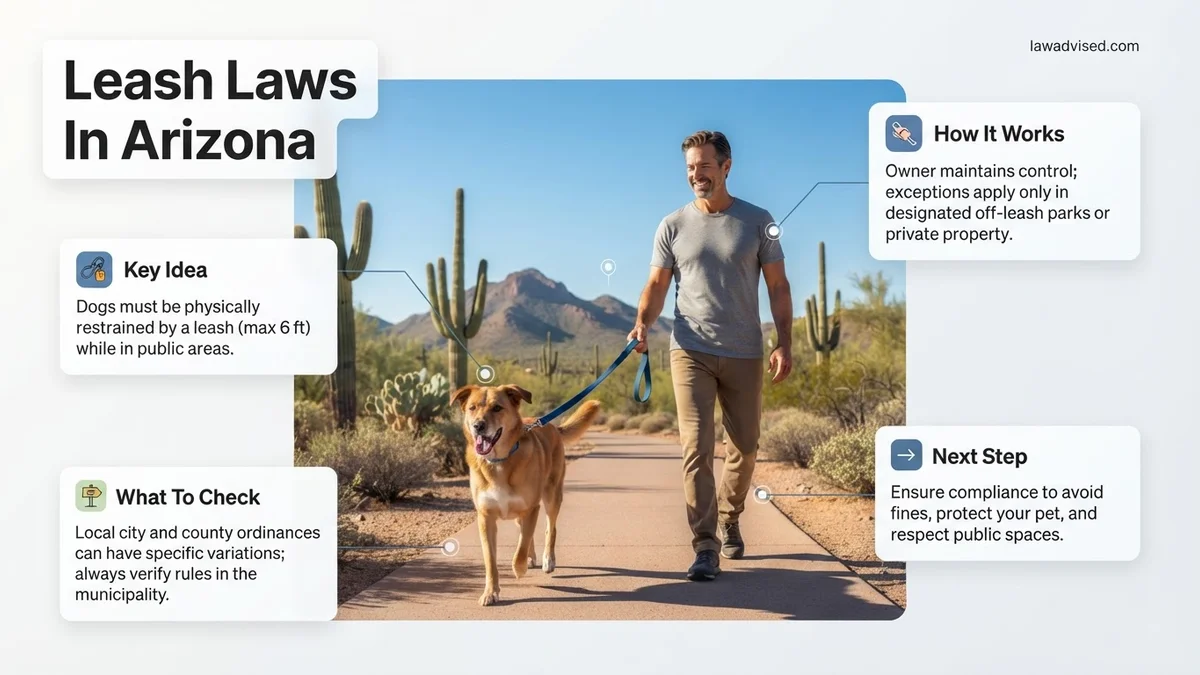
In Arizona, state statutes broadly require that dogs be restrained by a physical leash when off the owner’s property, but enforcement and specific length limits are heavily delegated to local municipalities. As of 2027, walking your dog without a proper restraint in public spaces exposes you to steep municipal fines, which often start at $100 for a first offense and scale past $500 for repeat violations or incidents involving aggressive behavior.
Navigating these regulations requires looking past state-level statutes down to county and city codes. Because Arizona does not enforce a single statewide leash length—unlike states that strictly mandate a six-foot maximum—knowing the exact boundary lines between Phoenix, Tucson, Mesa, and unincorporated county land is essential to keeping your pet legal and safe.
Key Takeaways
- Arizona does not have a single statewide leash statute, leaving enforcement to local municipalities and counties.
- Maricopa County and Pima County mandate that dogs be restrained on a physical leash in public spaces.
- Designated off-leash dog parks and private property are the primary legal exceptions to public leash rules.
- Violating local animal control ordinances can result in expensive civil citations and steep fine penalties.
- Dog owners face strict civil and criminal liability if an unleashed animal causes injury, bite damage, or property loss.
What Causes Leash Law Violations and Public Confusion in Arizona
The Illusion of Statewide Uniformity
Many pet owners assume that Arizona state law provides a universal rule for dog restraint. In reality, Arizona Revised Statutes (A.R.S.) § 11-1012 and related statutes give counties and incorporated cities the authority to draft their own animal control codes. This creates a patchwork of regulations where a six-foot leash might be required in one municipal park, while a retractable leash extending up to 16 feet is permitted just across city lines.
Ambiguous Boundaries in Desert Preserves and Washes
Another major source of confusion stems from multi-jurisdictional public lands. You might legally allow your dog off-leash on a specific federal Bureau of Land Management (BLM) trail, only to step across a marker into a city-managed desert preserve where strict leash laws apply. Misinterpreting these boundaries frequently results in accidental citations.
- Failing to recognize municipal park boundaries versus county open spaces.
- Assuming hiking trails share the same rules as urban sidewalks.
- Misjudging the legal status of unpaved desert washes that intersect residential neighborhoods.
How to Fix Compliance Issues Using Step-by-Step Local Ordinance Checks
Verifying Your Specific City or County Code
To ensure total compliance in 2027, you must verify the local code for the exact jurisdiction you plan to visit. Do not rely on general Arizona state summaries. Go directly to the municipal website for Phoenix, Tucson, Mesa, or your respective county department of animal care and control.
Implementing a Foolproof Walking Strategy
Adopt a standard operating procedure for every neighborhood walk or park visit to eliminate the risk of a violation. By sticking to predictable, compliant gear and checking signage at every trailhead, you protect your dog and your wallet.
- Always carry a fixed-length leash of six feet or shorter, even if you plan to visit a designated off-leash dog park.
- Check entry signage at parks and preserves immediately upon arrival for updated 2027 local ordinances.
- Keep digital bookmarks of local animal control codes on your phone to quickly check leash length and control rules before exploring new areas.
What If It Still Doesn’t Work and You Face Fines or Legal Disputes
Navigating Arizona’s animal control regulations can become complex if a citation is issued or a liability dispute arises. Even with careful adherence to the 2027 leash laws, misunderstandings or unexpected encounters happen. Resolving these legal challenges requires a structured approach to protect your rights as a pet owner.
Handling Citations and Escalations
When animal control officers issue a fine for a leash law infraction, ignoring the notice only leads to increased financial penalties or a mandatory court appearance. Legal experts recommend addressing the matter immediately to minimize long-term consequences.
- Review the citation thoroughly to identify the exact municipal code violated and the specified court date or response deadline.
- Gather all supporting evidence, including neighborhood witness statements, time-stamped photographs of signage, or veterinary records verifying your dog’s temperament and vaccination status.
- Contact the issuing municipal court or county justice court to discuss potential mitigation options, such as completing a responsible pet ownership course.
- Consult with a licensed animal law attorney if the violation involves a bite incident or property damage, as civil liability can escalate rapidly under strict liability statutes.
Professional Advocacy and Cost Estimates
If informal negotiations fail or you face severe administrative penalties, retaining professional help is often necessary. According to verified legal industry data for 2027, the estimated cost range for retaining an attorney specializing in Arizona animal law spans from $300 for a basic citation review up to $2,500 or more for contested administrative hearings involving dangerous dog designations.
Engaging a certified animal behaviorist may also prove vital during legal disputes. Expert behavioral evaluations typically range between $250 and $600. These professional assessments provide objective documentation to contest unfair aggressive animal classifications in court.
Conclusion
Mastering Arizona leash laws in 2027 protects your pet, your community, and your financial well-being from costly municipal citations. By understanding state statutes, local county ordinances, and strict liability rules, dog owners can ensure safe and compliant outdoor excursions. According to verified research and expert sources from municipal animal care departments, proactive compliance remains the single most effective defense against legal disputes and animal control penalties. Your actionable next step is to review your local municipality’s specific leash radius rules today and invest in a durable, regulation-compliant restraint before your next walk.
❓ Frequently Asked Questions
How do county leash laws differ between Maricopa County and Pima County?
Both Maricopa and Pima counties strictly require dogs to be restrained by a leash when off the owner’s property, but local municipalities within these counties may enforce their own specific fine structures and park restrictions.
Can my dog run free on public hiking trails in Arizona?
Most state parks, national forests, and municipal trail systems in Arizona strictly require dogs to be kept on a leash measuring six feet or shorter to protect local wildlife and trail users.
What should I do if I encounter an aggressive unleashed dog in public?
Stay calm, avoid direct eye contact, do not run, and create distance between yourself and the animal. Report the incident immediately to local animal control or law enforcement.
Are there specific leash length limits enforced in Arizona cities?
Many Arizona cities enforce a maximum leash length of six feet in public parks and sidewalks to ensure handlers maintain physical control over their pets at all times.
What happens if my unleashed dog damages someone else’s property?
The dog owner is legally responsible for the full cost of property damage, and animal control may issue citations for failure to restrain an animal properly.
Do apartment complexes and HOA communities have their own leash rules?
Yes, private HOAs and apartment complexes in Arizona have the legal right to enforce strict community leash rules that exceed local public ordinances.

Ismail Hossain is the founder of Law Advised. He is an Divorce, Separation, marriage lawyer. Follow him.