Home Defense Laws in California 2027 Expert Legal Guide
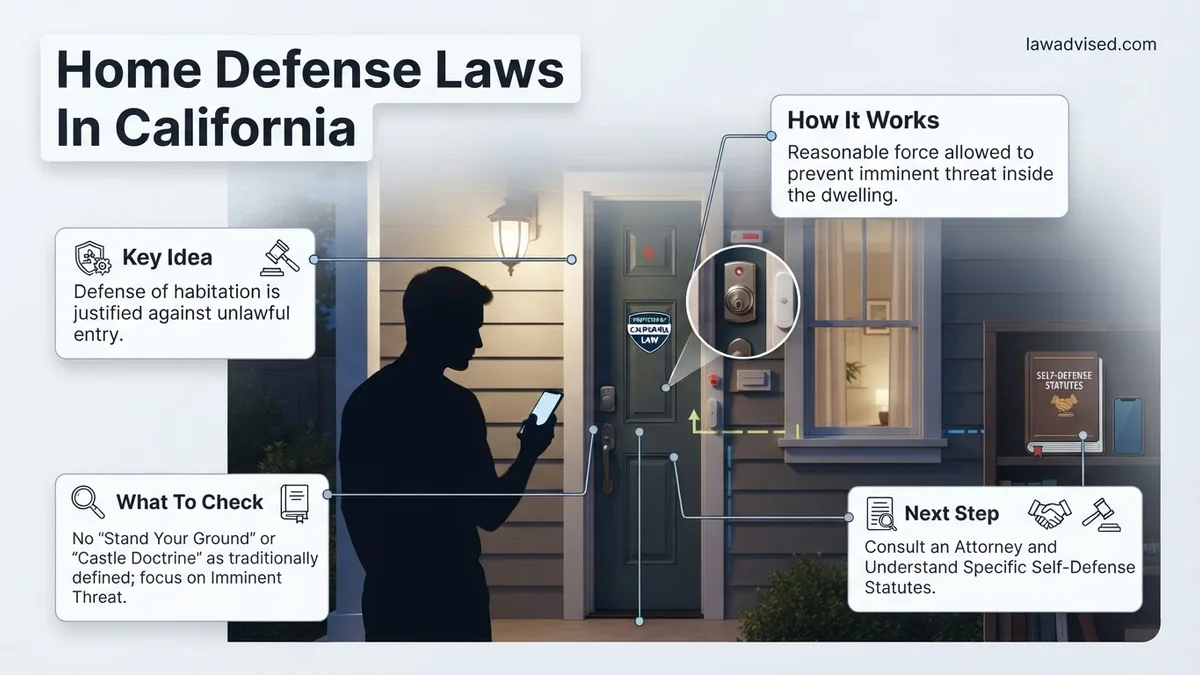
Navigating home defense laws in California requires understanding your rights and legal limits under the state’s strict self-defense statutes. California recognizes the Castle Doctrine, which grants residents the legal right to protect their homes against unlawful intruders using necessary force. However, your response must align strictly with legal definitions of reasonable fear and imminent danger to avoid criminal prosecution.
Yes, you are legally allowed to use deadly force to protect your home and family in California, provided specific, strict legal thresholds are met. California law does not give you a blank check to shoot intruders, but it does provide robust protections under the state’s version of the Castle Doctrine, which eliminates your duty to retreat inside your own residence as of 2027.
Understanding these laws can mean the difference between protecting your family and facing severe criminal prosecution. Prosecutors in California scrutinize every home defense shooting, meaning your split-second decisions will be analyzed under a microscope by the legal system long after the smoke clears.
Key Takeaways
- California Penal Code 198.5 establishes the legal basis for the state’s Castle Doctrine.
- Residents have no duty to retreat when facing an unlawful intruder inside their home.
- Deadly force is only justified if there is a reasonable fear of imminent death or great bodily injury.
- Force used against an intruder must remain strictly proportional to the perceived threat.
- Post-shooting investigations and potential civil liability require immediate professional legal representation.
What Causes Legal Liability During a California Home Invasion
Legal liability arises when a homeowner uses a level of force that the law deems unreasonable under the specific circumstances. Even inside your own house, you cannot automatically shoot someone simply for trespassing. California prosecutors look at your actions to determine if you acted out of actual, reasonable fear or out of anger, retaliation, or panic.
Misunderstanding the Threshold of Threat
You face serious criminal charges if you use deadly force against an intruder who poses no immediate danger of death or great bodily injury. For example, shooting a non-violent property offender running away with your television outside your home will land you in prison. Liability also triggers if you continue firing after the intruder has clearly surrendered or fled, shifting your status from defender to aggressor.
Key Risk Factors for Criminal Charges
- Shooting an intruder who is clearly retreating or posing no physical threat.
- Using deadly force against a social guest or family member you mistakenly identified, where your mistake of fact was deemed unreasonable.
- Failing to establish that the intruder unlawfully and forcibly entered your living space.
- Making damaging statements to responding 2027 law enforcement officers without legal representation present.
California Home Defense Laws Made Easy: Your Essential Action Plan
Navigating the complex legal landscape of protecting your home in the Golden State requires a precise understanding of self-defense statutes, firearm regulations, and property rights. This practical walkthrough breaks down California home defense laws into actionable steps, ensuring you can safeguard your household while remaining fully compliant with state legislation.
Step 1: Understand the Castle Doctrine and Stand Your Ground in California
What you need: Basic legal knowledge of California Penal Code Section 198.5, local law enforcement resources, and a commitment to proportional response.
Instructions: Familiarize yourself with California’s version of the Castle Doctrine, which is codified under Penal Code 198.5. Unlike some states with broad “Stand Your Ground” laws outside the home, California applies the Castle Doctrine specifically to your residence, workplace, or occupied vehicle. The law presumes you have a reasonable fear of imminent peril of death or great bodily injury if an intruder unlawfully and forcefully enters your home. You do not have a duty to retreat inside your own dwelling before using defensive force, provided the entry was forced and you reasonably believed the intruder intended to commit a violent felony.
Pro Tip: Never pursue a fleeing intruder outside your home or into an unattached structure, as the legal protections shift dramatically once the immediate threat inside the dwelling has subsided.
Step 2: Evaluate the Principle of Proportional Force
What you need: Clear judgment, situational awareness, and an understanding of the legal definitions surrounding deadly versus non-deadly force.
Instructions: Assess how California law treats the level of force you apply during a break-in. The force used must be proportional to the threat faced. If an intruder is unarmed and simply trying to steal a television without threatening physical harm, using deadly force is legally indefensible and could result in manslaughter or murder charges. Deadly force is legally justified only when you have a reasonable belief that you or another occupant face imminent death or severe bodily injury. Always prioritize verbal warnings and non-lethal deterrents if the situation allows for safe evaluation.
Pro Tip: Documenting the physical layout of your home and maintaining smart lighting can help you articulate in court why you reasonably perceived a lethal threat in a dark hallway.
Step 3: Comply with California Firearm Storage Laws
What you need: California-approved gun safes, trigger locks, or lockboxes, and knowledge of Penal Code 25140 regarding firearm access.
Instructions: Balance your need for rapid home defense with strict California safe storage laws. Under state law, if a minor (under 18) or a prohibited person is reasonably likely to gain access to your firearm, you must store it in a locked container or disable it with a firearm safety device. For home defense, many legal experts recommend biometric safes or quick-access bedside lockboxes. These devices allow you to maintain legal compliance while retrieving your firearm within seconds during an emergency. Leaving a loaded, unsecured firearm out in the open where unauthorized individuals can access it is a criminal offense.
Pro Tip: Practice opening your quick-access safe in total darkness using muscle memory so you can deploy your firearm safely and efficiently under high-stress conditions.
Step 4: Master Safe Firearm Transport and Possession Inside the Home
What you need: A legally acquired firearm registered in California, standard-capacity magazines (or grandfathered legally owned large-capacity magazines), and compliance with the state handgun roster.
Instructions: Ensure that any firearm kept in your home for defense meets California Department of Justice (DOJ) standards. Handguns generally must be on the California roster of certified handguns (unless acquired via exempt transactions like inter-familial transfers or law enforcement purchases). You must legally own and register the firearm in your name. While inside your private residence, you generally do not need a Concealed Carry Weapon (CCW) permit to carry a firearm on your person, but the weapon must not be brandished in public areas or shared common spaces of multi-family complexes unlawfully.
Pro Tip: Keep a record of all firearm purchase receipts and DOJ registration confirmations in a secure folder separate from your defense hardware.
Step 5: Execute Effective Emergency Communication Protocols
What you need: A charged mobile phone, smart home integration, and a pre-established family communication plan.
Instructions: When an intrusion occurs, your immediate priority after securing a safe defensive position is notifying law enforcement. Call 911 as soon as it is safe to do so. Clearly state your address, the nature of the emergency, a description of yourself and family members, and a physical description of the intruder. When police arrive, they will be operating on high alert; keeping your hands visible and following all officer instructions precisely will prevent tragic misidentifications. Establish a code word with family members so everyone knows to shelter in place and not wander into hallways.
Pro Tip: Program your local police precinct’s direct non-emergency and emergency numbers into your cell phone speed dial alongside 911 for instant access.
Step 6: Handle Post-Incident Legal and Law Enforcement Interactions
What you need: Composure, an emergency retainer contact for a criminal defense attorney specializing in self-defense, and legal awareness.
Instructions: If you are forced to use defensive force, the legal battle begins the moment the incident ends. When law enforcement arrives, cooperate minimally to secure the scene, identify yourself as the victim, and point out evidence or suspects. However, exercise your constitutional right to remain silent regarding the detailed specifics of the event until your attorney is present. State clearly: “I am the victim, I will cooperate fully, but I want to speak to my attorney before making any further statements.” High-stress adrenaline can cause you to misstate facts, which prosecutors can use against you later.
Pro Tip: Keep the contact information of an attorney who specializes in California self-defense law saved in your phone and written down in your safe.
✅ Final Checklist
- Verified that all firearms are stored securely in California-compliant safes or lockboxes while maintaining quick access
- Reviewed and understood the parameters of California Penal Code 198.5 (Castle Doctrine)
- Confirmed all home defense firearms are legally registered with the California DOJ
- Established a clear family emergency plan, safe room, and 911 communication protocol
- Saved contact information for a qualified criminal defense attorney specializing in self-defense
Important Notes:
- California self-defense laws change frequently via state legislation and court rulings; review updates annually.
- Consult with a certified firearms instructor and a legal professional to ensure your specific home defense setup complies with local ordinances.
- Estimated initial cost for a compliant quick-access safe and legal firearm registration ranges from $200 to $1,500+ depending on equipment choices.
How to Fix and Apply California Castle Doctrine Rules Correctly
To keep yourself legally protected, you must understand how California Penal Code 198.5 operates in real-time practice. The Castle Doctrine establishes a legal presumption that you hold a reasonable fear of imminent peril of death or great bodily injury when specific criteria are met. Getting this right means knowing the exact boundaries of your legal sanctuary.
The Four Pillars of Penal Code 198.5
For the legal presumption of fear to protect you, four conditions must exist simultaneously during the incident. If any single pillar is missing, the blanket presumption disappears, and you must prove your fear was objectively reasonable:
- The intruder must unlawfully and forcibly enter your residence.
- You must be inside the residence at the time of the entry.
- The intruder must not be a member of your household or family.
- You must have held a reasonable belief that the intruder intended to commit a violent felony or harm someone inside.
Applying the Rules in Daily Practice
When applying these rules, remember that the Castle Doctrine applies strictly to your habitation, which includes your house, apartment, attached garage, and sometimes enclosed porches. It does not extend to your open front yard or public driveway in 2027. Inside the home, you have no duty to retreat, even if a safe escape route is available to you. You stand your ground, but every round fired must still be justified by the immediate necessity to stop an ongoing, violent threat to human life.
Step-by-Step Guide to Evaluating Imminent Danger and Proportional Force
Navigating California self-defense laws requires a precise understanding of how courts evaluate life-or-death scenarios. Legal experts and criminal defense attorneys emphasize that homeowners must rapidly assess specific criteria before deploying force. According to updated judicial guidelines for 2027, the evaluation process hinges on the reasonable person standard.
Assessing the Threat Level
Homeowners must determine if the intruder presents an immediate, unlawful threat of death or great bodily injury. Vague trespassing or property theft does not justify lethal force under California Penal Code 198.5. You must observe overt acts, such as brandishing a weapon or forcing entry into an occupied bedroom, that signal explicit danger.
Calibrating Response and Proportionality
The force used must match the severity of the perceived threat. Utilizing excessive violence after a threat has dissipated will forfeit legal protections. Follow this structured assessment framework:
- Identify Intrusion: Verify that an unauthorized person has unlawfully crossed your threshold or broken into an inhabited dwelling.
- Evaluate Capability: Look for weapons, physical size advantages, or numerical superiority that give the intruder the capacity to cause severe harm.
- Weigh Opportunity: Confirm the intruder has immediate access to you or your family members, leaving no time to retreat safely.
- Determine Response: Apply the minimum level of effective force necessary to neutralize the active threat, escalating to lethal options only if death or grave injury is imminent.
What If Legal Complications Still Arise After a Self-Defense Incident
Even when a homeowner acts lawfully under the Castle Doctrine, law enforcement and prosecutors may still file charges while investigating the shooting. If immediate legal trouble persists or criminal charges are brought, specific escalation steps are required to protect your rights.
- Exercise Right to Silence: Politely decline to answer substantive police questions beyond identifying yourself and pointing out evidence until your defense attorney is present.
- Retain Specialized Counsel: Immediately hire a criminal defense attorney who specializes in California self-defense and firearms law. Avoid general practitioners.
- Secure Legal Defense Insurance: Activate specialized firearm self-defense coverage or prepaid legal protection plans to manage mounting expenses.
- Anticipate Financial Costs: Retaining expert defense counsel for a self-defense case typically ranges from $15,000 to over $50,000 for initial representation and pre-trial motions, escalating significantly if the case goes to trial.
Conclusion
Mastering home defense laws in California for 2027 demands strict adherence to the statutory boundaries of the Castle Doctrine and proportional force. Misjudging these legal thresholds can expose homeowners to severe criminal liability and immense financial strain. According to verified research and expert legal sources, immediate retention of specialized counsel and strict compliance with the reasonable person standard remain the most effective safeguards against prosecution. Take the next step today by consulting a certified legal professional to review your home security and emergency response plan.
❓ Frequently Asked Questions
What specific conditions must be met for the Castle Doctrine to apply in California?
Under Penal Code 198.5, the intruder must force entry into a residence that is currently occupied, the resident must know or have reason to believe an unlawful entry occurred, and the intruder must not be a family member or household resident.
How do California courts define ‘reasonable fear’ of death or great bodily harm?
Reasonable fear is evaluated from the perspective of a reasonable person placed in the same exact circumstances. The threat must feel immediate, and the belief that deadly force is necessary must be logically supported by the intruder’s actions.
Can I legally use a firearm that is not registered to me for home defense?
While possessing an unregistered firearm may carry separate weapons charges under California law, your right to self-defense is evaluated independently based on whether the threat justified the use of lethal force.
What happens legally immediately after a defensive shooting in a home?
Police will respond to secure the scene, confiscate the weapon involved, conduct interviews, and gather forensic evidence. It is critical to cooperate minimally with safety directives while immediately requesting legal counsel before making detailed statements.
Are there criminal charges if prosecutors believe excessive force was used?
Yes, if the state determines the threat did not warrant lethal force or that the force continued after the threat ended, you can face criminal charges ranging from manslaughter to attempted murder.
Can an intruder’s family sue me civilly even if the shooting was justified?
California law provides civil immunity from lawsuits brought by intruders or their families if you successfully establish that your use of deadly force was lawfully justified under the Castle Doctrine.

Ismail Hossain is the founder of Law Advised. He is an Divorce, Separation, marriage lawyer. Follow him.