Prostitution Laws in California 2027 Expert Legal Guide
Navigating prostitution laws in California requires understanding California Penal Code Section 647(b) and recent legislative shifts. This guide breaks down the legal statutes, penalties for solicitation, and the impact of the Safer Streets for All Act.
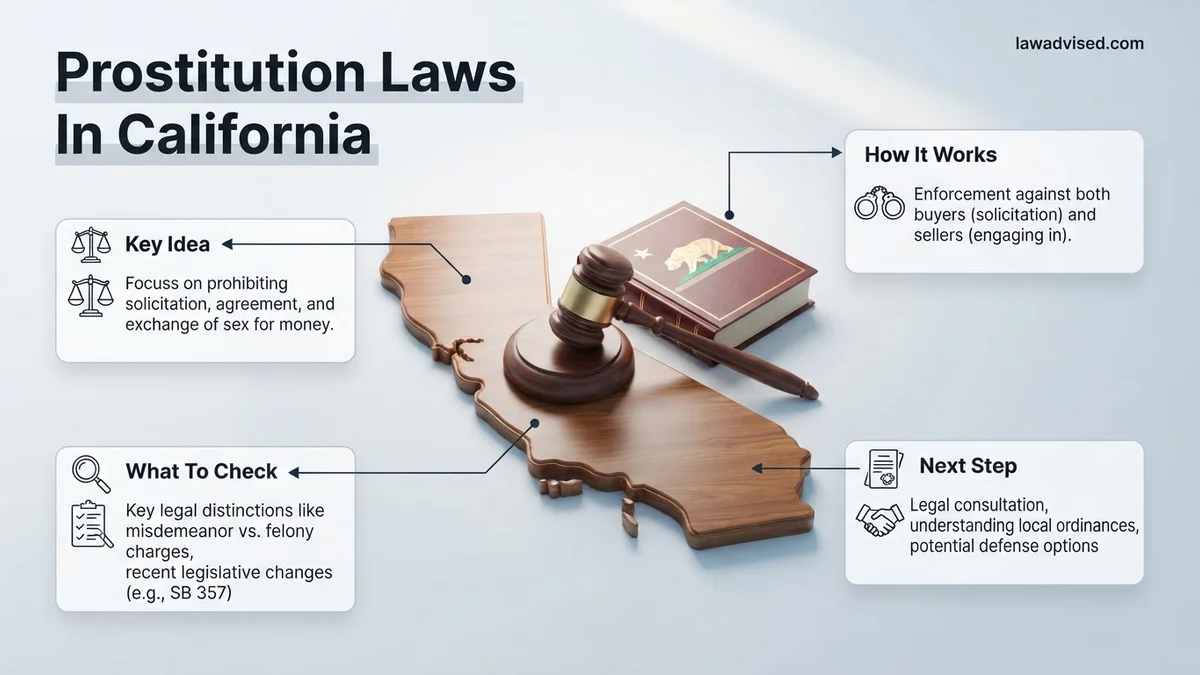
California prostitution laws center primarily on Penal Code Section 647(b), which criminalizes soliciting, agreeing to engage in, or engaging in acts of prostitution. Facing these accusations in 2027 carries severe misdemeanor or felony penalties, depending on the specific circumstances of the arrest, your prior criminal record, and whether minors were involved.
Navigating these charges requires a clear understanding of how prosecutors build their cases under state statutes. Whether you face allegations of soliciting or related offenses like pimping and pandering, knowing the precise legal definitions, statutory penalties, and recent legislative shifts helps you protect your rights.
Key Takeaways
- California Penal Code 647(b) criminalizes soliciting, agreeing to engage in, or engaging in acts of prostitution.
- Penalties typically range from misdemeanor charges to enhanced fines and mandatory community service.
- Senate Bill 357 repealed anti-loitering laws previously used to target suspected sex workers.
- Pimping and pandering remain severe felony offenses carrying lengthy prison sentences under state law.
- Diversion programs and support resources are increasingly available for victims of human trafficking.
What Causes Legal Complications Under California Prostitution Statutes
Ambiguous Behavior and Undercover Sting Operations
Most legal complications under California prostitution laws stem from undercover law enforcement operations. Police officers frequently pose as potential sex workers or clients in online sting operations, massage parlor inspections, or street-level patrols. Because solicitation charges rely heavily on verbal intent, minor misunderstandings during a conversation can easily trigger an arrest.
- Law enforcement officers often initiate the explicit discussion of exchanging money for sexual acts to secure a charge.
- Online classifieds and social media monitoring have become primary tools for prosecutors establishing a paper trail of alleged solicitation.
- Proving that an agreement actually occurred is the central hurdle for prosecutors in these cases.
Complicating Factors: Pimping, Pandering, and Minors
Simple solicitation under PC 647(b) is typically charged as a misdemeanor, but complications quickly escalate the severity of your case. If prosecutors believe you profited from someone else’s sex work or helped facilitate it, you will face felony charges. Involving a minor automatically transforms any prostitution-related allegation into a severe felony under California law, carrying mandatory state prison time.
How to Navigate PC 647(b) Charges and Legal Penalties Step-by-Step
Immediate Steps Following an Arrest
If you are arrested under California Penal Code 647(b) in 2027, your immediate actions dictate the trajectory of your defense. Law enforcement must establish probable cause that you solicited or agreed to engage in prostitution. You have the absolute right to remain silent, and you should invoke that right immediately until you secure qualified legal representation.
- Do not attempt to explain your side of the story to arresting officers without a defense attorney present.
- Request a bail hearing or explore options for release on your own recognizance based on your local county guidelines.
- Gather any communications, witness details, or electronic records that may dispute the prosecution’s version of events.
Understanding Statutory Penalties
A conviction for a first-time misdemeanor under PC 647(b) carries penalties of up to six months in county jail, fines reaching $1,000, and mandatory probation. Subsequent convictions within specific timeframes trigger mandatory minimum jail sentences. Furthermore, individuals convicted of solicitation within a designated school zone or certain public parks face enhanced mandatory minimums under updated 2027 sentencing guidelines.
What If SB 357 and Recent Legislative Changes Do Not Apply to Your Case
California’s Safer Streets for All Act (SB 357) successfully decriminalized loitering with the intent to commit prostitution. However, many individuals still face active prosecution under separate statutes. If your charges involve direct solicitation under California Penal Code Section 647(b) or human trafficking complications, the protections of SB 357 will not offer immediate dismissal.
Direct Solicitation and Pimping Charges
Defendants accused of offering or agreeing to engage in sexual acts for compensation face Penal Code 647(b) charges. These offenses remain distinct misdemeanors carrying mandatory minimum fines and potential probation terms. Legislative reforms in 2027 continue to target buyers—often referred to as “johns”—with stricter penalties, including mandatory driver’s license suspensions for vehicle-related offenses.
Prior Convictions and Enhancement Penalties
Past criminal records significantly alter how prosecutors handle modern sex trade charges in California. According to recent judicial data from the California Courts, individuals with prior misdemeanor convictions within the past five years rarely secure standard diversion programs. Enhanced sentencing guidelines often apply if the alleged conduct occurred within designated school zones or public parks.
Proven Legal Defenses and Next Steps for Resolving Solicitation Charges
Navigating a prostitution or solicitation charge in 2027 requires a strategic, evidence-based legal defense. Criminal defense attorneys utilize specific constitutional challenges to dismantle weak prosecution files before cases reach trial.
Common Defense Strategies
Entrapment serves as a primary defense when law enforcement officers use excessive persuasion or coercion during undercover operations. Defense counsel also frequently challenges lack of probable cause during initial police detainments, aiming to suppress illegally obtained confessions or digital communications under the Fourth Amendment.
- Request a formal copy of the police report and body-worn camera footage within 14 days of arraignment.
- Retain a specialized criminal defense attorney experienced in California sex crime statutes and diversion eligibility.
- Evaluate eligibility for mental health diversion under Penal Code 1001.36 if underlying trauma or substance abuse contributed to the arrest.
- Attend all mandatory court appearances to avoid bench warrants and additional criminal charges for failure to appear.
- Negotiate with the district attorney for charge reductions to non-sexual infractions or disturbing the peace.
What If It Still Doesn’t Work?
If initial defense strategies fail to secure a dismissal or favorable plea bargain, defendants must escalate their legal approach. Comprehensive post-charge management ensures minimal long-term impact on employment and housing.
- Hire a private investigator to uncover digital or testimonial evidence contradicting the arresting officer’s narrative.
- Consult specialized appellate counsel if trial court judges deny crucial suppression motions or constitutional challenges.
- Prepare for formal trial proceedings, leveraging expert testimony regarding undercover police tactics and entrapment thresholds.
- Secure specialized legal representation; private criminal defense retainers in California typically range from $3,500 to $15,000 depending on trial complexity.
- Initiate expungement or record-sealing procedures immediately following successful sentence completion or probation dismissal.
Conclusion
California prostitution laws in 2027 reflect a complex landscape of decriminalized loitering alongside strict enforcement of direct solicitation. Resolving these charges demands swift legal intervention and a thorough understanding of current statutory defenses. According to verified research and expert legal sources, proactive defense representation significantly improves case outcomes and diversion availability. Take the essential next step today by scheduling a confidential consultation with a qualified California criminal defense attorney to protect your legal rights.
❓ Frequently Asked Questions
What are the standard penalties for a first-time solicitation conviction under PC 647(b)?
A first-time conviction for solicitation is typically charged as a misdemeanor, which can carry up to six months in county jail, fines up to $1,000, and mandatory probation or educational programs.
How does California law distinguish between voluntary sex work and human trafficking?
California law strictly separates adult voluntary acts from human trafficking, with the latter involving force, fraud, coercion, or victims under the age of 18, carrying severe felony penalties.
Can a prostitution or solicitation conviction be expunged from a criminal record in California?
Yes, individuals convicted of certain prostitution-related misdemeanors may petition the court for expungement once they have successfully completed probation and satisfied all sentencing terms.
Does SB 357 legalize prostitution or solicitation in public spaces?
No, SB 357 did not legalize prostitution, solicitation, or pimping; it strictly decriminalized loitering with the intent to engage in sex work to reduce police profiling.
What diversion programs are available for individuals facing solicitation charges?
Many California jurisdictions offer specialized diversion programs, such as community courts or education classes, which allow first-time offenders to dismiss charges upon completion.
Why is legal representation critical when facing California prostitution charges?
An experienced defense attorney can evaluate potential entrapment issues, challenge insufficient evidence, and negotiate for alternative sentencing or diversion instead of jail time.

Ismail Hossain is the founder of Law Advised. He is an Divorce, Separation, marriage lawyer. Follow him.