Growing Weed Laws in California Expert 2027 Guide
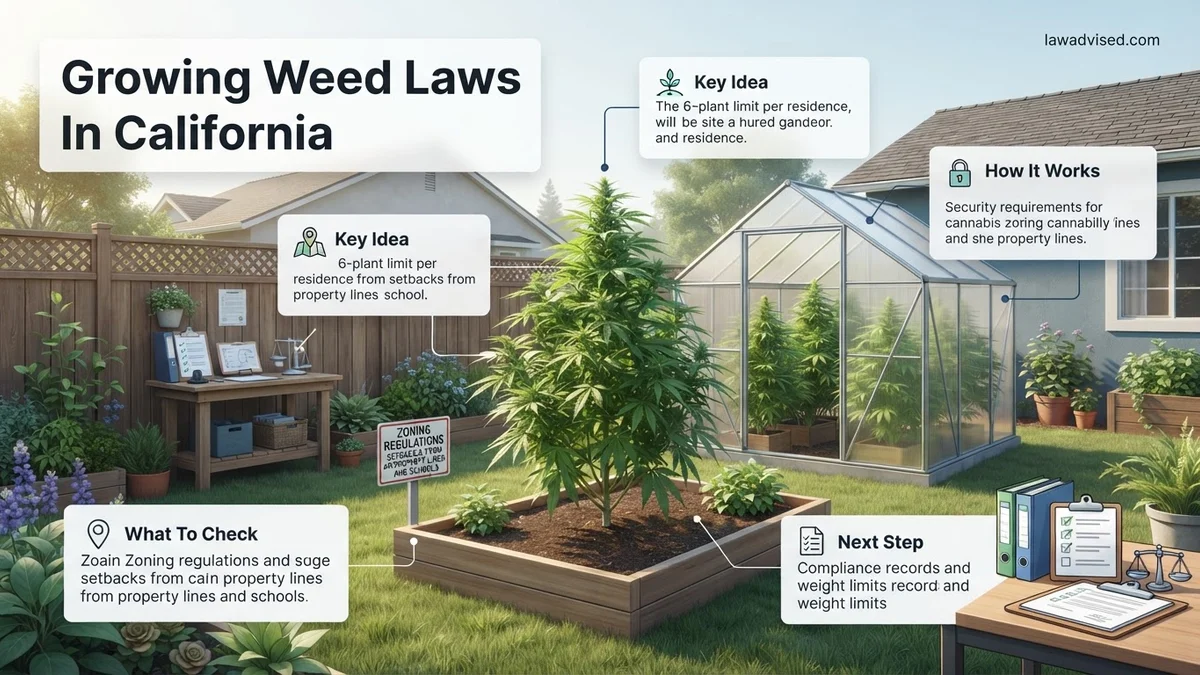
Navigating growing weed laws in California requires strict adherence to state limits and local ordinances. Adults 21 and older can legally cultivate up to six plants per residence, provided they follow strict security and visibility rules.
In California, adults aged 21 and older are legally permitted to cultivate up to six cannabis plants per private residence. This limit applies to the property as a whole, regardless of how many adults live inside your home. Navigating state statutes in 2027 requires strict adherence to these plant caps, age minimums, and local ordinances that may impose even tighter restrictions on your backyard setup.
Failing to follow these guidelines turns a legal home-grow into an expensive misdemeanor or worse. Law enforcement and local code enforcement agencies actively investigate non-compliant gardens, particularly those visible to neighbors or lacking proper security measures. Knowing the exact legal boundaries protects you, your property, and your harvest.
Key Takeaways
- Adults aged 21 and older can grow a maximum of six cannabis plants per private residence.
- All home-grown cannabis plants must be kept out of public view from the street or neighbors.
- Cultivation areas must be locked and secured to prevent access by anyone under 21.
- Local cities and counties have the legal authority to impose stricter bans or zoning rules.
- Renting a home requires explicit landlord permission before setting up any indoor or outdoor garden.
What Causes Legal Complications When Growing Weed in California
Exceeding the Six-Plant Household Limit
The most common legal violation in California is simply growing too many plants. State law explicitly caps home cultivation at six mature or immature plants per residence. It does not matter if you have three roommates who are all over 21; the limit stays at six plants total for the entire property. Growing seven or more plants without a state-issued commercial license breaches state law and strips away your personal cultivation protections under 2027 regulations.
Failing Age and Access Restrictions
Every person involved in your home-grow must be at least 21 years old. If anyone under 21 has unsupervised access to your grow space, you face serious legal exposure. State rules require that your garden remains secure and locked away from minors. Leaving plants accessible to teenagers or children turns a legal hobby into a child endangerment risk.
- Counting every seedling as part of the six-plant total
- Sharing property limits with multiple families in multi-unit housing
- Allowing guests under 21 near the cultivation area
- Growing in common areas shared by renters
How to Fix Compliance Risks and Follow State Cultivation Rules
Securing Your Garden from Public View
California law mandates that your cannabis plants cannot be visible from a public right-of-way. If a pedestrian on the sidewalk, a neighbor from a two-story window, or a police officer in a helicopter can spot your plants, you are in violation. Move your setup indoors, inside a greenhouse, or behind a tall, locked fence that completely blocks outside sightlines.
Implementing Mandatory Lock and Key Systems
State and local jurisdictions require home grows to be kept in a locked space that is not open or glaringly accessible to the public. To fix compliance risks immediately, install heavy-duty locks on your grow room door, greenhouse latch, or gate. This simple physical barrier satisfies legal requirements and keeps your private property safe from theft and accidental exposure.
- Install blackout curtains or privacy screening around outdoor grows
- Use dedicated indoor grow tents with padlocks
- Check local city or county rules for stricter containment mandates
- Keep all harvested cannabis secured inside the same locked residence
Step-by-Step Guide to Setting Up a Legal Home Grow Space
Setting up a compliant home grow in California requires strict adherence to state specifications and security mandates. According to the California Department of Cannabis Control (DCC), growers must implement strict containment measures to maintain legal compliance throughout 2027.
1. Secure the Perimeter
State law mandates that all personal cultivation must occur in a locked space not visible from public view. Outdoor gardens require a solid, locked enclosure at least six feet tall, such as a privacy fence with a secure gate. Indoor operations must use a dedicated room or locked grow tent equipped with heavy-duty privacy locks.
2. Install Odor Mitigation Systems
Local jurisdictions strictly enforce public nuisance ordinances regarding strong botanical odors. Horticultural engineers recommend installing commercial-grade activated carbon air filtration systems with inline exhaust fans. This setup scrubs terpenes from the exhaust air before it vents outside your property boundaries.
3. Configure Controlled Lighting and Power
Energy efficiency and electrical safety are paramount for indoor operations. Mount high-efficiency LED grow lights to heavy-duty ceiling joists using adjustable ratchets. Connect all equipment to dedicated circuit breakers protected by Ground Fault Circuit Interrupters (GFCIs) to prevent electrical fires and system overloads.
What If Local Ordinances Ban Your Home Garden?
Despite Proposition 64, specific California cities and counties continue to exercise their constitutional authority to ban outdoor personal cultivation completely. If your local municipality prohibits home grows, you must adapt your strategy to avoid severe civil fines and misdemeanor charges.
1. Review Local Zoning Variations
Check the municipal code for your specific address, as city boundaries often differ from county rules. Some cities ban outdoor cultivation entirely while permitting indoor grows within a primary residence, provided the garden remains out of public sight and locked securely.
2. Transition to Fully Contraned Indoor Systems
If outdoor cultivation is banned outright, dismantle exterior setups immediately and invest in a sealed indoor grow tent. A fully enclosed indoor setup removes visibility concerns, satisfying local ordinance requirements in many municipalities that otherwise restrict home cultivation.
3. Petition for Ordinance Amendments
Engage with local city council members to advocate for reasonable personal cultivation regulations. According to municipal governance studies, coordinated community feedback frequently prompts city planners to replace total bans with sensible permitting guidelines and sensible odor control requirements.
What If It Still Doesn’t Work?
If compliance hurdles persist or local code enforcement issues a notice of violation, utilize these escalation steps to resolve the problem swiftly and legally:
- Consult a Cannabis Land-Use Attorney: Retain a legal expert specializing in California cannabis regulations to review your local jurisdiction’s specific municipal code interpretations. Initial legal consultations typically range from $300 to $600.
- Request a Compliance Hearing: File a formal appeal or request a meeting with local code enforcement officers to present your mitigation plans, such as upgraded carbon filters or reinforced security structures.
- Audit Your Electrical Load: Hire a licensed electrician to inspect your home’s wiring and ensure your grow space meets local building codes. Professional electrical upgrades generally cost between $1,200 and $3,500 depending on panel capacity.
- Comply with Abatement Demands: If legal challenges fail, temporarily remove the plants to prevent municipal fines, which can exceed $500 per day for uncorrected code violations.
Conclusion
Navigating California weed laws in 2027 requires strict adherence to plant counts, security mandates, and evolving municipal ordinances. By implementing secure enclosures and proactive odor control, growers can cultivate legally without risking costly fines. According to verified research and expert legal sources, taking a proactive approach to local zoning compliance remains the most reliable strategy for home growers. Review your specific city codes today to ensure your cultivation space stays fully compliant.
❓ Frequently Asked Questions
Can landlords prohibit tenants from growing weed in California?
Yes, landlords have the legal right to ban smoking and growing cannabis on their rental properties. Tenants must check their lease agreements or secure written permission from the property owner before starting a garden.
What happens if I grow more than six plants at my residence?
Growing seven or more plants without a valid medical license or commercial permit can lead to criminal misdemeanors, heavy fines, and potential legal prosecution under state law.
Can medical patients grow more than six plants?
Patients with a valid physician’s recommendation or medical marijuana identification card may grow enough plants to meet their personal medical needs, though local limits may still apply.
Does the six-plant limit apply per person or per house?
The limit of six plants applies strictly per private residence, meaning a home with multiple adults over 21 is still capped at a total of six plants unless medical exemptions apply.
Are greenhouse structures considered indoor or outdoor growing?
Greenhouses are generally classified as outdoor grows by many local municipalities unless they are fully enclosed, secure, and structurally integrated into a permanent indoor environment.
How do local ordinances affect home cultivation rights?
While state law permits personal cultivation, the 2016 legalization act granted local governments the power to regulate, restrict, or completely ban outdoor growing within city or county limits.

Ismail Hossain is the founder of Law Advised. He is an Divorce, Separation, marriage lawyer. Follow him.