Holiday Pay Laws in California 2027 Expert Guide
Under California labor standards, employers are not legally required to provide paid holidays, holiday closures, or premium pay for working on holidays. Standard overtime rules only apply if working on a holiday exceeds daily or weekly hour thresholds.
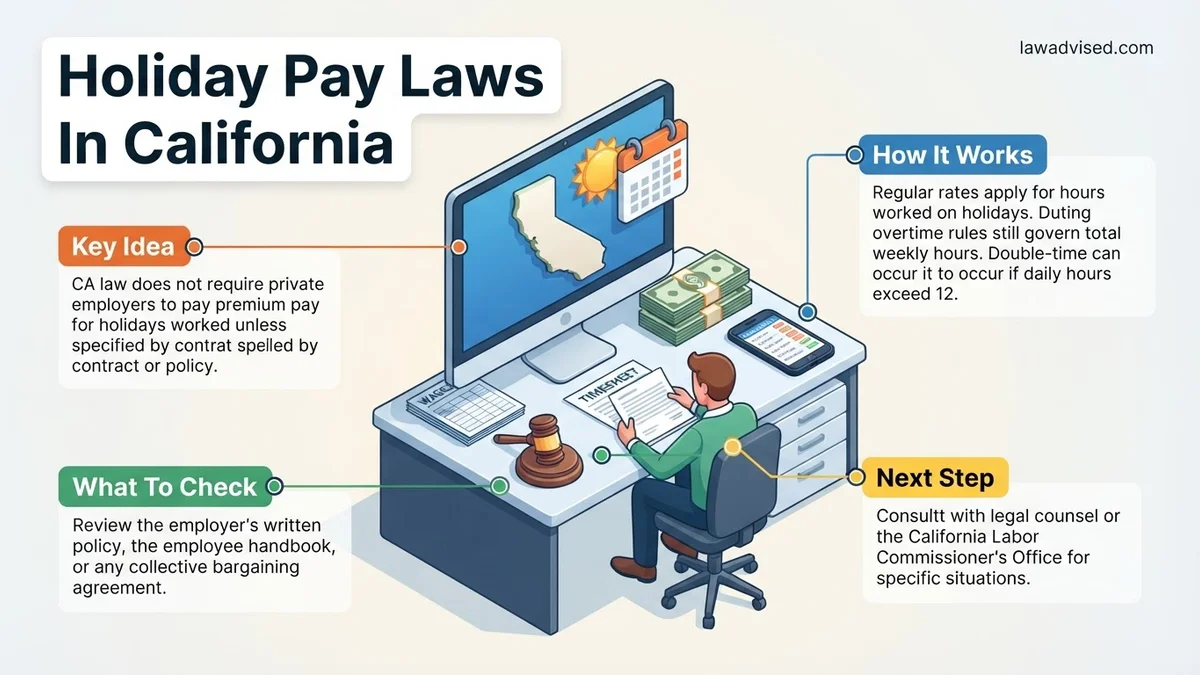
California law does not require private employers to give employees paid time off for holidays, holiday closures, or premium pay like time-and-a-half for working on holidays like Christmas, Thanksgiving, or New Year’s Day. If your business operates on a holiday in 2027, you can legally pay your staff their standard, regular hourly rate or salary without any extra statutory penalty.
Navigating holiday scheduling causes immense friction between employers and workers every year. Knowing the exact state boundaries prevents costly wage claims while helping you structure competitive benefits packages to attract top talent in a modern market.
Key Takeaways
- California law does not mandate paid holidays for private-sector employees.
- Working on a holiday does not automatically trigger time-and-a-half pay.
- Standard overtime rules apply if holiday hours push staff past 8 daily hours.
- Voluntary employer holiday policies become legally binding employment contracts once established.
- Union collective bargaining agreements often dictate specific holiday pay requirements.
What Causes Confusion About Holiday Pay Laws in California
The Myth of Mandatory Holiday Premiums
Many workers and managers assume that federal or state holidays automatically trigger premium pay rates. Popular media, federal contractor rules, and collective bargaining agreements heavily blur these lines. In reality, California treats holidays like any other standard calendar day. Unless a private employer voluntarily establishes a written holiday policy or enters into a binding union contract, working on a major holiday requires zero extra compensation under California labor code.
Federal vs. State Labor Rules
Another major source of confusion stems from government calendars. Federal employees and workers in specific government sectors enjoy strict holiday protections. Private sector employees often mistakenly believe these rules apply universally across the state. Furthermore, some employers confuse standard overtime triggers with holiday mandates. Because holiday myths run deep, clear communication regarding your company policy avoids grievances and keeps expectations aligned.
- Federal holiday schedules do not dictate private sector pay mandates.
- State labor commissioners receive thousands of inquiries every November regarding mandatory Thanksgiving pay.
- Private companies retain complete autonomy over holiday operational decisions.
How to Determine If You Qualify for Holiday Pay
Reviewing Company Policies and Employment Contracts
Since California state law offers zero mandates for holiday pay, your entitlement depends entirely on internal company documentation. Check your employee handbook, offer letter, or written personnel policies for a dedicated holiday section. Employers who promise paid holidays in writing become legally obligated to honor those terms. If your employee handbook promises time-and-a-half for working on Labor Day, that internal policy functions as an enforceable contract.
The Overtime Intersection Rule
Even though holiday work does not automatically trigger premium pay, standard California overtime rules still apply 365 days a year. If working on a holiday pushes an employee past 8 hours in a single workday, or past 40 hours in a standard workweek, traditional overtime rates take effect. For 2027, calculating daily and weekly thresholds remains critical during peak holiday retail seasons.
- Standard overtime requires time-and-a-half for hours worked beyond 8 in a day.
- Double-time applies to all hours worked past 12 in a single workday.
- Holiday shifts that trigger these hourly thresholds must be paid at the elevated overtime rate.
How to Apply Standard Overtime Rules to Holiday Shifts
Working on a holiday often triggers extended hours, making the interplay between holiday pay and overtime rules crucial for California employers and employees in 2027. Under California Labor Code Section 510, standard overtime mandates time-and-a-half pay for hours worked beyond eight in a workday or forty in a workweek, plus double-time for hours exceeding twelve in a single day.
Calculating Premium Rates for Overtime Holidays
- Determine if the employer voluntarily offers premium holiday pay, such as time-and-a-half for the holiday itself.
- Add any contractual holiday premium to the regular hourly rate before calculating statutory overtime, depending on the specific collective bargaining agreement or employment contract terms.
- Apply California’s mandatory daily overtime multiplier of 1.5x or 2.0x to the newly established base rate if the employee exceeds daily hour thresholds.
According to compliance data from the California Department of Industrial Relations (DIR), failure to properly compound holiday premiums with standard overtime rates accounts for millions of dollars in wage and hour violations annually.
What If Your Employer Violates Established Holiday Policies
When an employer fails to pay promised holiday wages or miscalculates legally mandated overtime during a holiday shift, workers have structured legal recourse available under state labor laws.
Steps to Recover Unpaid Holiday Wages
- Review internal company handbooks, employment contracts, and pay stubs to document the exact discrepancy between hours worked and compensation received.
- Submit a formal written inquiry to the human resources or payroll department outlining the specific pay violations under California 2027 labor guidelines.
- File a formal wage claim online or by mail with the California Labor Commissioner’s Office (Division of Labor Standards Enforcement) if the employer refuses to correct the error.
- Consult an experienced California employment attorney for civil litigation options, particularly if the violation impacts a broader group of workers.
Legal representation for wage claims typically involves contingency fees ranging from 33% to 40% of the recovered amount, though statutory provisions often require employers to pay attorney fees for successful wage claims.
What If It Still Doesn’t Work?
If internal resolution attempts and initial state filings do not yield the correct holiday pay adjustments, employees must escalate the matter to protect their financial rights. Consider these advanced fallback steps:
- Request a formal audit of your entire payroll history for the past three years through the California Labor Commissioner’s Office, which covers the state’s statutory recovery window.
- File a complaint with the federal Wage and Hour Division of the U.S. Department of Labor if interstate commerce factors apply to your specific employment classification.
- Engage a private employment law specialist to issue a formal demand letter, which often accelerates settlement negotiations outside of court. Private consultations generally cost between $250 and $500 for an initial review.
- Join or initiate a class-action lawsuit if multiple coworkers experienced identical holiday pay violations, maximizing leverage against systemic corporate non-compliance.
Conclusion
Navigating holiday pay laws in California requires a clear understanding of the distinction between voluntary employer policies and mandatory overtime statutes. While state law does not force businesses to pay extra for holiday shifts, any promised holiday compensation or resulting overtime must be strictly paid according to California Labor Code standards. According to verified research and expert sources from the California DIR, proactive payroll auditing remains the single most effective defense against costly wage disputes. Take the actionable next step today by reviewing your recent holiday pay stubs against state overtime thresholds to ensure absolute compliance.
❓ Frequently Asked Questions
Are federal holidays considered mandatory paid days off in California?
No, federal and state holidays like Christmas or Thanksgiving carry no legal requirement for private businesses to provide paid time off or holiday closures.
Can my employer make me work on a holiday without extra pay?
Yes, unless you are covered by a specific employment contract or union agreement that dictates otherwise, employers can require holiday work at standard pay rates.
Do public sector employees have different holiday rules in California?
Yes, government and public sector workers often have specific holiday pay structures and closures mandated by civil service rules or public employee unions.
How does California calculate overtime if I work a holiday?
Holiday hours count toward your total hours worked, meaning standard overtime rules apply if you exceed 8 hours in a single workday or 40 hours in a workweek.
What recourse do I have if my employer fails to follow their own holiday pay policy?
If an employer promises holiday pay in a written contract or handbook and fails to deliver, you can file a wage claim with the California Labor Commissioner’s Office.
Does working on a weekend holiday change the legal requirements?
Weekend holidays follow the exact same state guidelines as weekday holidays, meaning premium pay is still strictly a matter of company policy rather than state mandate.

Ismail Hossain is the founder of Law Advised. He is an Divorce, Separation, marriage lawyer. Follow him.