Infidelity Laws in California The Real Guide for 2027
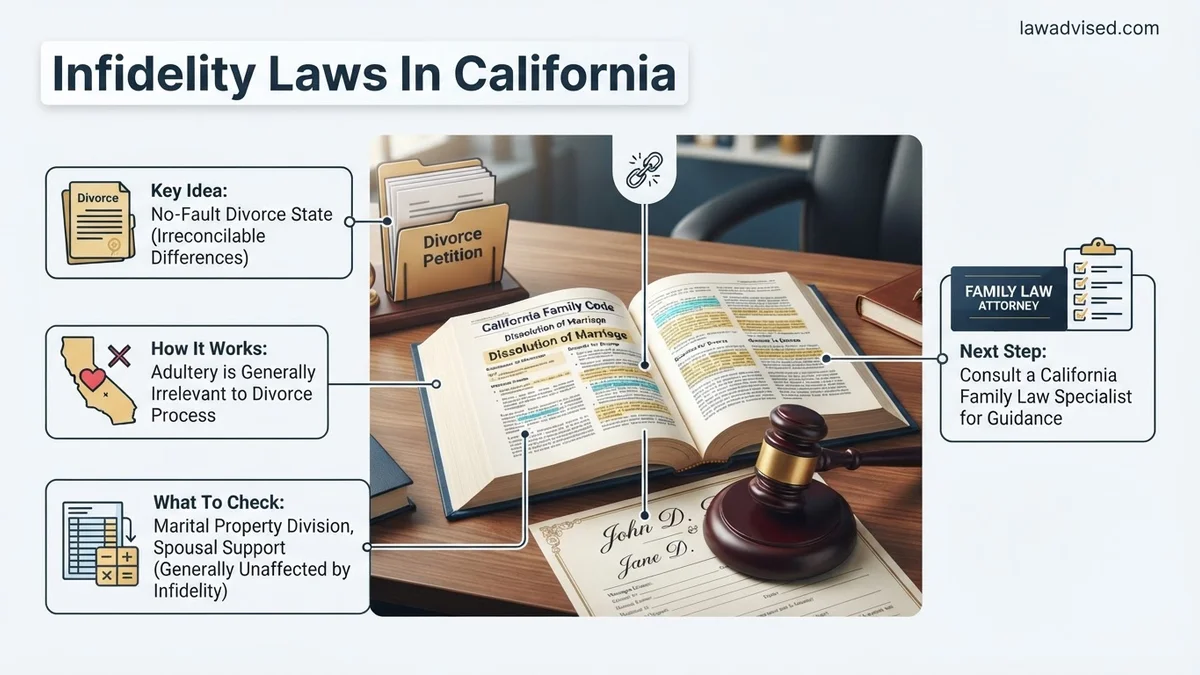
California is a pure no-fault divorce state, meaning adultery generally has no legal bearing on the dissolution of marriage or the 50/50 division of community property. However, cheating can indirectly impact your divorce if marital funds were spent to finance the affair. This guide breaks down the exact legal realities, financial exceptions, and custody rules.
California is a pure no-fault divorce state, meaning adultery will not grant you a larger share of the community property or change the legal grounds for ending your marriage. When you file for divorce in 2027, the family court does not care why the marriage broke down, only that irreconcilable differences exist.
This strict no-fault framework shapes every aspect of property division and spousal support. However, while cheating itself carries zero legal penalty in California family courts, the financial choices surrounding that affair often trigger severe legal consequences that can cost your cheating spouse dearly.
Key Takeaways
- California does not consider adultery a crime or legal fault in divorce filings.
- Community property and debts are strictly divided 50/50 regardless of marital misconduct.
- Spending joint funds on an affair breaches fiduciary duty and requires financial reimbursement.
- Infidelity alone does not strip a parent of child custody rights unless child welfare is harmed.
- Cheating rarely impacts spousal support unless it directly depleted marital assets.
What Causes Financial Penalties During Infidelity in California
Even though the act of adultery is legally ignored, the expenses tied to an affair frequently cross legal lines. Spouses often spend marital assets to sustain their secondary relationships, which directly violates California family law.
Misuse of Community Funds
All earnings and property acquired during marriage belong equally to both spouses as community property. When one partner uses these shared funds to finance an affair, legal trouble begins.
- Paying for hotel rooms, luxury trips, or romantic dinners using joint bank accounts.
- Buying expensive jewelry, clothing, or electronics for a paramour.
- Gifting shared assets, vehicles, or real estate to an affair partner.
- Funding a separate apartment or living expenses for the third party.
Breach of Fiduciary Duty
California law imposes a strict fiduciary duty between spouses, requiring the highest standard of good faith and fair dealing. Spending shared money on an affair is treated as a literal theft of community assets, allowing the court to intervene financially during your 2027 divorce proceedings.
How to Prove and Fix Breach of Fiduciary Duty in Divorce
If you suspect your spouse drained marital funds to finance an affair, you cannot simply make accusations in court. You must track the money and prove the financial waste to recover your rightful share.
Uncovering Hidden Financial Waste
Proving a breach of fiduciary duty requires meticulous financial discovery. Family law attorneys use subpoenas and forensic accountants to expose hidden spending.
- Reviewing joint credit card statements for recurring charges at restaurants, hotels, or rideshares.
- Auditing bank transfers, ATM withdrawals, and hidden digital wallet transactions.
- Analyzing tax returns and corporate filings if business assets were diverted.
- Requesting cell phone records or travel itineraries to match suspicious financial outflows.
The 100% Recompense Remedy
Under California Family Code Section 1101, if the court finds that your spouse deliberately squandered community assets on an affair, you are entitled to a specific financial remedy. Instead of the standard 50/50 split, the court can award you 100% of the asset’s value—or a matching offset from your spouse’s share of the remaining property.
Step-by-Step Guide to Protecting Assets During a No-Fault Divorce
Even though California law ignores marital misconduct when dividing property, you can still take strategic steps to safeguard your financial future in 2027. Protecting your assets requires a methodical approach to documentation and legal compliance.
1. Conduct a Comprehensive Financial Audit
Gather every financial document available before initiating divorce proceedings. According to certified divorce financial analysts, hidden assets account for a significant percentage of contested separations. Secure tax returns, bank statements, retirement accounts, and credit card records immediately.
2. Monitor Post-Separation Spending
California family law strictly prohibits the waste of community assets, legally known as “waste” or “breach of fiduciary duty.” If your spouse spent marital funds on an affair partner—such as expensive hotel rooms, trips, or gifts—you can seek reimbursement. Under California Family Code Section 1101, a court can award you 50% or even 100% of the asset value mismanaged or wasted on a paramour.
3. Retain Specialized Forensic Experts
Hire a certified forensic accountant if you suspect your spouse is hiding marital funds to fund an affair or preparing for a split. Forensic accountants trace complex digital transactions and uncover dissipated community property with high accuracy rates.
What If It Still Doesn’t Work?
If direct negotiations fail and your spouse refuses to cooperate with asset disclosures or financial settlements, you must take stronger legal action. Implement these fallback steps to regain control of your case:
- File a Motion to Compel: If your spouse withholds financial documents, request a court order compelling full disclosure. Courts heavily penalize parties who violate mandatory disclosure laws.
- Request Temporary Spousal Support Orders: Secure financial stability during the litigation process by filing for temporary support and attorney fees under California Family Code Section 2030.
- Engage a Private Mediator or Judge Pro Tem: Bypass overcrowded family court dockets by hiring a private judge. Private resolution typically costs between $5,000 and $15,000 but resolves complex asset disputes months faster than public courts.
- Seek Immediate Legal Representation: Retain a certified family law specialist if litigation becomes unavoidable. Full legal representation in contested California divorces ranges from $15,000 to over $40,000 depending on asset complexity.
Conclusion
Navigating a separation complicated by infidelity in California requires looking past the emotional betrayal to focus strictly on legal and financial realities. Because California operates entirely as a no-fault state in 2027, investing your energy into proving marital misconduct will not yield a larger property share, but tracking the financial waste of community funds certainly will. According to verified research and family law experts, maintaining a methodical, evidence-based approach to asset division produces the best long-term financial outcomes. Your next actionable step is to schedule a confidential consultation with a certified California family law attorney to review your financial disclosures and protect your estate.
❓ Frequently Asked Questions
How does California’s no-fault divorce law apply to infidelity?
California Family Code establishes that divorces are granted based on irreconcilable differences. This means you do not need to prove adultery to get a divorce, and a spouse’s cheating will not be used to punish them in the standard division of assets.
What happens if community funds were used to finance an affair?
While the divorce itself remains no-fault, using joint marital funds to support a paramour is a breach of fiduciary duty. Under California law, the betrayed spouse can request a ‘reimbursement claim’ to recover half of the wasted community assets.
Can text messages or proof of cheating be used in a California court?
Proof of infidelity is rarely admissible or relevant for property division or support. However, digital evidence like texts or bank statements can become crucial if you are tracking down hidden assets or financial waste tied to the affair.
Does cheating influence the length or amount of spousal support?
No, California courts focus on financial need, the standard of living during the marriage, and the ability to pay when calculating alimony. Infidelity is explicitly excluded as a factor in determining spousal support amounts.
Will a cheating spouse automatically lose custody of their children?
Judges evaluate the ‘best interest of the child’ in custody determinations, which centers on parenting capability and a stable home environment. An affair alone does not make someone an unfit parent unless the children were directly neglected or exposed to harm.
Should I hire a private investigator to prove infidelity in California?
Because California is a no-fault state, hiring a private investigator is rarely useful for the divorce proceedings themselves. The cost of an investigator usually outweighs any legal benefit, unless you are actively searching for hidden marital assets or financial dissipation.

Ismail Hossain is the founder of Law Advised. He is an Divorce, Separation, marriage lawyer. Follow him.