
Occupancy Laws in California 2027 A Proven Guide for Tenants
Navigating occupancy laws in california requires understanding both state baseline limits and strict local municipal ordinances. Landlords and tenants must follow specific rules regarding bedroom capacity, square footage, and over-crowding regulations to maintain legal compliance.
California residential occupancy limits are fundamentally governed by the Uniform Housing Code standard, which typically permits two persons per bedroom plus one additional occupant. For example, a standard two-bedroom rental unit legally accommodates up to five residents, regardless of their familial relationship.
Navigating these rules in 2027 requires understanding both state baselines and local municipal codes. Ignoring these thresholds exposes tenants to sudden lease terminations, while landlords risk severe municipal fines for overcrowding violations.
Key Takeaways
- California generally follows the ‘2 + 1’ rule for bedroom occupancy limits.
- Local city ordinances often set stricter tenant limits than the state baseline.
- Habitable rooms require minimum square footage and natural light standards.
- Newborns are typically exempt from standard maximum occupancy calculations.
- Landlords cannot use arbitrary occupancy caps to discriminate against families.
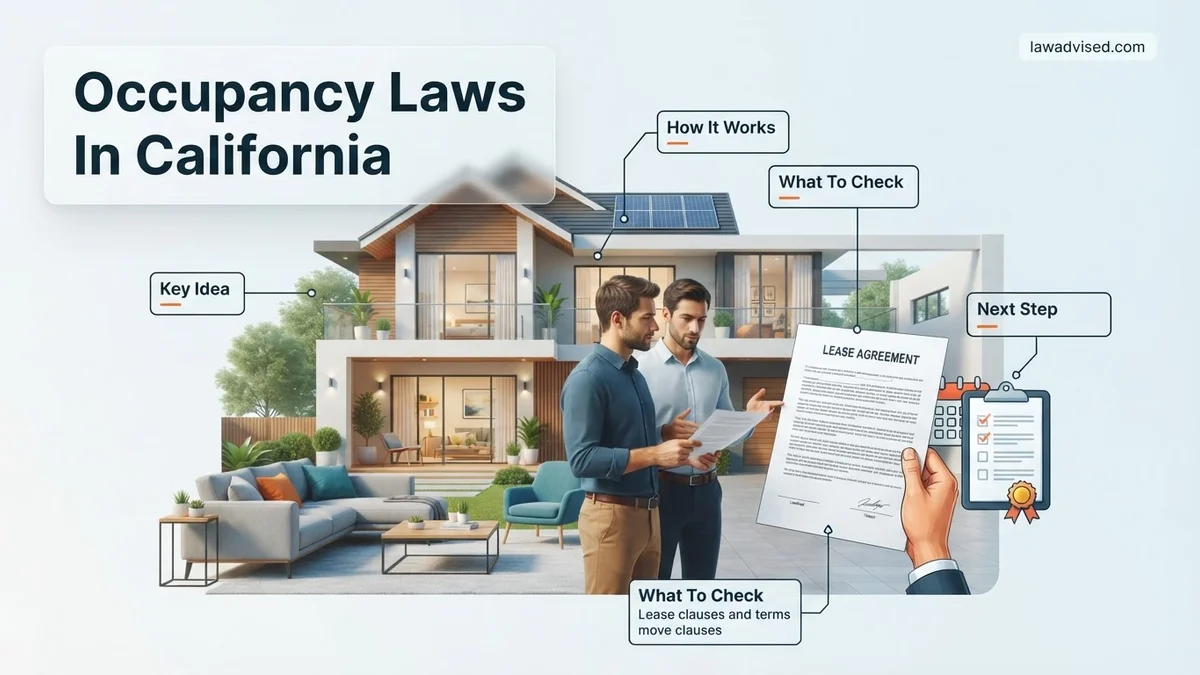
What Causes Overcrowding Violations and Legal Disputes in California
The Uniform Housing Code Formula and Square Footage Requirements
Landlords and municipal code enforcement officers rely heavily on standard head-count ratios and room sizes. Under the standard California formula, a sleeping room must generally provide at least 70 square feet of floor space for the first occupant, and an additional 50 square feet for each subsequent occupant. If your rental unit violates these minimum square footage thresholds, you face an overcrowding citation even if you stay under the two-per-bedroom plus one limit.
Unapproved Subletting and Unauthorized Guests
Most occupancy disputes in 2027 stem from unauthorized roommates or long-term guests. If a guest stays past the threshold defined in your lease—typically 14 consecutive days or 30 total days in a calendar year—landlords can claim you are violating occupancy terms. Bringing in a subtenant without written consent instantly triggers lease default procedures, even if the total head count technically fits within legal square footage limits.
How to Fix and Verify Rental Occupancy Compliance Step-by-Step
Reviewing Your Lease Agreement Against Municipal Codes
Start by auditing your current lease agreement and measuring the exact square footage of your bedrooms. Keep in mind that local California cities often enforce stricter rules than the state baseline. For instance, cities like Los Angeles or San Francisco maintain unique housing ordinances that may factor in habitable space configurations differently than suburban counties. Always cross-reference your lease terms with your local city housing department guidelines for 2027.
- Measure the total square footage of all designated bedrooms
- Check local municipal codes for stricter city-level occupant caps
- Review guest policy clauses to prevent accidental lease violations
Correcting Overcrowding and Negotiating with Landlords
If your household currently exceeds legal occupancy limits, you must take proactive steps before a formal inspection occurs. Communicate openly with your landlord if family changes have increased your head count. You can request a lease addendum, evaluate larger units within the same property management portfolio, or transition excess occupants out of the unit to restore full legal compliance.
- Calculate your exact current room-to-occupant ratio
- Identify any guests exceeding temporary stay limitations
- Consult with a local tenants rights organization if facing unfair eviction threats
What If Local Municipal Codes Conflict With State Housing Guidelines
Navigating California housing regulations often reveals a complex interplay between state mandates and local municipal ordinances. Under the California Housing Element law, state statutes set a strict baseline for habitability and anti-discrimination. However, cities like Los Angeles, San Francisco, and Oakland frequently enforce stricter tenant protection ordinances. When local occupancy limits contradict broader state standards, legal experts look to specific preemption doctrines to determine which rule applies.
Understanding the Supremacy of Stricter Tenant Protections
Generally, California state law establishes minimum floors for tenant rights rather than maximum ceilings. If a municipal code provides greater protection against overcrowding or arbitrary eviction than state guidelines, the local ordinance usually prevails. Conversely, local laws that attempt to weaken state-mandated habitability standards or override uniform building codes are rendered invalid. Tenants in 2027 must examine both the California Civil Code and their specific city municipal codes before signing a lease or challenging an occupancy notice.
Analyzing Square Footage Versus Uniform Building Codes
State housing guidelines heavily rely on the Uniform Housing Code standards, requiring at least 150 square feet for the first occupant in a residential room and an additional 100 square feet for every subsequent occupant. Local building departments, however, may factor in historical district rules, seismic retrofitting limits, or local infrastructure capacity. When a landlord cites a local code to restrict occupants, tenants have the right to request the specific municipal statute in writing. Reviewing these documented metrics ensures that landlords cannot arbitrarily invent occupancy limits to bypass rent control or eviction protections.
Proven Steps to Resolve Landlord and Tenant Occupancy Disagreements
Resolving disputes over guest policies, familial additions, or unit capacity requires a structured, documented approach. Escalating a conflict emotionally often leads to unlawful lockouts or retaliatory rent increases. Tenants must rely on legal protocols and administrative frameworks to achieve a binding resolution.
- Review the Lease and Local Ordinances: Examine the original lease agreement for specific clauses regarding overnight guests, subtenant policies, and maximum headcounts. Cross-reference these clauses with current 2027 municipal tenant protection guidelines.
- Draft a Written Communication: Issue a formal, written notice to the landlord citing applicable housing codes, such as the California Civil Code or local rent board regulations, clarifying the legal status of the occupants.
- File a Complaint with the Local Housing Board: If the landlord refuses to cooperate or issues an illegal notice to vacate, submit a formal grievance to the city housing department or local rent stabilization board for mediation.
- Engage Legal Aid Services: Contact a regional tenants’ rights organization or legal aid clinic to review the case file and issue a formal attorney letter if landlord harassment persists.
What If It Still Doesn’t Work?
If direct communication and initial municipal filings fail to resolve an occupancy dispute, tenants must pursue formal legal intervention. Attempting to withhold rent independently without court approval can jeopardize tenancy rights under California law.
- Consult a Tenant Rights Attorney: Schedule a formal consultation with a specialized housing lawyer to evaluate potential claims for wrongful eviction or harassment. Initial legal consultations typically range from $150 to $350.
- File a Civil Lawsuit for Injunctive Relief: If the landlord attempts an illegal lockout or shuts off utilities, petition the superior court for an emergency injunction. Court filing fees for civil motions generally range from $60 to $450, though fee waivers are available for qualifying low-income households.
- Report Code Violations to Local Building Inspectors: Request an official inspection from the local department of building safety if the landlord uses overcrowding claims as a pretext to avoid making necessary structural repairs.
- Utilize State Mediation Programs: Engage state-sponsored dispute resolution services designed specifically for landlord-tenant conflicts to negotiate a legally binding settlement outside of trial.
Conclusion
Occupancy laws in California balance property management rights with essential tenant protections against overcrowding and discrimination. By understanding state minimum standards, local municipal codes, and formal dispute resolution steps, tenants can successfully protect their housing stability. The most actionable next step is to obtain a written copy of local housing ordinances from the municipal rent board if an occupancy dispute arises. According to verified research and expert housing sources, proactive documentation remains the single most effective defense against unlawful landlord actions in the California rental market.
❓ Frequently Asked Questions
How do California occupancy laws apply to family size and children?
Housing providers cannot enforce arbitrary occupancy caps that intentionally discriminate against families with children under the Fair Housing Act. However, safety-based limits tied to square footage and bedroom counts remain legally enforceable.
What happens if a rental unit violates local occupancy codes?
Both landlords and tenants can face legal notices, fines, or mandatory cure-or-quit orders from municipal code enforcement agencies if a unit exceeds legal occupancy thresholds.
Can landlords restrict the total number of occupants regardless of bedroom size?
While landlords can set reasonable occupancy standards, they must align with the state’s baseline habitability formulas and cannot set rules designed solely to exclude specific demographics.
How are living rooms and dens counted under California occupancy laws?
Living rooms are generally considered habitable spaces, but municipal codes strictly regulate whether they can be utilized as permanent sleeping areas based on egress and ventilation.
What recourse do tenants have against retaliatory occupancy complaints?
Tenants are protected under California law from retaliatory evictions if a landlord attempts to penalize them for exercising their legal housing rights or reporting code violations.
Are there differences between affordable housing and market-rate occupancy rules?
Yes, subsidized or affordable housing programs often carry strict federal and state household size restrictions tied directly to funding compliance and unit AMI limits.

Ismail Hossain is the founder of Law Advised. He is an Divorce, Separation, marriage lawyer. Follow him.