Auto Repair Laws in California Expert 2027
Under California law, auto repair shops must provide written estimates before beginning any work and cannot exceed that price without your explicit authorization. Navigating the Automotive Repair Act protects you from unauthorized charges, hidden fees, and fraudulent practices enforced by the Bureau of Automotive Repair.
California law gives you strict legal rights that prohibit auto repair shops from performing unauthorized work or charging you a single penny over your agreed estimate without explicit consent. Regulated by the Bureau of Automotive Repair (BAR) under the Business and Professions Code, every licensed shop in 2027 must follow rigid rules regarding written estimates, parts returns, and itemized billing.
Knowing these rules protects you from predatory garage practices, inflated repair bills, and held-hostage vehicles. When a shop violates these legal consumer protections, you hold the power to dispute the charges, demand refunds, or file a formal state citation that can suspend their operating license.
Key Takeaways
- Shops must give you a signed written estimate before starting any diagnostic or repair work.
- Unauthorized repairs are illegal, and you generally do not have to pay for them.
- Shops cannot charge more than the estimated price without getting your prior consent.
- You have the legal right to inspect your replaced parts upon request.
- The Bureau of Automotive Repair handles disputes and investigates shady repair practices.
What Causes Consumer Disputes Under California Auto Repair Laws
The Mandatory Written Estimate Violation
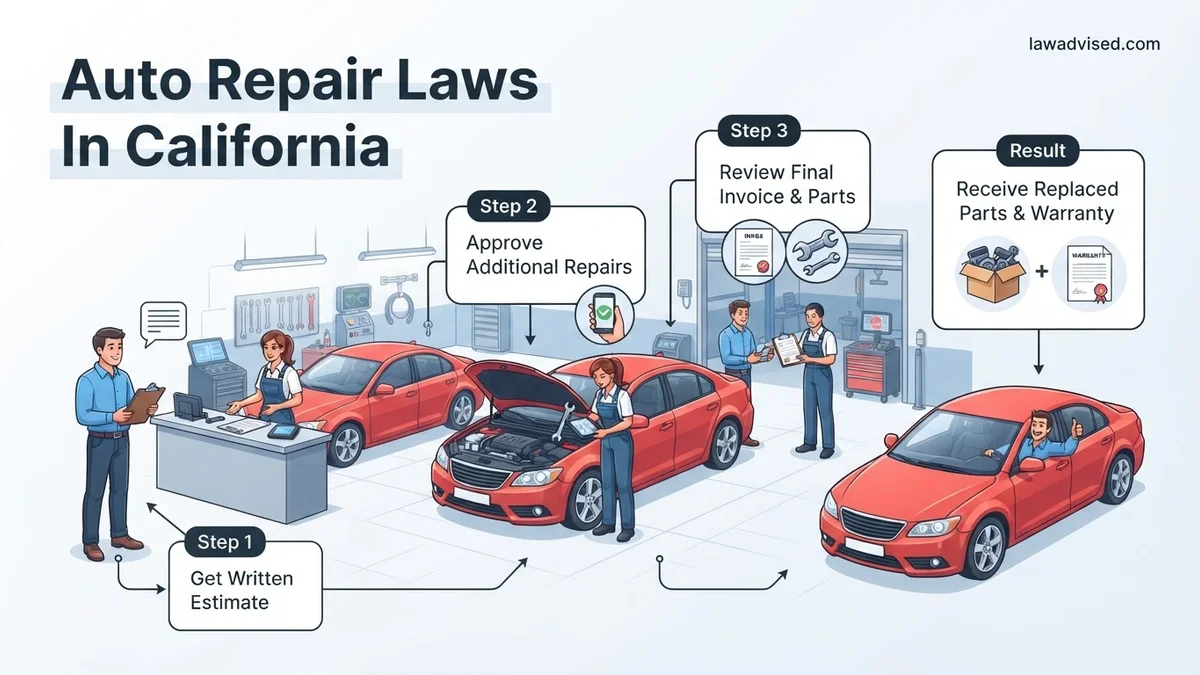
By California law, a repair facility cannot start working on your car until they give you a clear, written estimate detailing the exact parts and labor costs. Verbal agreements hold zero legal weight in a BAR dispute. If a shop diagnoses your vehicle and begins tearing down the engine or replacing brakes without handing you a physical or digital document that you signed, they are operating illegally.
- Shops must record your vehicle’s odometer reading and exact complaint on the estimate.
- They cannot charge you for storage or diagnostic fees unless you were notified in advance.
- You have the right to request a price ceiling before they touch your vehicle.
Exceeding the Estimate Without Authorization
The number one trigger for legal disputes is the surprise phone call where a shop claims they found additional damage and demands hundreds of dollars more. Under California regulations, if the final cost exceeds your written estimate, the shop must stop immediately. They cannot legally charge you for the extra work or parts unless you give explicit oral or written consent to raise the limit.
- If they complete unauthorized repairs, you are legally entitled to receive that work for free.
- Shops must document who authorized the price increase, the date, and the telephone number called.
- Ignoring this rule can result in the shop losing their Bureau of Automotive Repair license.
California Auto Repair Laws Made Easy: Your Essential Action Plan
Navigating the complex landscape of automotive repair regulations in the Golden State can feel overwhelming, but understanding your rights protects your wallet and ensures quality service. California enforces some of the strictest consumer protection laws in the nation through the Bureau of Automotive Repair (BAR). This comprehensive guide walks you through every phase of a legal, transparent repair process, from authorizing initial diagnostics to resolving disputes, empowering you to handle any mechanic interaction like an experienced professional.
Step 1: Verify the Shop’s Automotive Repair Dealer License
What you need: A smartphone or computer with internet access, and the physical address or name of the auto repair facility.
Instructions: Before you hand over your keys or authorize any work, you must legally verify that the facility is registered with the California Bureau of Automotive Repair. Visit the official BAR website or use their mobile verification tools to search the shop’s name or license number. Every legitimate automotive repair dealer in California is required by law to display a valid BAR sign prominently on their premises and hold an active, unrevoked license. If a shop operates without this license, they are breaking the law, and you should take your vehicle elsewhere immediately.
Pro Tip: Never rely solely on online reviews or word-of-mouth; checking the official BAR database will also reveal if the shop has any active disciplinary actions or consumer complaints against them.
Step 2: Insist on a Written Estimated Cost
What you need: Your vehicle, a pen, and the shop’s intake desk.
Instructions: Under California law (Business and Professions Code Section 9884.9), a repair facility cannot legally begin any work or charge you a single penny without first giving you a written estimated price for labor and parts. This estimate must be presented to you before the work starts, and it must include a detailed breakdown of the specific repairs needed. The shop is legally prohibited from charging you anything above this estimated amount without your explicit oral or written consent. If they attempt to perform unauthorized repairs, you are under no legal obligation to pay for them.
Pro Tip: Always ensure the written estimate includes a specific breakdown of diagnostic fees, as shops cannot charge you an open-ended diagnostic fee without prior notification and consent.
Step 3: Understand Your Right to Authorize Extra Charges
What you need: Your phone to remain accessible, and your original written estimate document.
Instructions: Once teardown or diagnostics begin, technicians frequently discover additional hidden problems. If the final cost of the repairs is going to exceed your original written estimate, California law requires the shop to stop working and contact you immediately. They must obtain your explicit authorization—either verbally (which they must document with date, time, and your name) or in writing—before proceeding with any additional labor or parts replacement. If they perform unauthorized extra work and try to bill you for it upon pickup, you have the legal right to refuse payment for those specific unapproved charges.
Step 4: Request the Return of Replaced Parts
What you need: A large plastic tote or box, and your original repair order invoice.
Instructions: California law grants you the absolute right to demand the return of all replaced parts, components, or fluids removed from your vehicle during the repair process. You must make this request before the work begins or at the time you authorize the estimate. Inspecting your old parts provides physical proof that the repairs were actually necessary and performed. There are only two legal exceptions: parts that must be returned to a manufacturer or distributor under a warranty or core exchange program (in which case you still have the right to inspect the core part before it leaves the shop) or parts that are deemed hazardous waste.
Pro Tip: Even if you do not plan to keep the old parts, always request them on your initial paperwork, as this deters dishonest shops from billing you for parts they never actually changed.
Step 5: Review the Final Itemized Invoice
What you need: Your payment method, reading glasses, and a clear understanding of the completed work.
Instructions: When you return to pick up your vehicle, the shop is legally required to provide you with a clear, legible, itemized final invoice. This document must separately list every single part installed (distinguishing between new, used, rebuilt, or reconditioned components), the exact labor charges, the technician’s hourly rate or flat-rate breakdown, and subcodes or taxes. Carefully compare this final invoice against your original written estimate and any subsequent authorized add-ons. Verify that the mileage out matches your odometer and that all promised warranties are explicitly printed on the page.
Step 6: Leverage the BAR Complaint Process for Disputes
What you need: All copies of estimates, invoices, text messages, and receipts related to the disputed repair.
Instructions: If you find yourself in a genuine dispute with a repair facility—such as being overcharged without consent, receiving shoddy workmanship, or having your vehicle held hostage—do not resort to shouting matches. Instead, utilize the official state dispute mechanism. File a formal consumer complaint online or via mail with the California Bureau of Automotive Repair. A BAR representative will step in as a state-certified mediator to investigate the shop’s practices, review documentation, inspect the vehicle, and facilitate a binding resolution or potential refund if the shop violated state automotive laws.
Pro Tip: Keep a meticulously organized paper trail of every interaction, phone call log, and document, as this evidence is crucial for the BAR investigator to rule in your favor.
✅ Final Checklist
- Verified the repair facility holds an active, valid BAR license displayed on-site and online
- Obtained and signed a written, itemized cost estimate before any diagnostic or repair work began
- Provided explicit authorization for any additional or unexpected repair costs exceeding the original estimate
- Requested the return of all replaced parts prior to the commencement of the repair work
- Inspected the final itemized invoice to ensure all charges match prior authorizations and warranties are listed
Important Notes:
- Always prioritize personal safety; never attempt to inspect a vehicle lift or drive an unsafe car to prove a point.
- Seek professional legal counsel or contact the state Bureau of Automotive Repair if a shop illegally refuses to release your vehicle upon payment of the authorized amount.
- Understanding these laws costs nothing, but following them can save you hundreds or thousands of dollars in fraudulent automotive repair fees.
How to Fix Unauthorized Charges and Dispute Bad Auto Repair Bills
Demanding Your Replaced Parts and Itemized Invoices
When you pick up your car in 2027, California law mandates that the shop provide a detailed, itemized invoice showing every single part, fluid, and labor hour charged, broken down by price. Furthermore, you have the absolute legal right to demand your old, replaced parts back before you pay a dime—as long as you requested them before the work began. This stops dishonest shops from charging you for new parts they never actually installed.
- Always check your invoice to ensure the parts listed match what was physically put into your vehicle.
- Warranty repairs and core-charge items (like old batteries or alternators) have specific legal exceptions for return.
- If they refuse to show you an itemized breakdown, do not sign or pay until they comply.
Filing a Complaint with the Bureau of Automotive Repair
If you find yourself stuck with an unauthorized charge or a fraudulent repair bill, you do not have to pay it blindly to get your car back. California law protects your possession rights. You can file an immediate online complaint with the Bureau of Automotive Repair (BAR). BAR investigators actively mediate disputes, audit shop records, and can force the business to refund your money or surrender your vehicle without extra fees.
- Gather your original written estimate, your itemized final invoice, and all text or email communications.
- File your complaint through the official California Department of Consumer Affairs portal.
- Never threaten the shop; instead, calmly cite California Business and Professions Code Section 9884.9 to prove you know your rights.
Step-by-Step Guide to Filing a Complaint with the Bureau of Automotive Repair
When a California auto repair facility violates the Automotive Repair Act or engages in deceptive trade practices, consumers have direct recourse through the Bureau of Automotive Repair (BAR). Navigating this state agency requires a structured approach to ensure your case is investigated efficiently under 2027 standards.
1. Gather Documentation
Before submitting any paperwork, collect all written estimates, final invoices, diagnostic reports, and text messages or emails exchanged with the shop. California law mandates that shops provide clear paperwork; missing documents can delay BAR processing.
2. Submit the Complaint Form
File your complaint online through the official California Department of Consumer Affairs BAR portal or mail a printed consumer complaint form. According to BAR compliance guidelines, online submissions are processed up to 48 hours faster than physical mail.
3. Mediation and Investigation
A BAR representative will review your file and typically contact the repair facility to mediate a resolution. If the shop remains non-compliant, a state investigator may physically inspect the vehicle or review parts replaced during the service.
- Compile your original written estimate and final invoice showing the price discrepancy or unauthorized work.
- Access the California DCA/BAR online portal and complete the formal consumer complaint form with exact dates and costs.
- Wait for assigned BAR mediation contact, which typically occurs within 7 to 10 business days of initial filing.
- Comply with any requests from the assigned state investigator regarding physical vehicle inspections.
What If the Repair Shop Still Refuses to Release Your Vehicle
A repair shop holding your vehicle hostage over disputed charges violates California law, specifically the provisions regarding lawful liens. If BAR mediation fails to secure the immediate release of your automobile, specific legal escalations become necessary.
Understanding Possessory Liens and Legal Rights
Under California Civil Code, a shop has a mechanic’s lien only for authorized repairs. If they performed unauthorized work without your written consent, their lien is legally invalid, and withholding your vehicle constitutes conversion or unlawful seizure.
- Issue a formal demand letter citing California Business and Professions Code section 9884.9, demanding immediate release of the vehicle without storage fees.
- Contact local law enforcement to document that the shop is wrongfully withholding personal property, noting that civil disputes sometimes require police presence to maintain the peace.
- Consult a consumer protection attorney to file an expedited writ of possession through the local county superior court.
- If necessary, pay the disputed amount under written protest—explicitly writing “Paid Under Protest” on the check or invoice—to secure your vehicle, which preserves your right to sue for recovery in small claims court later.
What If It Still Doesn’t Work?
If direct negotiation, BAR mediation, and initial legal demands fail to resolve your dispute with a California auto repair facility, secondary fallback measures are required to mitigate financial loss and protect your investment.
- File a claim in California Small Claims Court for amounts up to the 2027 statutory limit of $12,500 to recover unauthorized charges and towing fees.
- Hire an independent BAR-licensed master technician to perform a forensic teardown and diagnostic verification, with costs typically ranging from $250 to $600.
- Submit a formal complaint against the shop owner’s mandatory state surety bond to seek financial restitution for fraudulent business practices.
- Report deceptive or fraudulent trade practices directly to your local county District Attorney’s Bureau of Fraud and Consumer Protection.
Conclusion
Resolving auto repair disputes in California requires strict adherence to the Automotive Repair Act and timely intervention by state regulatory bodies. When shops violate consumer protection statutes regarding estimates and unauthorized work, swift documentation and BAR escalation remain your strongest defenses. According to verified research and expert sources from the California Department of Consumer Affairs, proactive enforcement of your rights prevents financial exploitation and holds dishonest facilities accountable. Take the next step today by securing all paperwork and initiating a formal inquiry through the official BAR portal if your rights have been violated.
❓ Frequently Asked Questions
What details must be included on a California auto repair estimate?
Under the Automotive Repair Act, estimates must clearly list the estimated cost of labor and parts, a description of the specific problem or request, and the shop’s BAR registration number.
What should I do if a shop performs unauthorized repairs on my car?
You should immediately inform the shop that you did not authorize the work and refuse to pay for the unapproved portions. If they withhold your vehicle unlawfully, contact local law enforcement or the Bureau of Automotive Repair.
Can a repair facility exceed the written estimate total?
No, a shop cannot exceed the written estimate without contacting you first to explain the extra costs and securing your explicit oral or written approval.
Are repair shops required to post consumer rights signs?
Yes, California law mandates that licensed auto repair facilities display a clearly visible sign informing customers of their rights under the Automotive Repair Act.
How do I file an official complaint against a mechanic in California?
You can file a consumer complaint directly online or by phone through the Bureau of Automotive Repair (BAR) website, providing copies of your work orders, invoices, and estimates.
What options do I have if mediation through the BAR fails?
If the BAR mediation does not resolve the dispute, you can pursue legal action through small claims court for financial recovery up to the state limit.

Ismail Hossain is the founder of Law Advised. He is an Divorce, Separation, marriage lawyer. Follow him.