Mini Bike Laws in California 2027 A Real Guide
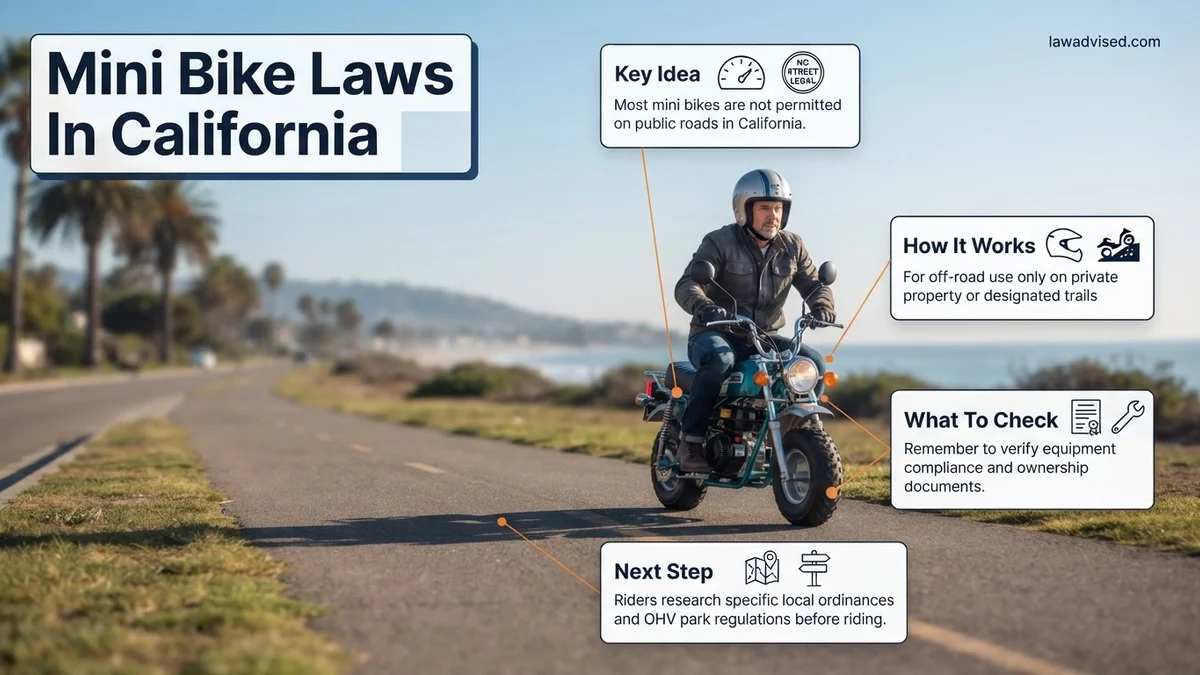
Navigating mini bike laws in california can be confusing since traditional pocket bikes and mini bikes are strictly illegal to ride on public streets, sidewalks, and bike paths. To stay compliant under the California Vehicle Code, riders must operate these vehicles exclusively on private property or designated off-highway vehicle (OHV) areas with proper registration.
Traditional mini bikes and pocket bikes are completely illegal to ride on public streets, sidewalks, and bike paths throughout California. Under the California Vehicle Code, these small motor-driven cycles do not meet federal safety standards, lack necessary emissions equipment, and cannot be registered with the DMV for highway use.
Navigating these restrictions as a rider in 2027 matters because law enforcement agencies actively impound non-compliant mini bikes and issue heavy fines. Knowing where you can legally twist the throttle saves you from costly citations and keeps your equipment out of the police impound lot.
Key Takeaways
- Traditional mini bikes are illegal on public streets, sidewalks, and bike paths.
- Riding on private property is legal with the owner’s permission.
- Public OHV areas require a California Green or Red Sticker.
- Helmets are legally mandatory for all off-road mini bike operators.
- Law enforcement can issue heavy fines or impound illegal street mini bikes.
What Causes Mini Bike Illegality on California Public Streets
The primary reason mini bikes face a strict ban on public asphalt comes down to manufacturing specifications and safety equipment. California law enforces rigid equipment mandates that standard pocket bikes and backyard mini bikes simply cannot fulfill.
Missing Federal Motor Vehicle Safety Standards
To register any motorized two-wheeler for public roads in 2027, the vehicle must possess a manufacturer certificate of origin proving compliance with Federal Motor Vehicle Safety Standards. Mini bikes fail this requirement immediately.
- They lack Department of Transportation approved tires.
- They do not come equipped with functional turn signals or dual mirrors.
- The braking systems do not meet highway-speed stopping distance criteria.
- Manufacturers build them exclusively for closed-course or off-road recreation.
California Vehicle Code Classifications
The state Department of Motor Vehicles classifies traditional mini bikes as motorized bicycles or pocket bikes, neither of which fit the legal definition of a street-legal moped or motorcycle. If your vehicle lacks working headlights, taillights, a horn, and a license plate bracket from the factory, you cannot put it on public pavement.
- Riding a mini bike on a public sidewalk violates pedestrian safety codes.
- Operating one on neighborhood streets invites reckless driving and unregistered vehicle charges.
- Bike paths and multi-use trails strictly prohibit gas-powered mini bikes.
How to Identify Legal Off-Highway Riding Areas and OHV Sticker Rules
While public streets remain entirely off-limits, you still have options for riding your mini bike legally in California. The key lies in transporting your machine to designated off-highway vehicle areas and adhering to state environmental registration programs.
Where Off-Highway Riding Is Allowed
You can legally ride mini bikes on private property with the owner’s explicit consent, or within designated state and federal off-highway vehicle recreation areas. Public lands managed by the Bureau of Land Management or the California State Parks OHV Division provide the legal acreage you need.
- State vehicular recreation areas like Hungry Valley or Oceano Dunes feature dedicated tracks and trails.
- Private motocross tracks often host mini bike practice days if your machine fits class specifications.
- Always verify local noise ordinances, as many OHV areas enforce strict decibel limits on small engines.
Understanding California OHV Sticker Requirements
If you plan to ride your gas-powered mini bike on public state or federal lands in 2027, California law requires a valid OHV registration sticker issued by the DMV. This sticker must be clearly displayed on the vehicle.
- Green Stickers allow year-round riding access in designated state OHV areas.
- Red Stickers apply to certain non-compliant models, though California’s ongoing phase-out of red sticker seasons means you must check current seasonal riding windows for your specific model year.
- Electric mini bikes face different environmental criteria, but gas models must display current registration decals to avoid steep fines from rangers.
Step-by-Step Guide to Registering Your Mini Bike for Off-Road Use
Operating a mini bike legally in California requires navigating the California Department of Motor Vehicles (DMV) registration process for off-road vehicles. If your mini bike lacks standard manufacturer documentation, securing a Green Sticker or Red Sticker demands a methodical approach to satisfy compliance standards set by the California Air Resources Board (CARB).
Gathering Required Documentation
Before visiting a DMV field office, assemble the paperwork proving ownership and compliance with state environmental regulations. Missing documents will immediately halt the registration process and result in rejected applications.
- Locate the original Manufacturer’s Certificate of Origin (MCO) or the signed-off title from the previous owner.
- Complete the California DMV Application for Title or Registration (Form REG 343).
- Secure a bill of sale containing the vehicle identification number (VIN), engine size, purchase date, and seller information if an MCO is unavailable.
- Check the CARB emissions database to confirm your engine meets off-road vehicle standards for the 2027 model year.
Completing the DMV Submission Process
Once paperwork is organized, physical inspection and fee payment finalize the off-road registration. Registration fees generally range from $50 to $75 depending on local county assessments and administrative processing charges.
- Bring the mini bike to an authorized DMV VIN inspector or a participating California law enforcement agency for verification.
- Submit the verified application form, ownership documents, and identification at a DMV office.
- Pay the required biennial registration fees and applicable transfer taxes.
- Affix the newly issued Green Sticker or Red Sticker to the left fork or frame tube in a visible location.
What If Your Mini Bike Is Impounded: Citations and Legal Fallbacks
Riding an unregistered or non-compliant mini bike on public property or California streets carries severe financial and legal penalties. Law enforcement agencies routinely impound illegal motorized recreational vehicles under California Vehicle Code provisions, creating complex retrieval hurdles for owners.
Understanding Citations and Impound Fees
When law enforcement confiscates a mini bike, the owner receives a citation that mandates a court appearance or fine remittance. Retrieval costs escalate quickly due to municipal storage fees and mandatory administrative towing charges.
- Expect base municipal fines ranging from $250 to $500 for illegal street operation without registration or safety equipment.
- Calculate daily tow yard storage fees, which typically cost between $45 and $95 per calendar day.
- Provide proof of valid off-road registration or proof of legal transport arrangements before the impound yard releases the vehicle.
What If It Still Doesn’t Work?
If your DMV registration application gets rejected or law enforcement refuses to release an impounded mini bike, standard administrative procedures may not resolve the issue. Riders must utilize specific legal and technical fallbacks to rectify compliance roadblocks in 2027.
- Consult a DMV Title Specialist: If paperwork is permanently lost, hire a licensed vehicle registration service or bonded title broker. Professional assistance typically costs between $150 and $300 in service fees.
- Request a DMV Supervisor Review: When registration is unjustly denied due to VIN discrepancies, request an official referee inspection to verify frame authenticity.
- Retain a Traffic Defense Attorney: For criminal citations involving reckless riding or repeat impound offenses, retain legal counsel. Legal representation ranges from $500 to $1,500 depending on court appearances.
- Surrender for Destruction: If retrieval and compliance costs exceed the market value of a budget mini bike, authorize the impound yard to scrap the vehicle to avoid mounting storage debts.
Conclusion
Navigating California mini bike laws in 2027 requires strict adherence to CARB environmental mandates, local municipal codes, and DMV off-road registration protocols. Riders eliminate the risk of costly impounds and legal citations by keeping their vehicles off public roads and properly registered for designated state parks. According to verified research and expert sources from the California Department of Parks and Recreation, proactive compliance remains the single most effective way to protect your investment. The next essential step is to inspect your mini bike today, verify its VIN, and complete the necessary off-road registration paperwork before your next riding trip.
❓ Frequently Asked Questions
What happens if police catch you riding a mini bike on a public street?
Law enforcement can issue steep financial fines, misdemeanor charges for unlicenced operation, and immediately impound the mini bike at the owner’s expense.
How do I know if my mini bike qualifies for a California Green Sticker?
The mini bike must be certified by the California Air Resources Board (CARB) to meet state off-road emission standards, usually verified through the Vehicle Identification Number (VIN).
Can children ride mini bikes on public streets in California?
No minor is permitted to ride a mini bike on public streets, roads, or sidewalks. Age restrictions and safety rules only apply to designated off-road tracks and private land.
Are electric mini bikes subject to the same laws as gas mini bikes?
Yes, unless an electric two-wheeler specifically qualifies as a certified electric bicycle (e-bike) under DMV guidelines, standard mini bike and OHV restrictions apply.
Do I need a driver’s license to ride a mini bike off-road?
A driver’s license is not required to operate an OHV on designated public lands or private property, but age restrictions and adult supervision rules apply to younger riders.
What is the difference between a Green Sticker and a Red Sticker in California?
Green Stickers allow year-round riding in California OHV areas, while Red Stickers restrict riding to designated seasonal periods based on strict seasonal emissions standards.

Ismail Hossain is the founder of Law Advised. He is an Divorce, Separation, marriage lawyer. Follow him.