Progressive Income Tax Explained 2026 Step-by-Step Guide
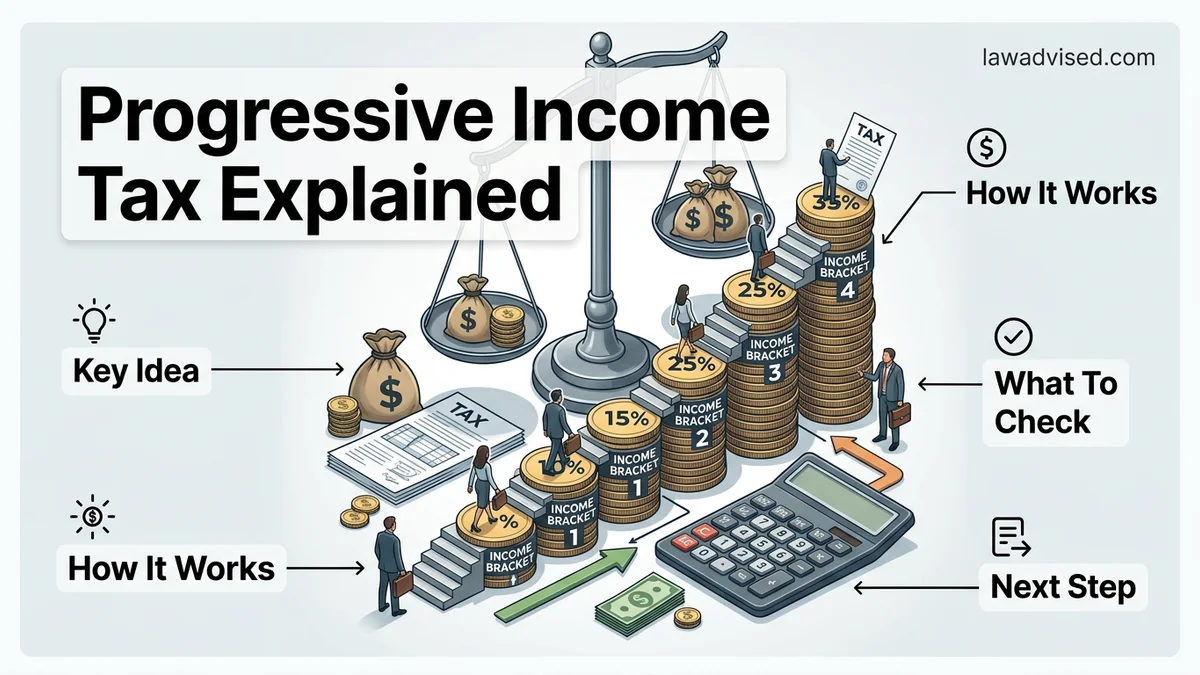
A progressive income tax system charges higher tax rates as an individual’s income increases. The primary misconception is that moving into a higher bracket means all your income is taxed at that higher rate, which is mathematically false.
A progressive income tax system charges higher tax rates on higher levels of income, dividing your earnings into chunks called tax brackets. The single biggest misunderstanding about this system is the belief that crossing into a higher tax bracket means your entire income is suddenly taxed at that higher rate.
In reality, tax brackets apply sequentially. Only the money that falls within a specific bracket is taxed at that rate, protecting lower portions of your income from higher taxation. Mastering this concept for the 2026 tax year ensures you can accurately project your take-home pay and avoid common financial planning mistakes.
Key Takeaways
- Tax brackets only apply to the income falling within that specific range, not your total earnings.
- Your marginal tax rate is the highest bracket your last dollar hits.
- Your effective tax rate is your actual overall percentage of tax paid.
- Progressive systems aim to distribute the tax burden based on ability to pay.
- Earning more money always leaves you with more take-home pay despite higher brackets.
What Causes Confusion About Progressive Income Tax Brackets
The Myth of the Single Tax Rate
People often hear that they have entered the 22 percent or 24 percent tax bracket and assume every dollar they earned is now taxed at that percentage. This misconception leads to the false fear that getting a raise or working extra hours could somehow result in taking home less money overall. Our tax system simply does not work that way.
How Marginal Rates Protect Your Earnings
Your total income is taxed in layers rather than a single flat percentage. Understanding this prevents panic when your salary increases:
- Earning more money always results in more net take-home pay.
- Entering a higher bracket only applies the new rate to the dollars earned above that threshold.
- Your initial earnings continue to be taxed at the historically lower rates established for the lower brackets.
How to Calculate Your Taxes Using Step-by-Step Marginal Brackets
Breaking Down the Bracket Math for 2026
To see how progressive taxation works in practice, let us walk through a clear numerical example for a single filer navigating the 2026 tax brackets. Suppose you earn a gross annual income of $60,000, and we use a simplified two-tier bracket structure for clarity: a 10 percent rate on the first $11,000, and a 12 percent rate on income between $11,001 and $44,725, and a 22 percent rate on income above that.
Your $60,000 income is sliced and taxed sequentially through each tier:
- The first $11,000 of your income is taxed at 10 percent, resulting in $1,100 of tax.
- The portion of income from $11,001 to $44,725 (amounting to $33,725) is taxed at 12 percent, resulting in $4,047 of tax.
- The remaining income above $44,725 up to your $60,000 total (amounting to $15,275) is taxed at the 22 percent marginal rate, resulting in $3,360.50 of tax.
Marginal Versus Effective Tax Rates
This sequential calculation introduces two distinct terms you need to know: your marginal tax rate and your effective tax rate. Your marginal rate is 22 percent because that is the rate applied to your very last, highest-earning dollar.
However, your effective tax rate represents your true overall tax burden. By adding your total tax owed ($1,100 plus $4,047 plus $3,360.50 equals $8,507.50) and dividing it by your total income ($60,000), your effective tax rate is roughly 14.1 percent. This distinction explains why your actual tax bill is almost always much lower than your nominal tax bracket suggests.
How to Find Your True Effective Tax Rate
Many taxpayers confuse their top marginal tax rate with the actual percentage of income they pay to the government. Calculating your true effective tax rate reveals the exact financial impact of the 2026 progressive tax system on your household budget.
Step-by-Step Effective Rate Calculation
Follow this numbered procedure to determine your precise effective tax rate using your 2026 tax documents:
- Locate your total taxable income on line 15 of your Form 1040, or estimate your gross income minus the standard deduction.
- Find your total tax liability on line 24 of your Form 1040, which reflects the combined tax owed across all applicable brackets.
- Divide your total tax liability by your total taxable income.
- Multiply the resulting decimal by 100 to convert the figure into your true effective tax rate percentage.
According to economic studies from the Tax Foundation, the average effective federal income tax rate sits significantly lower than top marginal rates. Most middle-income earners pay an effective rate well beneath their nominal bracket threshold due to the foundational lower tiers.
What If Your Income Crosses Into a Higher Tax Bracket
A common misconception is that earning more money to cross into a higher 2026 tax bracket reduces your take-home pay. Financial experts clarify that progressive tax structures apply higher rates strictly to the dollars within that specific upper tier.
Understanding Marginal Impact
If your taxable income pushes you into the next bracket, only the amount exceeding the lower threshold faces the increased percentage. Your earnings below that threshold continue taxing at the previous, lower rates.
- Calculate the exact dollar amount by which your income exceeds the lower bracket boundary.
- Apply the new, higher marginal tax rate only to that specific overage amount.
- Keep the calculated tax amounts from all previous brackets unchanged.
- Combine these tiered amounts to see that earning more always results in higher net take-home pay.
What If It Still Doesn’t Work?
If manual calculations, payroll withholdings, and software estimates yield conflicting numbers for your 2026 liability, targeted troubleshooting steps can resolve the discrepancy.
- Recheck your filing status, as standard deductions and bracket thresholds shift significantly depending on whether you file single, married filing jointly, or head of household.
- Verify that you properly subtracted above-the-line deductions, such as retirement contributions and student loan interest, before calculating your bracket placement.
- Review Form W-4 or state withholding forms to ensure employers are not over-withholding based on outdated allowances.
- Consult a certified public accountant (CPA) or enrolled agent if complex capital gains or multi-state income sources distort your progressive calculations. Professional tax advisory services typically cost between $300 and $750 for individual returns, depending on complexity.
Conclusion
Navigating the progressive income tax system requires understanding that marginal rates apply exclusively to specific income tiers rather than your entire earnings. According to verified research and expert sources from the Congressional Budget Office, this tiered structure ensures a balanced distribution of federal revenue while preserving incentives for wage growth. Your clear actionable next step is to review your current paystub or tax software projection to separate your marginal rate from your true effective tax rate today.
❓ Frequently Asked Questions
How does the United States progressive tax system work in practice?
The US federal income tax system uses multiple tax brackets ranging from 10% to 37%. As your income rises, each successive chunk of earnings is taxed at the corresponding bracket percentage, rather than your entire income being lumped into one top rate.
What happens to my old income when a new tax bracket is introduced?
Your lower blocks of income remain taxed at the lower historical rates established for those brackets. Moving up a bracket only changes how the new dollars entering that specific bracket are taxed.
How do standard deductions interact with progressive tax brackets?
The standard deduction reduces your total taxable income before it ever hits the progressive tax brackets. This shields a base amount of earnings from any federal income tax at all.
Are state income taxes always progressive?
No. While many states use a progressive income tax system similar to the federal model, some states use a flat tax rate, and others do not levy a general state income tax.
What is a regressive tax compared to a progressive tax?
A regressive tax takes a larger percentage of income from low-earning individuals than from high-earning individuals, such as flat sales taxes on everyday essentials, which is the opposite of a progressive model.
How can I estimate my effective tax rate for the year?
You can estimate your effective tax rate by dividing your total estimated tax liability by your total gross or taxable income, giving you the true average percentage you pay to the government.

Ismail Hossain is the founder of Law Advised. He is an Divorce, Separation, marriage lawyer. Follow him.