USA Tax System for Beginners 2026 Step-by-Step Guide
Navigating the USA tax system for the first time can feel overwhelming, but the process becomes simple once you understand withholding, tax brackets, and basic documents. This guide breaks down the fundamentals into plain English so you can file your taxes with confidence. Follow our step-by-step roadmap to gather your documents and file correctly in 2026.
The United States tax system operates on a pay-as-you-go model, meaning the federal government expects you to pay taxes on your income throughout the year rather than in one lump sum each spring. If you are new to the country or just entering the workforce, navigating terms like withholding, brackets, and deductions can feel overwhelming, but the core mechanics are straightforward once you break them down.
Filing your taxes correctly is not just about avoiding penalties from the IRS; it is your mechanism for claiming money back if you overpaid, accessing vital tax credits, and maintaining a clean financial record needed for major life milestones like buying a home. This guide cuts through the financial jargon to give you a clear, step-by-step roadmap for handling your taxes in 2026.
Key Takeaways
- Takeaway 1:Taxes are withheld from your paycheck throughout the year to cover your annual liability.
- Takeaway 2:W-2 forms are for employees, while 1099 forms are issued to independent contractors.
- Takeaway 3:Choose your filing status carefully as it directly impacts your tax rates and standard deduction.
- Takeaway 4:Most beginners should opt for the standard deduction instead of itemizing.
- Takeaway 5:Use reputable tax software to streamline the filing process and avoid costly math errors.
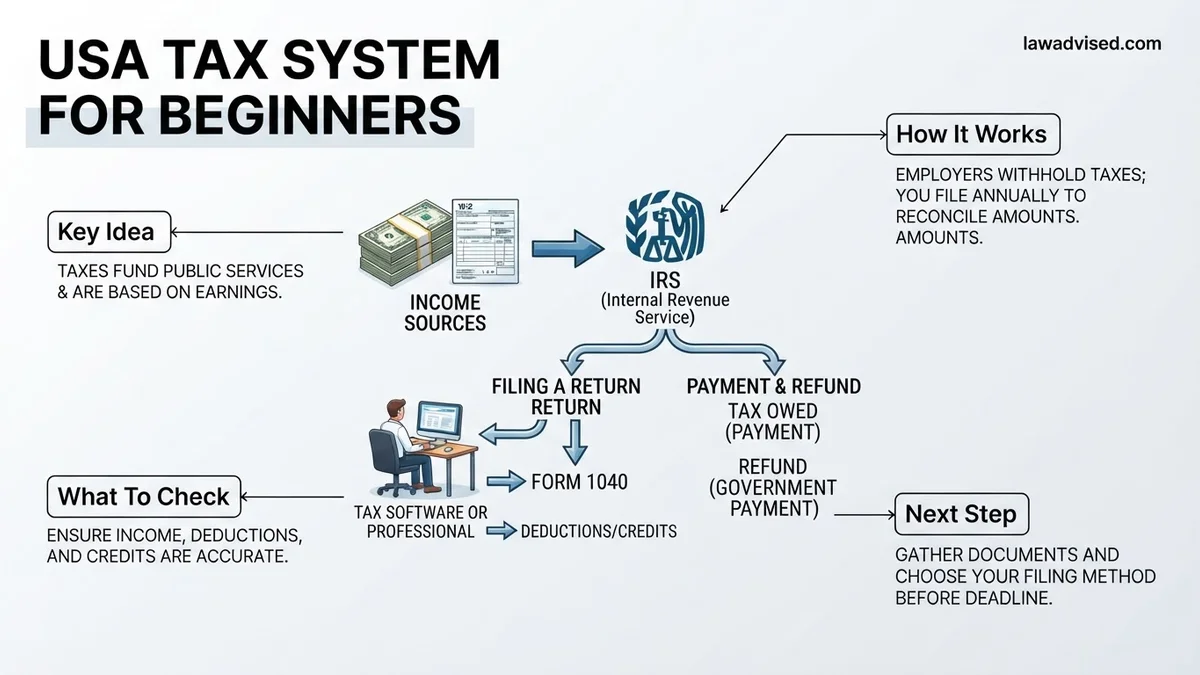
What Causes Tax Confusion: Understanding the US Tax System Basics
Tax season causes widespread anxiety primarily because people do not understand how money flows between their paycheck and the government. Your employer automatically deducts a portion of your earnings every pay period, estimating what you will owe for the entire year.
The Role of Tax Withholding
When you start a new job in 2026, you fill out Form W-4 to tell your employer how much tax to withhold from your paycheck. If your employer holds back too much, the government keeps an interest-free loan until you file a tax return and receive a refund. If your employer holds back too little, you will owe the IRS a lump sum when tax season arrives.
Refunds Versus Owning Money
Many beginners view a large tax refund as a bonus, but it simply means you gave the government free use of your hard-earned cash all year. The ideal financial scenario is breaking even, meaning your withholding precisely matched your actual tax liability for 2026.
How the US Progressive Tax Bracket System Actually Works
A common myth is that moving into a higher tax bracket means your entire income gets taxed at that higher rate. In reality, the United States uses a progressive tax system, meaning your income is taxed in slices, or brackets, as it grows.
Marginal Tax Rates Explained
For the 2026 tax year, federal income tax brackets range from 10 percent up to 37 percent, depending on your filing status. As you earn more money, only the dollars that fall within a specific bracket are taxed at that bracket’s specific rate. Your first dollars earned are always taxed at the lowest rate, protecting lower-income earners.
A Practical Example of Progressive Brackets
- Imagine you are a single filer in 2026 and your taxable income puts you into the 12 percent tax bracket.
- The first portion of your income is taxed at 10 percent, not 12 percent.
- Only the money you earn that crosses into the 12 percent threshold is taxed at that higher rate.
- Your effective tax rate, which is your total tax divided by your total income, is always lower than your top marginal bracket.
Step-by-Step Guide to Filing Your Taxes for the First Time
Navigating the United States tax system for the first time in 2026 requires a structured approach to avoid costly mistakes. According to IRS compliance data, filing electronically reduces error rates significantly compared to paper submissions.
Step 1: Gather Your Tax Documents
Collect all necessary forms before you begin your return. Common documents include Form W-2 for wage earners, Form 1099 for freelancers or independent contractors, and Form 1098-E if you paid student loan interest. Missing a document will trigger an automated notice from the IRS.
Step 2: Choose Your Filing Method
Select how you want to prepare your tax return based on your financial complexity and budget. Options range from IRS Free File software for qualified individuals to commercial tax preparation platforms and certified public accountants. Research shows that early electronic filing speeds up direct deposit refunds.
Step 3: Complete and Submit Your Return
Input your personal information, income, and deductions carefully into your chosen software. Double-check your Social Security numbers and bank routing details for accuracy. Once validated, electronically sign and submit your federal and state returns, retaining digital copies of your submission confirmation.
What If Your Return Gets Delayed or You Owe Money to the IRS
Tax season does not always go according to plan, and encountering a processing delay or an unexpected tax bill can be stressful. Financial experts recommend addressing IRS notices immediately rather than ignoring them, as penalties and interest compound over time.
Handling a Delayed Tax Refund
Most electronic tax refunds are issued by the IRS within 21 days of acceptance. If your refund is delayed, check the official “Where’s My Refund?” tool on the IRS website for real-time status updates. Common reasons for delays include math errors, missing identity verification, or claims involving the Earned Income Tax Credit.
Managing an Unexpected Tax Bill
If your calculation shows you owe money for the 2026 tax year, you must still file your return on time to avoid failure-to-file penalties. If you cannot pay the full balance immediately, apply for an online short-term payment plan or an installment agreement directly through the IRS portal. Setting up an official payment arrangement reduces late-payment penalties.
What If It Still Doesn’t Work?
If automated tax software rejects your filing or complex financial situations prevent you from completing your return, specific fallback measures are necessary. According to verified research and expert sources, attempting to guess complex tax rules often leads to costly IRS audits.
- Review IRS Rejection Codes: Read the specific error code provided by your software, correct the mismatched data, and resubmit the electronic file.
- Request a Filing Extension: File Form 4868 by the April deadline to secure an automatic six-month extension to submit your paperwork, noting that extensions to file are not extensions to pay owed taxes.
- Consult a Certified Public Accountant (CPA): Seek professional assistance from a licensed tax expert if your return involves multi-state income, small business assets, or complex cryptocurrency transactions. Professional tax preparation fees typically range from $220 to $550 for individual returns, depending on regional complexity.
- Utilize Volunteer Income Tax Assistance: Qualified taxpayers making under the IRS threshold can access free tax preparation assistance through certified IRS community volunteer programs.
Conclusion
Mastering the USA tax system for the first time in 2026 involves gathering correct documents, selecting reliable software, and submitting your returns accurately before the deadline. According to verified research and expert sources, proactive planning and early filing significantly reduce stress and accelerate refund delivery. Your next actionable step is to create a secure online account on the official IRS website to monitor your 2026 tax documents and payment status.
❓ Frequently Asked Questions
How do progressive tax brackets work in the US?
The US uses a progressive tax system, meaning different portions of your income are taxed at different rates rather than your entire income being taxed at a single rate. As your income crosses specific threshold amounts, only the money earned above that threshold is subject to the higher tax bracket.
Should I take the standard deduction or itemize?
Most beginners should choose the standard deduction because it provides a fixed, no-fuss dollar amount that lowers your taxable income. Itemizing only makes sense if your total deductible expenses, like mortgage interest and medical bills, exceed the standard deduction amount.
What documents do I need to start filing my taxes?
You will generally need your Social Security number, W-2 forms from employers, 1099 forms if you did freelance work, and records of any other income or eligible deductions. Having these documents ready before you begin will speed up the filing process significantly.
How long does it take to get a tax refund?
If you file electronically and choose direct deposit, the IRS typically issues tax refunds within 21 days. Paper returns take significantly longer, often six to eight weeks or more to process.
What happens if I cannot file my taxes by the April deadline?
You can request an automatic six-month extension by filing IRS Form 4868 before the April deadline. Keep in mind that an extension to file is not an extension to pay, so you should estimate and pay any taxes owed to avoid penalties and interest.
Are there free options available to file my taxes?
Yes, taxpayers with incomes below a certain threshold can use IRS Free File software or free guided tax preparation programs. Many commercial tax software providers also offer free tiers for simple federal and state returns.

Ismail Hossain is the founder of Law Advised. He is an Divorce, Separation, marriage lawyer. Follow him.