How Tax Revenue Is Used in USA A Proven 2026 Guide
Taxpayers often wonder where their hard-earned money goes after filing. Federal tax revenue is primarily distributed among major mandatory programs, national defense, and interest on the national debt.
When your tax dollars flow to Washington, D.C., they are primarily divided into two buckets: mandatory spending that runs on autopilot and discretionary spending that Congress debates every year. Over 70% of the federal budget is locked into pre-existing laws, meaning entitlement programs and interest payments claim the lion’s share of every dollar you pay.
Understanding where this money goes changes how you view your paycheck and national policy. In this 2026 guide, you will get a clear, data-driven breakdown of how tax revenue is actually used in the USA, bypassing political talking points to show you the hard numbers.
Key Takeaways
- Social Security and Medicare consume the largest share of federal tax revenue.
- Mandatory spending accounts for the majority of the federal budget automatically by law.
- Discretionary spending requires annual congressional approval, funding defense and education.
- State and local taxes primarily fund public education, local roads, and emergency services.
- Interest payments on the national debt claim a rising percentage of total tax collections.
What Causes Misunderstandings About How Tax Revenue Is Used in USA
The Illusion of Foreign Aid and Minor Programs
Many taxpayers assume a massive chunk of their federal income tax goes toward international affairs, foreign aid, or niche government grants. Social media feeds constantly amplify these minor line items, creating a widespread belief that discretionary pet projects dominate the federal ledger. In reality, foreign aid accounts for less than one percent of total federal spending.
To cut through the noise, you need to look at the actual scale of the federal budget:
- International affairs and diplomacy consume a tiny fraction of total outlays.
- Environmental protection and science funding represent single-digit percentages.
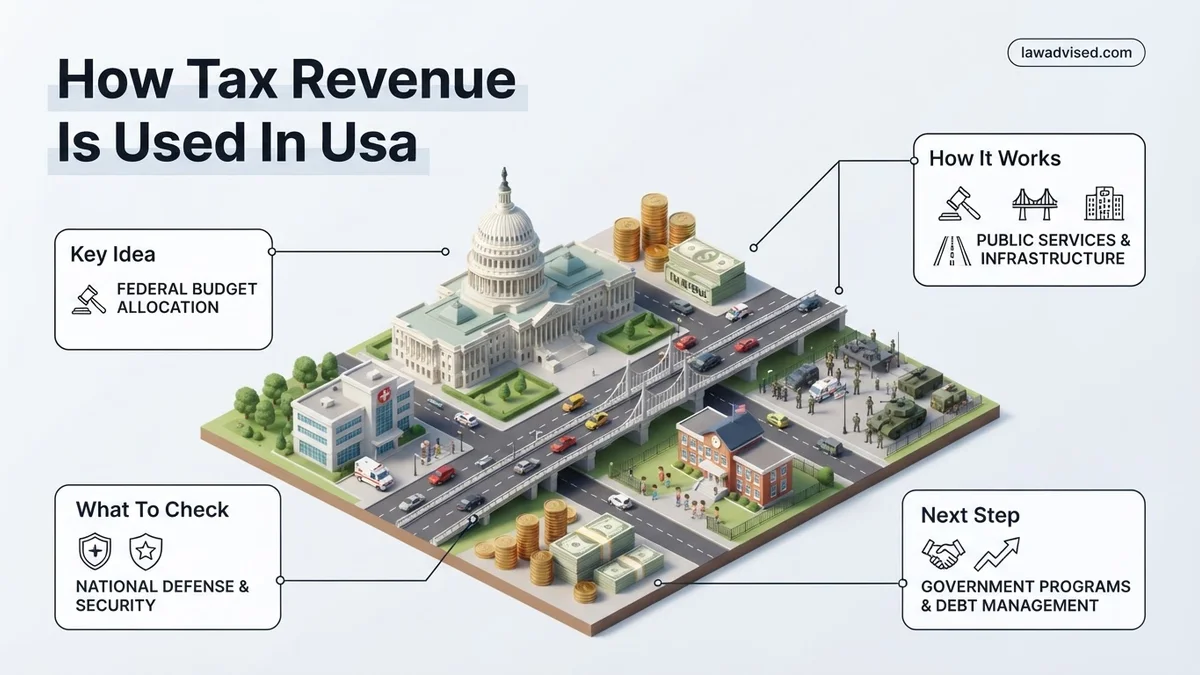
- The vast majority of your tax money is consumed by just three massive systems: Social Security, healthcare programs, and national defense.
Confusing State and Local Taxes with Federal Revenue
Another major source of confusion stems from mixing up what your federal taxes fund versus your state and local taxes. When your local roads have potholes, your neighborhood public school needs supplies, or local police patrol your streets, those services are rarely funded by your federal income tax returns.
Your federal tax revenue is strictly reserved for nationwide obligations. State income taxes, property taxes, and local sales taxes handle local infrastructure, K-through-12 education, and municipal services. Keeping these financial streams separate is essential if you want to understand the true impact of the taxes you pay.
How to Analyze Federal Spending Categories Step-by-Step
Step 1: Distinguish Between Mandatory and Discretionary Spending
To analyze the 2026 federal budget effectively, you must first separate mandatory spending from discretionary spending. Mandatory spending is locked in by permanent laws. If you qualify for Social Security or Medicare, the government is legally obligated to pay you, regardless of annual budget fights in Congress.
Discretionary spending, on the other hand, is negotiated and voted on every single year. This includes funding for the military, national parks, education grants, and transportation. Here is how the two types break down:
- Mandatory Spending: Comprises roughly 73% of the entire federal budget, driven largely by aging demographics and healthcare costs.
- Discretionary Spending: Accounts for the remaining 27%, with national defense making up about half of this category.
Step 2: Map the Five Core Spending Pillars
Once you separate mandatory from discretionary allocations, you can map out the five major pillars that consume nearly all federal tax revenue. As you review these categories for 2026, you will see exactly why lawmakers constantly struggle with national debt and deficit projections.
The primary buckets dominating the federal ledger include:
- Social Security: The single largest program, providing retirement and disability benefits to tens of millions of Americans.
- Health Programs: Medicare, Medicaid, and related health expenditures that fund care for seniors and low-income individuals.
- National Defense: Funding for the Department of Defense, military personnel, and weapons systems.
- Safety Net Programs: Income security programs like food assistance, unemployment benefits, and veteran support.
- Net Interest on the Debt: The mandatory interest payments the government must make on accumulated national debt.
How to Distinguish Between Mandatory and Discretionary Spending
Understanding the federal budget requires separating permanent obligations from yearly congressional allocations. According to the Congressional Budget Office (CBO), federal outlays split cleanly into two distinct budgetary tracks for fiscal year 2026.
Mandatory Outlays
Mandatory spending operates on autopilot through permanent laws rather than annual appropriations bills. To properly analyze this category, follow these evaluation steps:
- Examine the governing statute to confirm funding occurs automatically without yearly congressional renewal.
- Verify if the program uses formula-based eligibility criteria, such as age or income thresholds, like Social Security and Medicare.
- Calculate the percentage of total federal spending, which accounts for roughly two-thirds of the annual budget in 2026.
Discretionary Outlays
Discretionary spending requires active congressional approval every single fiscal year through the appropriations process. To identify these funds, apply the following checks:
- Review annual congressional budget bills to locate funded agencies and programs.
- Identify allocations for national defense, transportation, education, and foreign aid.
- Measure annual fluctuations, as these programs represent the flexible one-third of the federal budget subject to political negotiation.
What If State and Local Tax Allocations Differ from Federal Spending
Taxpayers frequently notice a disconnect between federal budget priorities and local government spending. While Washington allocates massive sums to defense and entitlement programs, state and local municipalities operate under entirely different mandates. Recognizing these operational boundaries prevents widespread confusion regarding tax utilization.
State-Level Priorities
State governments focus heavily on physical infrastructure, public safety, and health programs. When analyzing state budgets for 2026, keep these primary focus areas in mind:
- Review state funding allocations directed toward K-12 and higher education systems, which typically consume the largest share of state revenue.
- Examine Medicaid matching funds, as healthcare expenditures dominate state-level budgets alongside the federal government.
- Track transportation funds designated for state highway maintenance, bridges, and regional transit networks.
Local Municipal Allocations
City and county governments rely primarily on property and local sales taxes to deliver immediate community services. To track these local dollars, utilize these investigative steps:
- Inspect local property tax assessments to see how public safety departments, including police and fire services, receive funding.
- Investigate municipal utility funds dedicated to local water treatment, sanitation, and waste management.
- Review parks and recreation budgets funded directly by local commercial and residential tax receipts.
What If It Still Doesn’t Work?
Navigating complex tax allocation data and tracking government expenditures can present unexpected roadblocks. If initial research fails to clarify where specific tax dollars go, apply these troubleshooting steps:
- Access the official USAspending.gov portal to run granular queries on federal prime award summaries and agency-specific outlays.
- Submit a formal Freedom of Information Act (FOIA) request to state or federal agencies for itemized expenditure reports.
- Consult public finance databases managed by the Government Accountability Office (GAO) or the Tax Foundation for verified fiscal analyses.
- Seek professional guidance from a certified public accountant or public policy researcher when auditing complex municipal tax districts, with specialized consulting fees typically ranging from $150 to $350 per hour.
Conclusion
Comprehending how tax revenue is used in the USA requires a clear understanding of mandatory entitlements, discretionary programs, and state-level allocations. According to verified research and expert sources from the Congressional Budget Office, breaking down these funding streams empowers citizens to evaluate government efficiency accurately. Take the next step today by visiting official federal transparency portals to review your community’s exact fiscal impact for 2026.
❓ Frequently Asked Questions
How is federal income tax revenue tracked and reported?
The Office of Management and Budget (OMB) and the Department of the Treasury publish detailed reports, including the Daily Treasury Statement and the Budget of the US Government, outlining every dollar spent.
Does income tax fund federal highways?
Federal fuel taxes and general tax revenues both contribute to the Highway Trust Fund, which helps states build and maintain interstate highways and mass transit systems.
What percentage of taxes goes to foreign aid?
Foreign economic and military assistance makes up a very small fraction of the federal budget, typically less than 1% of total federal outlays.
Can taxpayers choose where their federal taxes are spent?
No, individual taxpayers cannot earmark their federal income tax dollars for specific government programs; Congress allocates funds through the annual budget process.
How do payroll taxes differ from income taxes?
Payroll taxes, such as FICA, are specifically earmarked to fund Social Security and Medicare, whereas income taxes go into the general fund to support all other government operations.
Where can citizens view their local government budget?
City and county governments publish annual public budget documents online, showing precisely how property, sales, and local income taxes are distributed within the community.

Ismail Hossain is the founder of Law Advised. He is an Divorce, Separation, marriage lawyer. Follow him.