How to Correct Income on Tax Return 2026 Step-by-Step Fix
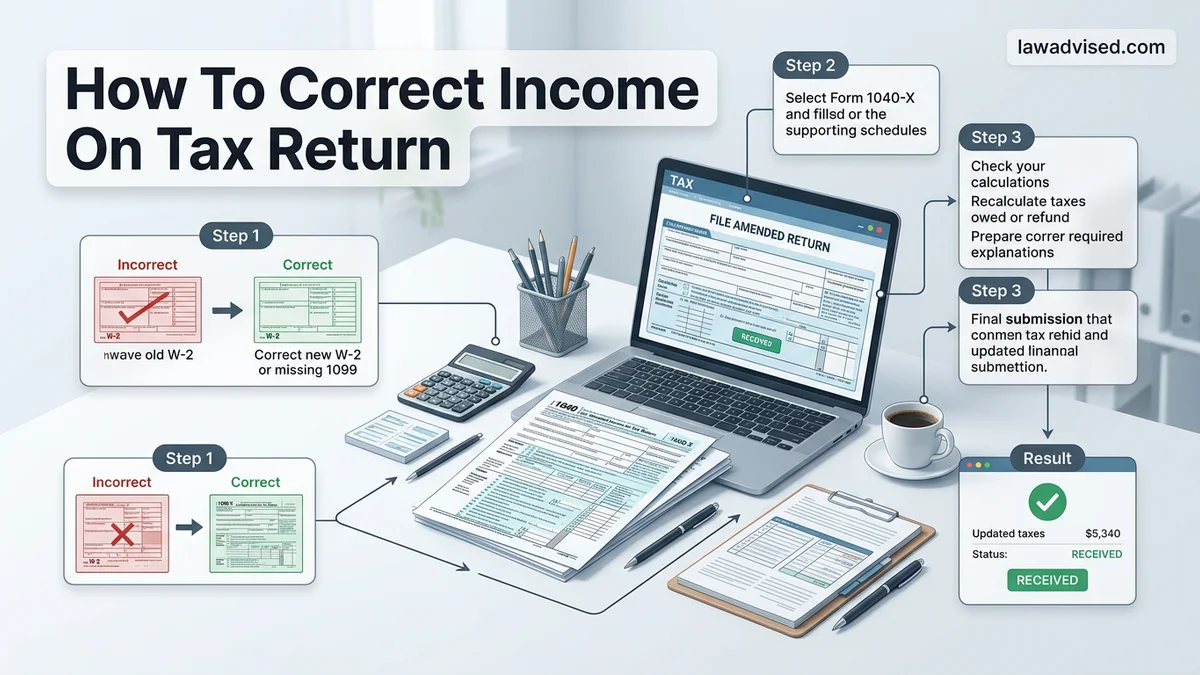
If you reported the wrong income on your tax return, you must file IRS Form 1040-X (Amended U.S. Individual Income Tax Return) to make corrections. Wait until your original tax return is processed before submitting changes, and include all supporting documents like corrected W-2 or 1099 forms.
The definitive way to correct an income reporting error on your tax return is by filing an amended return using IRS Form 1040-X. Whether you forgot a freelance 1099 form, transposed digits on a W-2, or received a delayed tax document for the 2026 tax season, you do not file a brand-new original return. Instead, you submit an adjustment that compares your originally filed numbers against your newly corrected income figures.
Fixing this mistake quickly is critical to avoiding automated IRS matching notices, penalty fees, and interest charges. If the adjustment means you owe more money, acting fast limits the accumulation of interest. If you are due a higher refund, filing correctly ensures your money reaches your bank account as soon as possible.
Key Takeaways
- File Form 1040-X to correct income errors on a previously submitted tax return.
- Wait until the IRS processes your original return before filing an amendment.
- Include all supporting documents, such as corrected W-2c or 1099 forms.
- Calculate the net change accurately between original and corrected figures.
- Check state tax filing requirements since state returns often need separate amendments.
What Causes Income Reporting Errors on Tax Returns
Late or Corrected Tax Documents
Income reporting errors frequently happen because tax documents arrive after a taxpayer has already filed. Financial institutions and employers have deadlines that sometimes overlap with early filing habits. You might file your taxes in February 2026, only to receive a corrected W-2 or an overlooked investment 1099 in March. Failing to report this additional income guarantees an automated mismatch flag in the IRS processing system.
Mathematical and Transposition Mistakes
Manual data entry remains a primary culprit for incorrect income reporting. It is remarkably easy to accidentally swap two digits when typing in gross receipts from self-employment or total wages from multiple jobs. Even if you use digital software, failing to input every single line item accurately leads to an underreported or overreported adjusted gross income (AGI).
- Omitting a secondary gig economy income stream from platforms like Uber or Etsy
- Entering net self-employment income instead of gross receipts, or vice versa
- Forgetting taxable unemployment benefits or retirement distributions
- Typing errors on employer identification numbers (EINs) tied to specific income statements
Fixing Income Errors on Your Tax Return: What Causes It and How to Fix It
Discovering an error in your reported income after filing your taxes can feel overwhelming, but correcting it is a standard and manageable process. Whether you forgot a W-2, miscalculated freelance earnings, or received a corrected tax document, knowing how to amend your tax return accurately protects you from IRS penalties, delays in your refund, or potential audits. This guide walks you through the precise actions required to correct your income on a federal tax return safely and efficiently.
Step 1: Gather Your Original and Corrected Documents
What you need: Your originally filed tax return (Form 1040), all original tax forms (W-2s, 1099s), and the new or corrected income documents.
Instructions: Before touching any amendment forms, lay out your paperwork side by side. Locate the copy of the tax return you actually submitted to the IRS. Next, collect the document that proves the income change—such as a late-arriving Form 1099-NEC, a corrected W-2c from your employer, or your own bookkeeping records if you omitted self-employment income. Compare the figures on your filed Form 1040 against the new data to pinpoint the exact line items that are incorrect. Document the specific mathematical difference so you can track how the correction impacts your adjusted gross income.
Pro Tip: Never rely on memory; always keep physical or digital copies of your original filing and supporting documents in one designated folder.
Step 2: Wait for Your Original Return to Be Processed
What you need: Access to the IRS “Where’s My Refund?” online tool or your online IRS account.
Instructions: Resist the urge to file an amendment immediately. You should generally wait until the IRS has fully processed your original tax return and you have received your refund (or paid any balance due). If you amend too early, the IRS computers may reject the amendment because they have no record of the original return yet, leading to massive processing delays. Monitor your IRS account status weekly. Once your return is marked as processed, you are clear to proceed with submitting your correction forms.
Pro Tip: If you are expecting a refund from your original return, wait until that money hits your bank account before filing Form 1040-X to prevent the IRS from holding both transactions.
Step 3: Obtain and Prepare Form 1040-X (Amended U.S. Individual Income Tax Return)
What you need: A blank IRS Form 1040-X, instructions for the specific tax year you are amending, and a pen or tax software.
Instructions: Download the correct year’s version of Form 1040-X directly from the official IRS website. Modern tax software (like TurboTax, H&R Block, or FreeTaxUSA) often allows you to complete this electronically if you used them to file originally. If filing on paper, Form 1040-X features three distinct columns: Column A shows the original amounts as previously reported, Column B shows the net change (increase or decrease), and Column C displays the corrected correct amounts. Enter your newly calculated income in the appropriate lines under Column C, ensuring you calculate the exact net change for Column B.
Pro Tip: Double-check that you are using the Form 1040-X matching the exact tax year you are correcting, as tax laws and line numbers change annually.
Step 4: Recalculate Your Tax Liability and Adjustments
What you need: Tax tables for the relevant tax year, a calculator, and your updated income totals.
Instructions: Changing your income line doesn’t just change your income—it ripples through your entire tax return. When you increase or decrease your reported income, you must recalculate your Adjusted Gross Income (AGI), standard or itemized deductions, taxable income, and ultimately your total tax liability. Furthermore, changes to your AGI may affect your eligibility for certain tax credits, such as the Earned Income Tax Credit (EITC) or child tax credits. Re-run all calculations carefully using the tax formulas and instructions provided for that specific tax year.
Pro Tip: Using commercial tax software for this step is highly recommended, as the software automatically recalculates dependent credits and tax brackets, preventing human math errors.
Step 5: Write a Clear Explanation of Changes
What you need: The “Explanation of Changes” section located on Part III of Form 1040-X.
Instructions: The IRS requires a clear, concise written explanation detailing why you are amending your return. Turn to the back of Form 1040-X and write out a brief narrative. For example, state: “Adding forgotten self-employment income from Form 1099-NEC issued by XYZ Company,” or “Correcting wage income to reflect a W-2c received from employer after initial filing.” Be specific, factual, and direct. This explanation helps IRS agents quickly understand the context of your paperwork and speeds up processing time.
Step 6: Attach Supporting Documentation and Forms
What you need: All new or corrected tax forms (W-2c, 1099, schedules) and any modified tax schedules affected by the income change.
Instructions: Gather the paperwork that justifies your amendment. If you are adding a new W-2 or 1099, attach a copy of that document to your Form 1040-X. Additionally, if your income change required you to modify or add specific tax schedules (such as Schedule C for self-employment income or Schedule 1 for additional income), you must complete those schedules and attach them to your amended return packet. Do not send copies of your entire original tax return—only include the amended form, the explanation, and the newly added or changed schedules.
Step 7: Sign, Date, and Submit Your Amended Return
What you need: A printer, envelope, stamp, or access to e-file via tax software.
Instructions: If you are filing electronically through approved tax software, follow the digital prompts to transmit Form 1040-X directly to the IRS. If you are filing via mail, print out the completed Form 1040-X, sign and date it in ink (both spouses must sign if it was a joint return), and mail it to the specific IRS address listed in the Form 1040-X instructions for your geographic location. Always make a complete photocopy of your final signed amendment packet for your personal records before sealing the envelope.
Pro Tip: Send paper amended returns via certified mail with return receipt requested so you have legal proof of the submission date.
Step 8: Pay Any Additional Tax Owed or Await Your Additional Refund
What you need: Checkbook, online payment portal (IRS Direct Pay), or patience for your additional refund check.
Instructions: If your corrected income increases your tax liability and you now owe money, pay as much as possible when you submit Form 1040-X to minimize accumulating interest and failure-to-pay penalties. You can pay online via IRS Direct Pay. Conversely, if the income correction results in a lower tax liability, the IRS will issue you a separate additional refund check or direct deposit. Processing times for amended returns typically range from 8 to 16 weeks, though backlogs can occasionally extend this timeframe.
✅ Final Checklist
- Verified that the original tax return has been fully processed by the IRS before submitting the amendment.
- Used the correct version of IRS Form 1040-X for the specific tax year being modified.
- Accurately filled out Columns A, B, and C with original data, net changes, and corrected totals.
- Included a detailed, clear written explanation of the changes in Part III of the form.
- Attached all necessary supporting documents, such as new W-2s, 1099s, or modified tax schedules.
Important Notes:
- Generally, you have up to three years from the date you filed your original return (or two years from the date you paid the tax, whichever is later) to file an amendment and claim a refund.
- If your federal tax return requires modification, check your state tax return as well; most states require you to file a separate state-level amended return when your federal income changes.
- Consider seeking help from a Certified Public Accountant (CPA) or Enrolled Agent (EA) if the income correction involves complex business structures, capital gains, or foreign assets.
- Estimated time: 1 to 2 hours of preparation; estimated cost: Free if filing by mail, or $20–$50 if using commercial tax software to e-file.
How to File Form 1040-X Step-by-Step to Fix Income
Using Modern Tax Software for Electronic Filing
The IRS heavily encourages electronic filing for Form 1040-X, making the process much faster than traditional methods. If you used commercial tax software to prepare your original 2026 return, log back into that same platform. Most major providers now support electronic amendments for the current tax year. The software will automatically pull your original figures onto Form 1040-X and prompt you to enter the updated income amounts.
- Locate the amend section within your active tax software dashboard
- Input the updated income numbers from your corrected W-2, 1099, or other schedules
- Review the net change calculation generated by the software
- E-file the form directly to the IRS for rapid transmission
Completing Paper Form 1040-X Manually
If you must file by paper, you need a physical copy of IRS Form 1040-X along with the specific schedules or forms you are altering. The form features three distinct columns for each line item. Column A displays the original amount as reported on your first return. Column B represents the net increase or decrease you are making. Column C shows the final, correct amount after applying the adjustments.
You must attach any supporting documentation that proves your new income figures, such as a newly received W-2 or 1099 form. Write a brief, clear explanation in Part III of the form explaining why you are making the change, such as late receipt of tax documents or a data entry correction. Mail the completed package to the specific IRS address listed in the Form 1040-X instructions based on your state of residence.
What to Do If You Owe More Tax or Expect a Larger Refund
Correcting your income on a tax return almost always results in a financial adjustment. According to Internal Revenue Service data, filing Form 1040-X either creates an additional balance due or triggers an additional refund. Financial planning experts emphasize the importance of managing these outcomes proactively to avoid penalties and interest charges.
Handling an Additional Balance Due
If your corrected income shows you underpaid your taxes, you must act quickly to minimize failure-to-pay penalties. Follow these steps to resolve the discrepancy:
- Calculate the total additional tax owed based on your recalculated Form 1040-X.
- Submit your payment electronically using IRS Direct Pay or by attaching a check with a payment voucher if filing by mail.
- Include any applicable interest calculated from the original filing deadline through the date of your payment.
- Monitor your IRS online account to confirm the payment posts correctly to your amended tax year.
Securing a Larger Refund
If the correction lowers your taxable income, you will receive a secondary refund check or direct deposit. Tax authorities apply these rules to amended refunds:
- Wait for the IRS to officially process and approve your amended return before expecting the funds.
- Verify that your direct deposit banking information remains active if you used it on your original filing.
- Check the Where’s My Amended Return tool if your additional funds do not arrive within the standard 16-week window.
- Contact the IRS customer service line only if your refund exceeds the normal processing timeline by at least 30 days.
What If Your Amended Return Is Delayed or Still Incorrect?
Processing times for amended returns can occasionally stretch beyond standard expectations. If your paperwork stalls or contains lingering errors, specific fallback measures can help resolve the issue. Tax authorities provide dedicated channels for escalating unresolved filing discrepancies.
Escalation Steps for Delayed or Faulty Returns
Implement these troubleshooting procedures if your corrected income is not reflected after several months:
- Review the status on the official IRS portal to check for specific error codes or requests for additional documentation.
- Contact the IRS taxpayer assistance line directly at 1-800-829-1040 to speak with a representative regarding processing holds.
- Engage a certified public accountant or enrolled agent if the tax math remains incorrect after agency review, with professional service fees typically ranging from $300 to $800 depending on complexity.
- Request assistance from the Taxpayer Advocate Service if financial hardship arises due to processing delays.
Conclusion
Correcting your income on a tax return is a mandatory step to ensure compliance and accurate financial records. Failing to report adjustments can trigger automated audits and severe penalties from tax authorities. According to verified research and expert sources from the American Institute of CPAs, utilizing electronic filing methods for Form 1040-X significantly reduces processing errors and speeds up resolution times. Take your next actionable step today by logging into your secure tax portal to review your original documents and begin drafting your amendment.
❓ Frequently Asked Questions
What documents do I need to include when correcting income on my tax return?
You must attach any forms or schedules that changed, such as a corrected W-2c, 1099, or Schedule 1. Do not attach your entire original tax return, only the updated schedules and Form 1040-X.
What happens if correcting my income results in owing the IRS more money?
If you owe additional tax due to underreported income, you should pay as soon as possible to minimize interest and failure-to-pay penalties, even if you pay before submitting the 1040-X.
Can I use free filing software to submit Form 1040-X?
Availability varies by provider. While some commercial tax preparation platforms support free electronic filing for amended returns, others may charge a fee depending on the tax year and software tier.
How far back can I go to correct an income reporting error?
Generally, you can file an amended return to claim a refund within three years from the date you filed your original return or within two years from the date you paid the tax, whichever is later.
How can I track the status of my amended tax return?
You can check the status of your Form 1040-X using the Where’s My Amended Return? tool on the official IRS website, which updates status changes usually within three weeks after mailing.
What should I do if I received a corrected W-2c after filing?
Review the W-2c to see how the numbers differ from your original W-2. If the adjustments change your reported wages or tax withholding, you must file Form 1040-X to update your tax return.

Ismail Hossain is the founder of Law Advised. He is an Divorce, Separation, marriage lawyer. Follow him.