Highest Federal Income Tax Bracket Best Guide for 2026
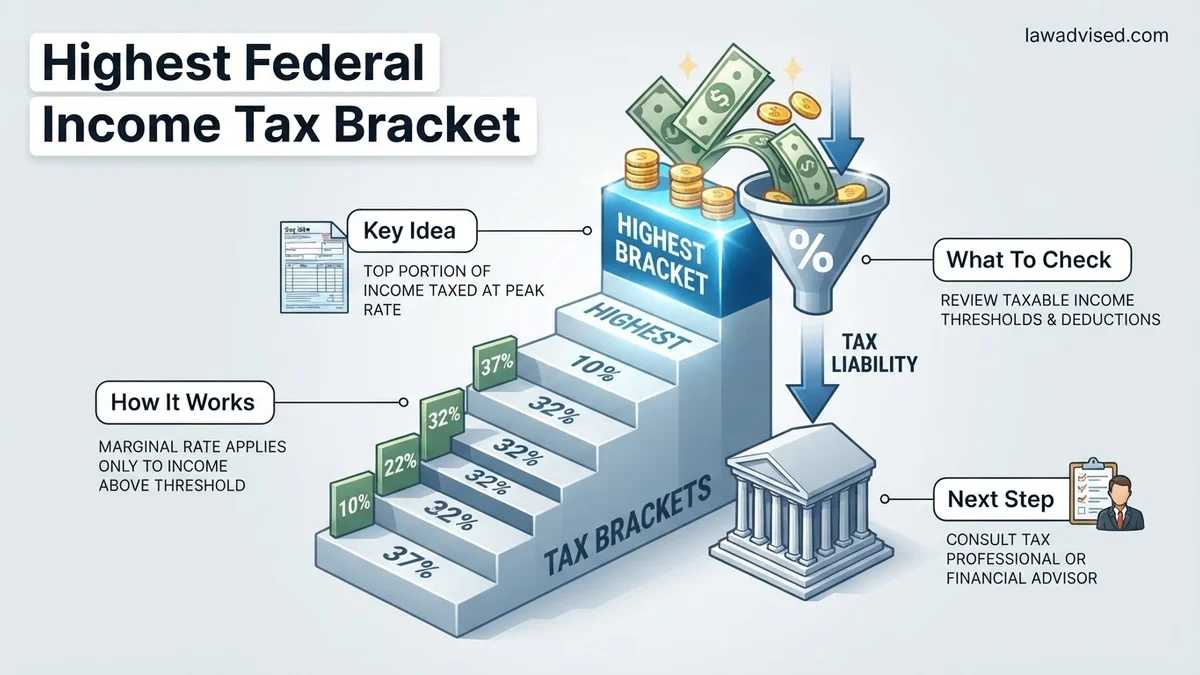
The highest federal income tax bracket is 37%, which applies to top earners meeting specific income thresholds depending on their filing status. Understanding these precise brackets helps you plan your taxable income and avoid tax surprises.
For the 2026 tax year, the highest federal income tax bracket rate sits at 37%. This maximum rate applies to single filers earning over $640,600 and married couples filing jointly earning over $768,400. Knowing these exact thresholds helps you project your liability and plan your financial moves before the tax year closes.
Reaching the top tax bracket does not mean all your income faces that 37% rate. The U.S. federal tax system uses a progressive structure, meaning your income is taxed in slices. Only the dollars crossing into that final threshold face the 37% rate, while your earlier earnings are taxed at lower marginal rates like 10%, 12%, 22%, 24%, 32%, and 35%. Understanding this mechanism stops you from fearing a higher-paying job or a sudden financial windfall.
Key Takeaways
- The current maximum federal income tax rate is 37%.
- Top tax brackets apply only to income earned above the specific threshold.
- Thresholds vary significantly by filing status, such as single versus married filing jointly.
- Marginal tax rates mean your entire income is not taxed at the highest rate.
- Inflation adjustments alter the threshold amounts for each tax year.
What Causes High Bracket Placement and Bracket Creep
Income Spikes and Lump Sums
Hitting the top 2026 tax bracket often happens because of concentrated, single-year events rather than a steady salary. Common triggers include:
- Exercising non-qualified stock options or a large batch of incentive stock options
- Realizing massive capital gains from a real estate or business sale without installment structuring
- Receiving large performance bonuses, severance packages, or retroactive commission payouts
When these lump sums land in a single calendar year, they push your taxable income straight past the $640,600 or $768,400 marks.
Bracket Creep and Inflation Adjustments
Bracket creep occurs when inflation pushes your nominal income higher, but your actual purchasing power stays the same. The IRS adjusts the federal income tax brackets annually to combat this effect for 2026. However, if your salary outpaces standard cost-of-living adjustments, you might find yourself slipping into a higher marginal bracket even though your standard of living hasn’t dramatically improved.
How to Fix Tax Liability with Step-by-Step Bracket Management
Deferring Income and Maximizing Pre-Tax Accounts
If you anticipate crossing into the 37% bracket, you can actively reduce your adjusted gross income through strategic deferral. Take these steps before December 31, 2026:
- Max out traditional 401(k), 403(b), or eligible employer-sponsored retirement accounts to lower your taxable baseline
- Utilize a Health Savings Account (HSA) if you are enrolled in a high-deductible health plan
- Ask your employer to defer year-end bonuses or commission payments into the following tax year if contractually permitted
Strategic Deduction Bunching
Controlling your placement in the highest federal income tax bracket requires aggressive management of your itemized deductions. Bunching charitable donations into a single tax year using a donor-advised fund can pull your taxable income back below the threshold. Similarly, timing major medical procedures or property tax payments can create a concentrated deduction window that offsets your peak earning years.
Step 1: Calculate Your Adjusted Gross Income Accurately
Reaching the highest federal income tax bracket in 2026 requires understanding how your Adjusted Gross Income (AGI) is determined. Tax experts emphasize that gross income is not the final metric used by the IRS to assess your bracket placement. Deductions and adjustments play a critical role in shifting your final taxable footprint.
Sub-step 1: Tally All Gross Income Streams
Begin by compiling W-2 wages, 1099 contractor earnings, investment dividends, capital gains, and business revenue. According to IRS guidelines, every dollar of worldwide income counts toward your initial gross total before exclusions are applied.
Sub-step 2: Subtract Above-the-Line Deductions
Next, apply adjustments to income to arrive at your true AGI. Qualified deductions include traditional IRA contributions, student loan interest, health savings account (HSA) contributions, and self-employed retirement plan contributions. These adjustments directly lower the figure used to evaluate the highest federal income tax bracket thresholds for 2026.
What If It Still Doesn’t Work and You Owe the Top Rate
If tax planning strategies fail to keep your income below the 2026 top marginal rate, managing the tax liability becomes the primary objective. High earners facing a steep tax bill can utilize specific fallback procedures to mitigate the financial impact without violating compliance standards.
- Request an IRS Payment Plan: Taxpayers unable to pay their total liability immediately can apply for an online payment agreement or installment plan directly through the IRS portal, incurring reduced failure-to-pay penalties.
- Explore Offer in Compromise Eligibility: While difficult for high-income earners to qualify for, extreme financial hardship cases can investigate an Offer in Compromise to settle tax liabilities for less than the full owed amount.
- Consult a Certified Public Accountant (CPA): Engage a licensed tax strategist or CPA to review the 2026 return for missed credits, loss carryforwards, or depreciation opportunities. Professional advisory fees typically range from $300 to $1,000+ depending on return complexity.
- Implement Proactive Entity Restructuring: For business owners consistently hitting the top bracket, work with a tax attorney to evaluate C-corporation vs. S-corporation structures to optimize future liability.
Conclusion
Navigating the highest federal income tax bracket in 2026 demands meticulous calculation of your Adjusted Gross Income and strategic deployment of above-the-line deductions. When proactive planning falls short, structured payment options and professional guidance protect your financial health. According to verified research and expert financial sources, early consultation with a certified tax professional remains the most effective method for mitigating high-bracket liability. Take the actionable next step today by auditing your current withholding and scheduling a comprehensive mid-year tax review.
❓ Frequently Asked Questions
What are the exact income thresholds for the highest federal income tax bracket?
The exact income thresholds change annually due to inflation adjustments. You must check the specific IRS revenue procedure for the active tax year to see the exact dollar limits for single and married filing jointly statuses.
How do marginal tax brackets function in the United States tax system?
The U.S. uses a progressive tax system, meaning your income is taxed in chunks at increasing rates. Entering the highest bracket only means the dollars earned above that cutoff are taxed at the 37% rate.
How do filing statuses affect my placement in tax brackets?
Filing statuses such as single, married filing jointly, and head of household have completely different income ranges for each tax bracket. Married couples typically have higher threshold limits before hitting the top rate compared to single filers.
Can deductions help me drop out of the highest tax bracket?
Yes, above-the-line deductions and standard or itemized deductions lower your taxable income. Reducing your taxable income below a bracket threshold keeps those top dollars from being taxed at the maximum rate.
What role does inflation play in setting tax brackets?
The IRS adjusts tax bracket thresholds every year based on the Consumer Price Index. This prevents bracket creep, which happens when inflation pushes nominal wages higher without a real increase in purchasing power.
Are capital gains taxed at the same rate as ordinary income in the highest bracket?
No, long-term capital gains and qualified dividends have their own separate tax brackets, which cap out at a maximum rate of 20% for top earners, plus a potential 3.8% net investment income tax.

Ismail Hossain is the founder of Law Advised. He is an Divorce, Separation, marriage lawyer. Follow him.