Do Tax Brackets Apply to All Income? A Step-by-Step 2026
No, tax brackets do not apply to all of your income at a single higher rate. Instead, the U.S. uses a progressive tax system where income is taxed in incremental ‘chunks’ or brackets as it rises.
No, tax brackets do not apply to all of your income. This is one of the most persistent financial myths, leading many workers to fear getting a raise or moving into a higher bracket for 2026. Under the U.S. progressive tax system, your income is not taxed at a single flat rate. Instead, the government splits your total earnings into different chunks, and each chunk is taxed only at its specific rate.
Understanding this mechanic is vital for your financial planning. When you cross the threshold into a higher bracket in 2026, only the money that actually pushes past that line gets taxed at the higher rate. Your earlier earnings remain safely taxed at the lower rates, meaning earning more money will always result in a higher take-home pay.
Key Takeaways
- Tax brackets only apply to the specific portion of money that falls within that bracket’s range.
- Moving into a higher tax bracket never results in taking home less overall pay.
- Your marginal tax rate is simply the tax rate applied to your very last dollar earned.
- Your effective tax rate is your total tax paid divided by your total taxable income.
- Deductions reduce your taxable income, effectively shielding dollars from higher tax brackets.
What Causes the Myth That Tax Brackets Apply to All Income
The Dangerous “Pay Raise” Misconception
The belief that a higher tax bracket applies to your entire income usually stems from how tax tables are displayed. When you look at the 2026 IRS tax brackets, you see income ranges paired with rates like 12 percent, 22 percent, or 24 percent. It is very easy to assume that if your total taxable income lands you in the 22 percent bracket, the IRS applies that 22 percent to every single dollar you earned.
This misunderstanding creates a real psychological barrier for taxpayers. People often worry about these common scenarios:
- Turning down overtime pay because of fear it will trigger a higher overall tax rate
- Hesitating to accept a performance bonus or a salary promotion
- Believing that a single dollar over a bracket threshold reduces net take-home pay
How Marginal Tax Rates Actually Work
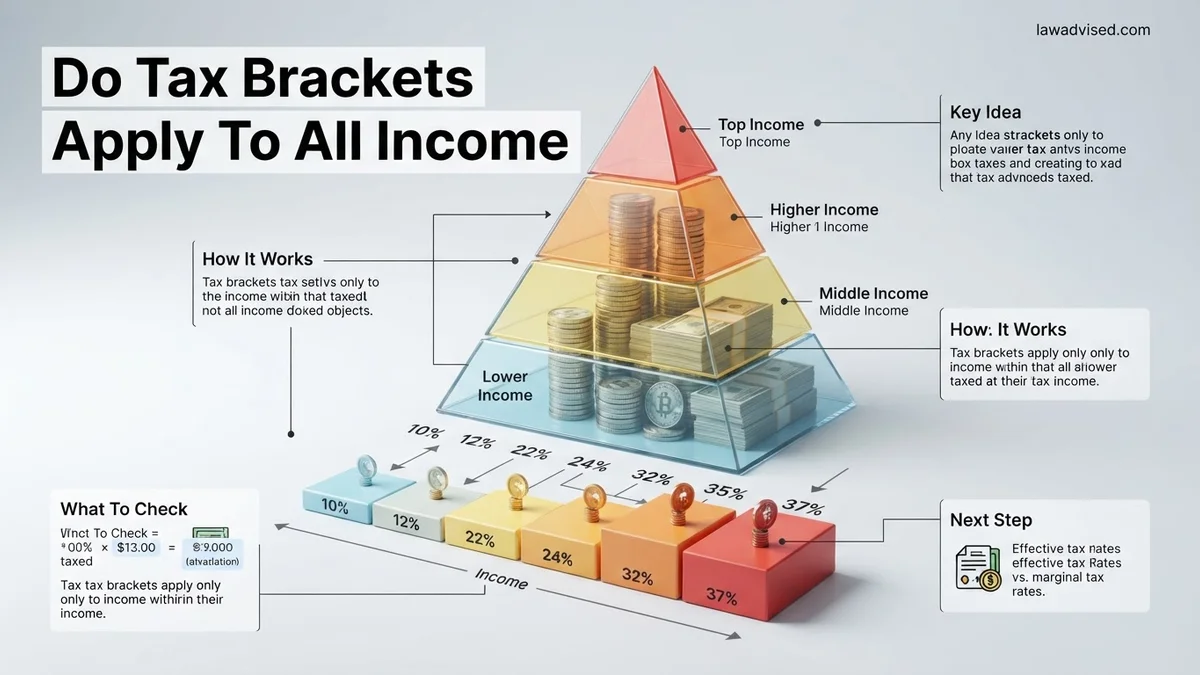
The term marginal tax rate is the key to demystifying how the system operates. The federal government uses a marginal tax bracket structure, meaning your income is taxed in progressive layers or tiers. Think of your income like filling up a series of empty buckets, where each bucket represents a specific tax bracket with its own rate.
As you earn more money throughout 2026, you fill up the first bucket completely before any money spills over into the next bucket. Only the income sitting inside that final, highest bucket faces the top marginal rate. Your total tax bill is simply the combined sum of the tax owed from each individual bucket.
How to Calculate Your Taxes Using Marginal Brackets Step-by-Step
Breaking Down the 2026 Tax Brackets
To see this math in action, let us look at a simplified version of the single filer tax brackets for 2026. Suppose the federal tax system features these progressive tiers:
- 10 percent bracket: Applies to taxable income from $0 to $11,000
- 12 percent bracket: Applies to taxable income from $11,001 to $45,000
- 22 percent bracket: Applies to taxable income from $45,001 and up
If you are a single filer with a taxable income of $50,000 in 2026, you do not pay 22 percent on that entire $50,000. Your income is divided across all three brackets sequentially.
Step-by-Step Mathematical Calculation
Let us calculate the exact tax liability for that $50,000 income using the bracket thresholds outlined above. You will quickly see why your entire income is never taxed at your top marginal rate:
- First Bracket (10 percent): The first $11,000 of your income is taxed at 10 percent. Calculation: $11,000 x 0.10 = $1,100.
- Second Bracket (12 percent): The income between $11,001 and $45,000 is taxed at 12 percent. This is a span of $34,000. Calculation: $34,000 x 0.12 = $4,080.
- Third Bracket (22 percent): The remaining income above $45,000 is taxed at 22 percent. Your income is $50,000, leaving $5,000 in this final bracket. Calculation: $5,000 x 0.22 = $1,100.
To find your total federal income tax, add the tax amounts from each tier together ($1,100 + $4,080 + $1,100), resulting in a total tax bill of $6,280. Your effective tax rate is lower than your top marginal rate because the earlier dollars benefited from lower brackets.
What If Your Income Pushes You Into a Higher Bracket?
One of the most persistent financial myths is that entering a higher tax bracket reduces your overall take-home pay. According to verified research from the Tax Foundation, the United States uses a progressive marginal tax system for 2026. This structure means higher rates only apply to the portion of income that exceeds specific threshold boundaries.
Understanding the Threshold Spillover
When a salary increase crosses a bracket boundary, only the dollars above that threshold are taxed at the higher rate. The income earned below that line remains taxed at the previous lower percentages. Earning more money always results in higher net take-home pay, regardless of the marginal rate applied to the final dollars.
- Calculate the exact dollar amount that exceeds the current bracket threshold.
- Apply the newly triggered 2026 marginal tax rate exclusively to that surplus amount.
- Add the resulting tax liability to the total calculated from all lower preceding brackets.
How to Fix Misconceptions Between Marginal and Effective Tax Rates
Taxpayers frequently confuse their marginal tax bracket with their effective tax rate. The marginal rate represents the top bracket touched by the final dollar of income. Conversely, the effective tax rate reflects the true average percentage of total income paid to the government across all brackets combined.
Calculating True Tax Burden
Financial experts emphasize that evaluating a tax situation requires looking at the effective rate rather than the headline marginal bracket. IRS guidelines for 2026 dictate that deductions and exemptions lower the baseline taxable income before brackets are even applied.
- Divide the total federal income tax owed by the total gross income earned.
- Multiply the resulting decimal by 100 to determine the true effective percentage.
- Compare this effective rate against the peak marginal bracket to see the actual savings provided by the progressive system.
What If It Still Doesn’t Work?
Tax calculations can become overly complicated due to self-employment income, capital gains, or multi-state filings. If manual bracket computations or tax software results remain confusing, taxpayers should utilize professional intervention to ensure compliance and avoid overpaying.
- Verify income reporting documents, including W-2s and 1099 forms, to ensure gross figures match employer submissions.
- Consult a Certified Public Accountant (CPA) or Enrolled Agent (EA) to review complex deductions and tier distributions.
- Utilize professional tax software with updated 2026 algorithmic checks to reconcile automated calculation discrepancies.
- Prepare for professional service costs, which typically range from $300 to $900 depending on the complexity of the return.
Conclusion
Tax brackets do not apply to all income uniformly; rather, they divide earnings into progressive tiers taxed at incrementally higher rates. Understanding the distinction between marginal brackets and effective tax rates prevents costly financial misunderstandings. According to verified research and expert sources from the IRS, proactive tax planning remains the best method to optimize deductions and manage liability. An actionable next step is to review the current 2026 IRS tax tables to accurately map out personal income thresholds before filing.
❓ Frequently Asked Questions
Do tax brackets apply to all income earned in a single year?
No, tax brackets never apply to your entire income all at once. Your income is broken up into segments, and each segment is taxed according to its own specific bracket rate.
Why do people think a higher tax bracket applies to everything?
This common misconception stems from confusion between marginal tax rates and flat tax systems, where people incorrectly assume crossing a threshold spikes the tax rate on all previous earnings.
How do standard deductions interact with tax brackets?
Standard deductions lower your total taxable income right off the top, which can completely shield your lowest dollars of income or keep higher dollars from reaching upper brackets.
Does moving up a tax bracket affect income I already earned in a lower bracket?
Not at all. Income that falls into the 10% or 12% brackets will always be taxed at those low rates, even if your newest earnings push into the 22% or 24% brackets.
How can I lower the amount of income subject to higher brackets?
You can reduce your taxable income and avoid higher brackets by utilizing pre-tax retirement accounts, health savings accounts, and available tax deductions.
Is the federal income tax system the same for single filers and married couples?
The progressive structure works the same way for everyone, but the income thresholds that define each bracket change depending on your chosen filing status.

Ismail Hossain is the founder of Law Advised. He is an Divorce, Separation, marriage lawyer. Follow him.