Standard Deduction vs Itemized Deductions Expert 2026 Guide
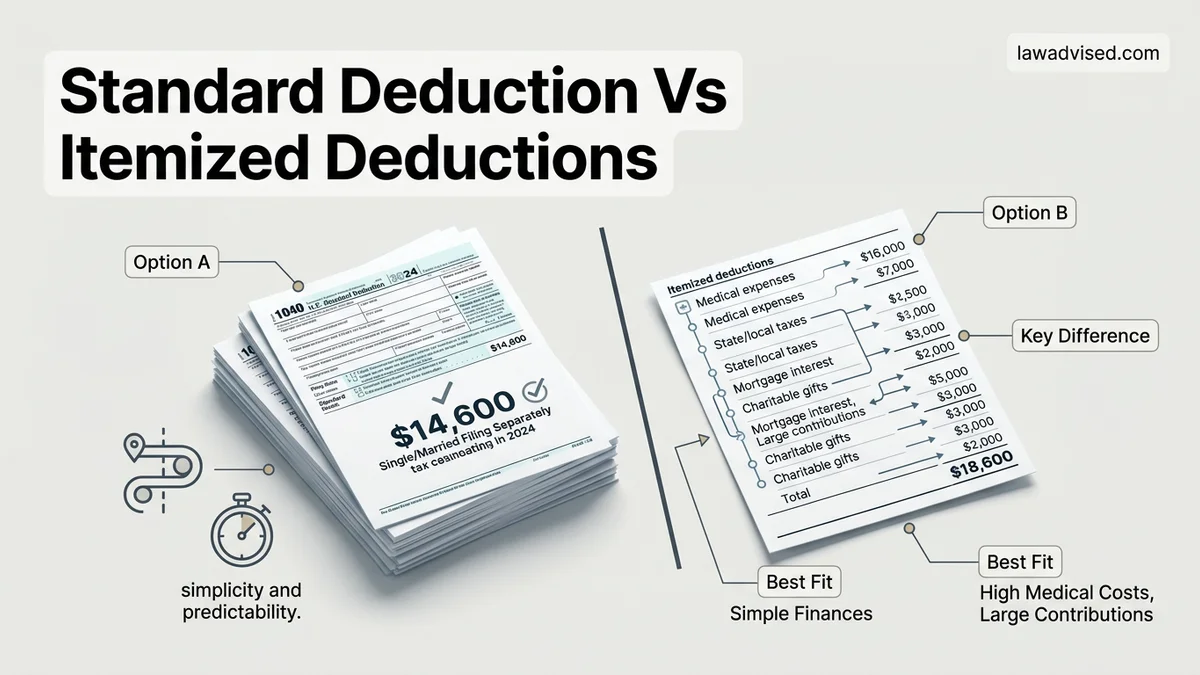
Choosing between the standard deduction and itemized deductions determines whether you take a flat tax break or deduct specific expenses. Your goal is simple: pick the option that results in the lower taxable income and the highest tax refund.
Choosing between the standard deduction and itemizing your deductions comes down to a simple mathematical threshold: whichever total is higher gets you the lowest tax bill and the largest refund. For the 2026 tax year, the standard deduction amounts are projected to be roughly $15,000 for single filers and $30,000 for married couples filing jointly, adjusted slightly for inflation.
If your total deductible expenses—like mortgage interest, state taxes, and charitable donations—exceed those dollar amounts, you should itemize. If they fall short, taking the standard deduction gives you the maximum tax savings with zero paperwork hassle.
Key Takeaways
- Always choose the option that gives you the higher deduction amount to minimize your taxes.
- Compare your total itemized expenses against the flat standard deduction threshold for your filing status.
- Common itemized write-offs include mortgage interest, state and local taxes, and charitable gifts.
- Major life events like buying a home often push taxpayers to itemize.
- Keep meticulous receipts if you plan to itemize to withstand potential IRS audits.
What Causes Confusion in Standard Deduction vs Itemized Deductions
The Illusion of Itemizing Everything
Many taxpayers assume that because they paid for mortgage interest, medical bills, and property taxes throughout the year, they automatically qualify to write them all off. The confusion stems from the fact that these expenses only matter if their combined sum beats the standard deduction baseline. If you are a single filer in 2026 with $12,000 in total eligible expenses, itemizing actually hurts you because you miss out on the higher standard deduction.
The $10,000 SALT Cap Trap
Another major point of confusion is the State and Local Tax (SALT) deduction limit. Taxpayers often tally up their property taxes and state income taxes, expecting a massive write-off, only to find that the federal cap stops them at $10,000. Understanding this ceiling prevents you from falsely assuming you will clear the itemization threshold.
- Property taxes and state income taxes are capped at a combined $10,000 maximum.
- Common expenses like car registration fees or credit card interest are entirely non-deductible for personal use.
- Medical expenses must exceed 7.5 percent of your Adjusted Gross Income (AGI) to count toward itemizing.
How to Fix Your Strategy and Calculate Your Total Deductions
Run the Quick Math Before Filing
Stop guessing and start adding. To fix your strategy for the 2026 tax year, pull out last year’s receipts and estimate your major deductible buckets: home mortgage interest, charitable donations, and out-of-pocket medical costs that exceed your AGI threshold. Compare that raw total against the 2026 standard deduction threshold for your specific filing status.
Bunching Strategies for Maximum Impact
If your total itemized deductions hover just below the standard deduction limit, you can use a tactic called “bunching.” Instead of spreading your charitable giving and elective medical procedures evenly across multiple years, you squeeze them into a single calendar year. This pushes your 2026 total way past the threshold, allowing you to itemize that year, and then you can take the standard deduction the following year.
- Calculate your projected standard deduction for your filing status in 2026.
- Add up your potential itemized expenses using a simple spreadsheet.
- If itemizing wins by a significant margin, organize your receipts; otherwise, take the standard deduction and save your time.
Step-by-Step Guide to Choosing the Best Deduction for 2026
Optimizing your tax strategy for the 2026 tax year requires a systematic approach rather than guesswork. Financial planners and certified public accountants recommend evaluating your potential deductions well before the filing deadline to ensure maximum tax savings.
Step 1: Estimate Your 2026 Itemized Expenses
Begin by calculating your total likely itemized deductions for the upcoming year. Gather records for your mortgage interest, state and local taxes (SALT) up to the statutory limit, charitable contributions, and qualified medical expenses that exceed 7.5 percent of your adjusted gross income.
Step 2: Compare Against Projected 2026 Thresholds
Match your estimated itemized total against the official 2026 standard deduction baseline for your specific filing status. According to data from the Tax Foundation and IRS inflationary adjustments, inflation-indexed standard deductions for 2026 determine the exact baseline you must beat.
Step 3: Leverage Bunching Strategies
If your combined itemized expenses sit just below the standard deduction threshold, consider timing your expenses strategically. Accelerating charitable donations or elective medical procedures into a single calendar year allows you to surpass the standard deduction hurdle every alternative year.
What If Your Itemized Expenses Fall Just Short of the Threshold
Taxpayers frequently discover that their total itemized deductions land frustratingly close to the standard deduction limit. When traditional expense tracking leaves you just a few hundred or thousand dollars short, specific tactical adjustments can salvage your tax strategy for 2026.
- Double-check overlooked deductions: Review records for less common write-offs, such as educator expenses, investment interest expenses, or state-specific tax credits that interact favorably with itemized totals.
- Utilize a donor-advised fund: Bundle multiple years of planned charitable giving into a single 2026 contribution using a donor-advised fund, instantly pushing your itemized total well past the standard deduction limit.
- Consult a qualified tax professional: If complex assets, small business interests, or rental properties blur the line between standard and itemized options, enlist a Certified Public Accountant (CPA) or Enrolled Agent (EA). Professional tax preparation fees typically range from $300 to $900 depending on complexity.
- File an extension if documentation is pending: Requesting a filing extension pushes your deadline to October 2026, granting extra time to track down missing receipts or verify deductible medical outlays.
Conclusion
Choosing between the standard deduction and itemized deductions directly impacts your overall tax liability and take-home pay for 2026. While the standard deduction offers simplicity and immediate relief, strategic itemization unlocks greater savings for homeowners and high-volume charitable donors. According to verified research and expert financial sources, proactive year-end tax planning remains the most effective method for securing the lowest possible tax burden. Your immediate next step is to audit your anticipated 2026 expenses against the current inflation-adjusted thresholds before the filing season closes.
❓ Frequently Asked Questions
What are the main categories of itemized deductions?
The primary itemized deductions include home mortgage interest, state and local taxes (SALT) capped at $10,000, charitable donations, and medical expenses that exceed a specific percentage of your adjusted gross income.
How do I know if I should itemize my taxes?
Add up all your qualified deductible expenses for the year. If that total sum is higher than the standard deduction amount for your filing status, you should itemize.
Are medical expenses easy to itemize?
Medical expenses can be itemized, but only the portion that exceeds 7.5% of your adjusted gross income (AGI) qualifies, making it difficult for many taxpayers to clear the hurdle.
What documentation do I need to itemize deductions?
You must keep detailed records, receipts, Form 1098 for mortgage interest, charitable contribution receipts, and canceled checks to prove your itemized expenses if audited.
Does filing status change the standard deduction amount?
Yes, the standard deduction varies significantly depending on whether you file as single, married filing jointly, head of household, or married filing separately.
What happens if my itemized total is very close to the standard deduction?
If your expenses are right on the line, the time and effort required to track receipts and file Schedule A may not be worth the minimal tax savings gained by itemizing.

Ismail Hossain is the founder of Law Advised. He is an Divorce, Separation, marriage lawyer. Follow him.