Common Questions About Standard Deduction Standard 2026
Navigating federal taxes requires knowing your standard deduction amounts to lower your taxable income. This guide answers common questions regarding filing statuses, additional senior deductions, and whether you should itemize.
For the 2026 tax year, the federal standard deduction amounts are $15,000 for single filers and married individuals filing separately, $30,000 for married couples filing jointly, and $22,500 for heads of household. These baseline thresholds dictate whether millions of Americans will take the easy route of the standard deduction or spend hours itemizing individual expenses.
Knowing these exact 2026 figures immediately helps you calculate your taxable income and decide your filing strategy before tax season arrives. Navigating federal tax rules requires precision, and getting these baseline numbers right is the most critical first step for your financial planning.
Key Takeaways
- Review the 2026 standard deduction limits specific to your exact tax filing status.
- Add extra standard deduction amounts if you are age 65 or older.
- Claim additional deductions if you are legally blind for the tax year.
- Compare total itemized deductions against your standard deduction threshold before filing.
- Keep accurate records of medical, mortgage, and charitable expenses if itemizing.
What Causes Confusion About the Standard Deduction
Misunderstanding Eligibility Rules
Many taxpayers struggle because they assume everyone qualifies for the exact same standard deduction regardless of their dependency status. If someone else can claim you as a dependent on their 2026 tax return, your standard deduction is severely limited. You cannot simply claim the full single amount without checking these dependency rules first.
- Dependents face a basic standard deduction that is usually limited to earned income plus a small buffer, or a specific statutory minimum.
- Nonresident aliens and individuals filing short-tax-year returns also encounter strict limitations.
- Checking your dependency status upfront prevents costly IRS rejection letters later.
Itemizing Versus Standard Deduction Confusion
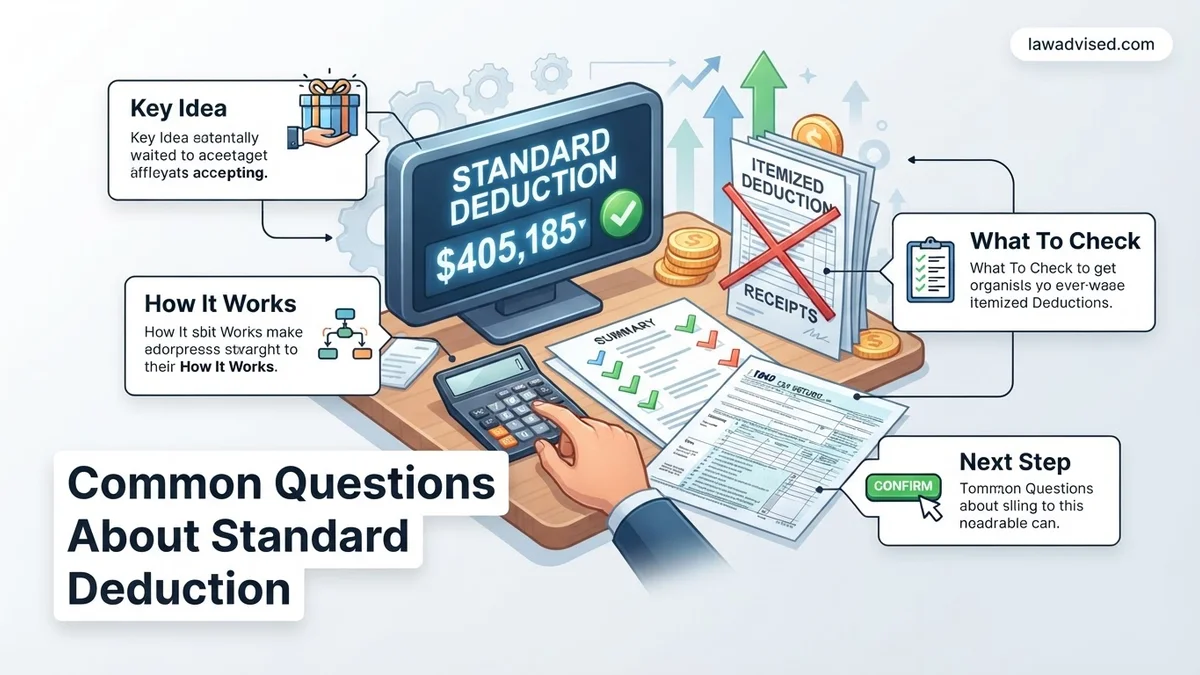
Another major pain point is deciding whether to take the standard deduction or itemize your specific expenses. You must choose the option that results in the lower overall tax liability. If your total deductible expenses—such as mortgage interest, state and local taxes, and charitable donations—exceed your 2026 standard deduction threshold, itemizing saves you money.
- Most households find the standard deduction significantly higher than their itemized totals.
- Keeping accurate records of your medical bills and charitable contributions ensures you make the right mathematical choice.
- You cannot pick and choose individual deductions; it is an all-or-nothing decision for each tax year.
How to Determine Your 2026 Standard Deduction Amount
Matching Your Filing Status
Your correct standard deduction depends entirely on your official IRS filing status on the last day of 2026. Filing status categories include Single, Married Filing Jointly, Married Filing Separately, and Head of Household. Each status carries a distinct dollar amount adjusted for inflation.
- Single filers and married individuals filing separate returns both qualify for the $15,000 baseline.
- Married couples filing a joint return receive the maximum baseline amount of $30,000.
- Heads of household receive $22,500, reflecting the added financial responsibilities of supporting a dependent household.
Accounting for Age and Vision Status
If you or your spouse are age 65 or older, or legally blind by the end of 2026, you qualify for an additional standard deduction amount. These extra increments increase your total protection from federal income tax. You must calculate these additions carefully based on your exact filing status.
- For 2026, the additional standard deduction for being over 65 or blind is generally $1,600 for unmarried filers.
- For married taxpayers, the additional amount is typically $1,300 per qualification, per person.
- A married couple where both spouses are over 65 can stack these additional amounts on top of the $30,000 base.
How to Decide Whether to Take the Standard Deduction or Itemize
Choosing between the standard deduction and itemizing deductions requires comparing your total itemized expenses against your standard deduction threshold for the 2026 tax year. According to Internal Revenue Service data, the vast majority of taxpayers benefit more from the standard deduction because legislative adjustments have raised these thresholds significantly.
To make the optimal financial choice for 2026, evaluate your specific categories of deductible expenses. Financial planners recommend calculating both totals before filing to ensure you do not leave money on the table.
Evaluating Your Itemized Expenses
To determine if itemizing beats the 2026 standard deduction, you must aggregate specific out-of-pocket costs that qualify under IRS guidelines. Common itemized deductions include mortgage interest on loans up to designated limits, state and local taxes capped at $10,000, charitable contributions, and medical expenses that exceed 7.5 percent of your adjusted gross income.
Running the Comparative Analysis
Follow this procedure to definitively choose the right filing path for your household:
- Gather all receipts and annual statements for mortgage interest, property taxes, medical bills, and charitable donations made throughout 2026.
- Sum these individual amounts to calculate your total potential itemized deduction.
- Locate the official 2026 standard deduction amount for your specific filing status, whether single, married filing jointly, or head of household.
- Compare the two figures and select the higher number to report on your federal tax return.
What If Your Deduction Eligibility Changes Mid-Year
Life events such as marriage, divorce, the birth of a child, or a change in primary caregiving responsibilities can alter your tax filing status mid-year. Tax regulations dictate that your filing status is determined by your marital status and household composition on the final day of the tax year, which is December 31, 2026.
When significant life transitions occur, your standard deduction amount may shift. Failing to account for these changes can result in calculation errors when preparing your annual return.
Managing Status Shifts
If your household dynamic changes during the 2026 calendar year, take these administrative steps:
- Review the IRS guidelines for each filing status to identify which category applies to your household configuration as of December 31, 2026.
- Update your Form W-4 with your employer if your withholding requirements change due to your new status and associated deduction amount.
- Recalculate your projected taxable income using the adjusted standard deduction threshold for your updated filing status.
- Maintain documentation of dates surrounding major life events, such as marriage certificates or adoption decrees, in case of a tax agency review.
What If It Still Doesn’t Work?
If navigating 2026 standard deduction rules, filing statuses, and itemization thresholds becomes overly complex, you have access to several reliable fallback options:
- Utilize IRS-approved Free File software programs if your adjusted gross income falls below the designated annual threshold, which eliminates software costs entirely.
- Consult a certified public accountant or an enrolled agent to review your tax documents. Professional tax preparation services typically cost between $220 and $550 depending on return complexity.
- Contact the IRS taxpayer assistance line or visit a local Taxpayer Assistance Center for direct guidance on standard deduction rules and filing status definitions.
- Engage a volunteer income tax assistance program if you qualify based on income limitations, age, or disability status for free, certified tax help.
Conclusion
Understanding the standard deduction for the 2026 tax year ensures you minimize your tax liability and file an accurate return without unnecessary complications. By comparing your total itemized expenses against updated statutory thresholds and accounting for any mid-year life changes, you can confidently select the right deduction strategy. According to verified research and expert tax sources, taking the higher deduction option remains the single most effective way to reduce taxable income. Your next actionable step is to review your projected 2026 income and potential deductions using reliable tax calculation software before the filing deadline.
❓ Frequently Asked Questions
How are standard deduction amounts adjusted each year?
The IRS adjusts standard deduction thresholds annually to account for inflation based on the Consumer Price Index.
Can married couples file separately and take different deduction types?
If married filing separately, both spouses must either both take the standard deduction or both itemize their deductions.
What happens if my filing status changes during the tax year?
Your filing status is determined by your marital status and household situation on the final day of the tax year.
Are dependents allowed to claim the additional deduction for being over 65?
Yes, dependents who meet the age 65 or older or blindness criteria can still claim the additional standard deduction.
Does taking the standard deduction affect my eligibility for tax credits?
No, the standard deduction reduces your adjusted gross income, while tax credits directly reduce your calculated tax liability dollar-for-dollar.
What common expenses are lost if I switch from itemizing to the standard deduction?
Common expenses like state and local taxes, mortgage interest, and charitable donations are bypassed in favor of the flat standard deduction amount.

Ismail Hossain is the founder of Law Advised. He is an Divorce, Separation, marriage lawyer. Follow him.