Itemized Deductions vs Standard Deduction A 2026
Deciding between the standard deduction and itemizing can drastically change your tax bill, with most taxpayers benefiting from the simpler standard route. You should choose the method that results in the highest total deduction to minimize your overall tax liability. A careful comparison of your cumulative eligible expenses against current IRS thresholds makes this choice clear.
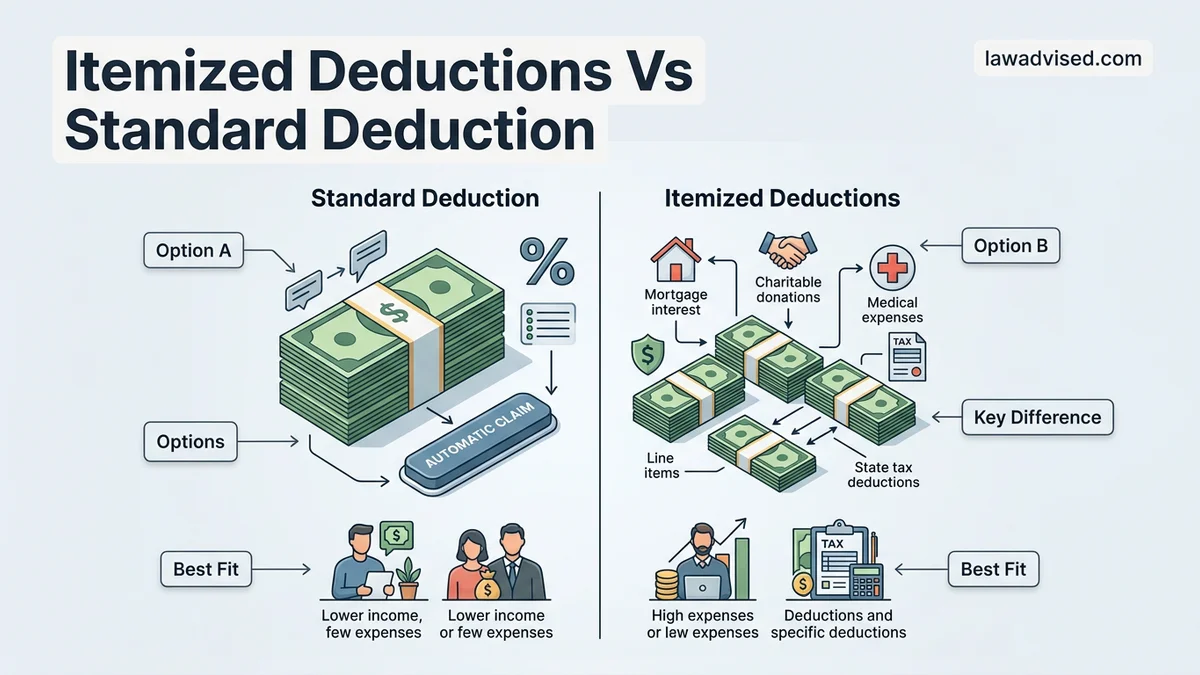
Choosing the standard deduction instead of itemizing is usually the easiest way to minimize your 2026 tax liability if your total deductible expenses fall below the inflation-adjusted threshold. For the vast majority of individual filers, the standard deduction offers an immediate, hassle-free reduction of taxable income without requiring a shoe-box full of receipts.
Deciding which path to take comes down to a simple math problem: does the total of your specific eligible expenses—like mortgage interest, state and local taxes, and charitable donations—exceed the flat dollar amount the IRS allots for your filing status in 2026? Getting this right directly impacts whether you keep more of your hard-earned money or accidentally overpay the government.
Key Takeaways
- Choose the standard deduction if your total eligible expenses fall below the current IRS threshold.
- Itemize if your qualified deductible expenses exceed the standard deduction amount for your filing status.
- Track mortgage interest, charitable donations, and state taxes to evaluate itemizing potential.
- Use tax software or a CPA to accurately calculate your personal break-even point.
- Reevaluate your deduction strategy annually as tax thresholds and personal finances change.
What Causes Confusion in Itemized Deductions vs Standard Deduction
The Myth of Mixing and Matching
Many taxpayers mistakenly believe they can claim both the standard deduction and itemize their favorite expenses, such as charitable gifts. The tax code strictly requires you to choose one method for the entire tax year. You either take the predetermined standard amount or add up every single qualifying expense you incurred.
Shifting Legislative Thresholds and Caps
Confusion often stems from how deduction limits change year over year. For 2026, the standard deduction amounts stand at higher levels than in previous years due to inflation adjustments. Additionally, caps like the 10,000 dollar limit on state and local taxes (SALT) trip up filers who assume every dollar of property and income tax they pay is fully deductible.
- Standard deduction amounts vary significantly by filing status (single, married filing jointly, head of household).
- Itemized deductions often face strict adjusted gross income (AGI) floor percentages, meaning you can only deduct the amount exceeding a certain percentage of your income.
- Fewer than 10 percent of taxpayers itemize nowadays because the high standard deduction clears the hurdle for most households.
How to Calculate and Compare Your Deductions Step by Step
Gathering and Tallying Your Potential Itemized Expenses
To see if itemizing makes sense for your 2026 return, you need to aggregate your potential write-offs before filing season begins. Create a preliminary list of the major categories allowed under current tax rules to establish your baseline itemized total.
- Calculate your total home mortgage interest paid throughout the year on up to 750,000 dollars of debt.
- Sum your state and local income or sales taxes, plus property taxes, keeping the 10,000 dollar SALT ceiling in mind.
- Add up all documented monetary and property donations made to qualified 501(c)(3) charitable organizations.
- Include out-of-pocket medical and dental expenses that exceed 7.5 percent of your 2026 adjusted gross income.
Comparing the Total Against Your 2026 Standard Deduction
Once you have a reliable grand total for your itemized expenses, compare that exact figure directly against the standard deduction threshold for your specific 2026 filing status. If your itemized total beats the standard threshold by even a few hundred dollars, itemizing is mathematically the right choice to lower your overall tax liability.
- If your itemized sum is lower than the standard deduction, take the standard deduction to save time and maximize your tax savings effortlessly.
- If you live in a high-cost-of-living area with steep property taxes and a large mortgage, running the numbers carefully is essential.
- Always use the official 2026 IRS inflation-adjusted thresholds, as using outdated figures will lead to an incorrect filing strategy.
How to Fix Record-Keeping Gaps for Common Itemized Expenses
Reconstructing missing documentation for the 2026 tax year requires a systematic approach, especially for volatile categories like charitable donations and medical out-of-pocket costs. According to IRS compliance guidelines, taxpayers bear the absolute burden of proof for every dollar claimed on Schedule A.
Reconstructing Charitable Donations
Missing receipts for cash or property contributions threaten your entire itemized threshold. To fix this gap, follow these sequential steps:
- Access your online banking portals and credit card statements from 2026 to export explicit line-item transactions for qualified 501(c)(3) organizations.
- Contact the recipient charity directly via email or phone to request a retroactive annual giving statement summarizing your total 2026 contributions.
- Cross-reference digital acknowledgment emails or cancelled checks with the organization’s official federal tax-exempt status using the IRS Tax Exempt Organization Search tool.
Recovering Medical Expense Records
Reaching the strict threshold for medical deductions demands exhaustive proof of unreimbursed healthcare costs. Execute these steps to capture missing figures:
- Log into patient portals for every pharmacy, hospital, and specialist you visited throughout 2026 to download complete annual billing ledger PDFs.
- Call your health insurance provider to request a comprehensive Year-End Explanation of Benefits (EOB) report detailing all out-of-pocket coinsurance and deductible payments.
- Review flexible spending account (FSA) or health savings account (HSA) annual statements to verify qualifying medical disbursements made during the tax year.
What If Your Eligible Expenses Fall Right on the Threshold
When your total itemized deductions sit within a narrow window of the 2026 standard deduction, minor miscalculations can cost you money. Financial advisors recommend evaluating strategic acceleration or bunching tactics to definitively clear the hurdle.
If your deductions hover too close to call, consider these advanced strategic adjustments:
- Bunch discretionary medical procedures, dental work, or elective prescriptions into the final months of 2026 to force your total past the percentage floor.
- Prepay your January 2027 state and local property taxes or charitable pledges before December 31, 2026, ensuring they clear your financial institution in time.
- Bundle multiple years of charitable contributions into a single tax year by utilizing a Donor-Advised Fund (DAF), immediately capturing a larger itemized deduction.
What If It Still Doesn’t Work?
If your calculated itemized deductions still fail to surpass the 2026 standard deduction threshold after exhaustive documentation, strategic maneuvers are necessary to protect your financial outcome.
Consider these four fallback steps when the numbers simply do not align:
- Accept the 2026 standard deduction to eliminate audit risk and drastically simplify your annual tax preparation process.
- Engage a Certified Public Accountant (CPA) or Enrolled Agent (EA) to review complex scenarios like passive activity losses or complex capital loss carryovers; professional fees typically range from $300 to $850 depending on return complexity.
- Utilize IRS-approved, 2026-certified tax preparation software that runs simultaneous calculations for both filing methods to guarantee absolute mathematical accuracy.
- Adjust your W-4 withholding selections with your employer for the upcoming year to optimize your cash flow if switching to the standard deduction alters your overall tax liability.
Conclusion
Navigating the complex choice between itemized deductions and the standard deduction for 2026 hinges on meticulous record-keeping and precise mathematical thresholds. According to verified research and tax policy experts, failing to properly evaluate both filing methods often results in thousands of dollars of overpaid federal taxes. Your immediate actionable next step is to run a preliminary digital audit of your 2026 receipts and compare that exact aggregate sum against the updated standard deduction limits before finalizing your tax return.
❓ Frequently Asked Questions
What happens if my itemized deductions are slightly lower than the standard deduction?
You should always choose the standard deduction if it is higher than your total itemized amount. Taking the higher deduction directly lowers your taxable income as much as legally possible.
Are there limits on how much I can claim for itemized deductions?
Yes, certain itemized deductions have specific caps. For example, the state and local tax (SALT) deduction is capped at $10,000, and medical expenses must exceed a certain percentage of your adjusted gross income.
Do I need to keep receipts if I take the standard deduction?
No, if you take the standard deduction, you do not need to provide receipts or document specific personal expenses to the IRS.
Can married couples filing separately choose different deduction methods?
If one spouse itemizes deductions, the other spouse must also itemize and cannot take the standard deduction. Both must coordinate their filing strategy.
How do charitable donations affect the choice between standard and itemizing?
Charitable contributions only reduce your taxable income if you choose to itemize your deductions. If you take the standard deduction, standard charitable write-offs generally do not apply.
Does owning a home automatically mean I should itemize?
Not necessarily. While mortgage interest and property taxes are common itemized deductions, the higher modern standard deduction thresholds mean many homeowners still benefit more from the standard deduction.

Ismail Hossain is the founder of Law Advised. He is an Divorce, Separation, marriage lawyer. Follow him.