Who Qualifies for Child Tax Credit 2026 Expert Guide
Navigating the rules for claiming tax benefits can be confusing, but knowing who qualifies for the Child Tax Credit ensures you do not miss out on vital savings. This guide breaks down the exact IRS age, income, and relationship requirements you must meet for the 2026 tax year.
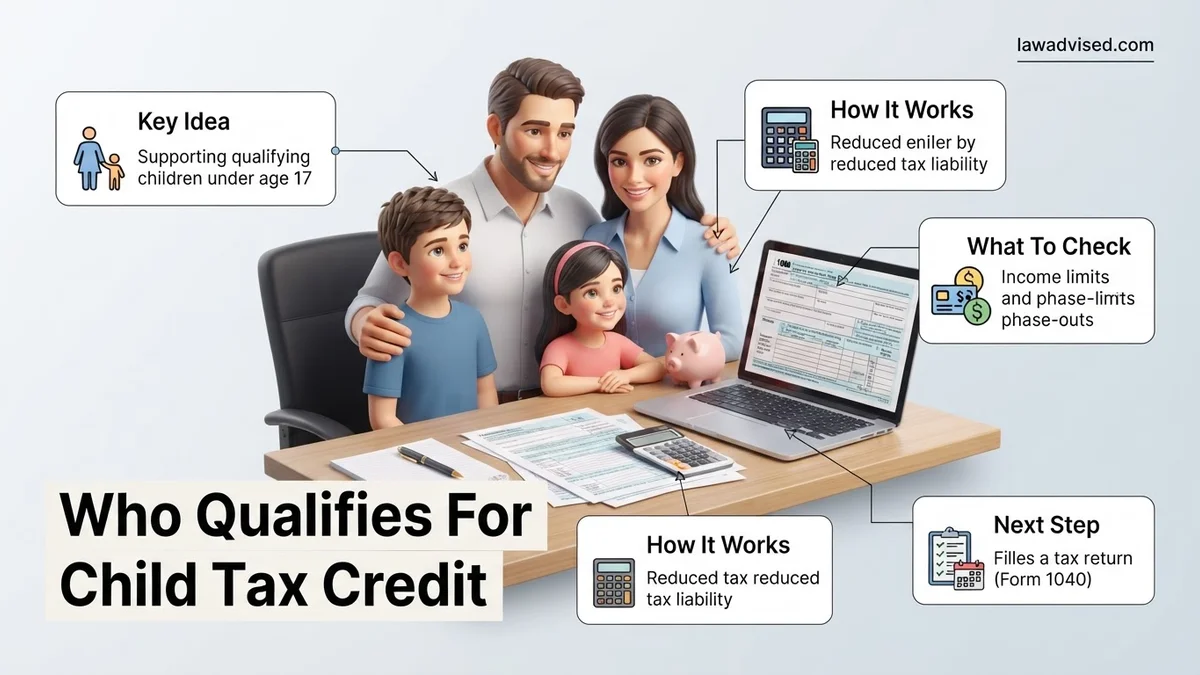
To qualify for the Child Tax Credit for the 2026 tax year, your dependent generally must be under the age of 17 at the end of the year, hold a valid Social Security number, and pass specific relationship, residency, and financial support tests. Additionally, your Modified Adjusted Gross Income (MAGI) must fall below the IRS phase-out thresholds to receive the full or partial credit.
Navigating these IRS rules prevents costly processing delays and ensures you claim the maximum financial benefit you deserve. Meeting these strict criteria is the only way to secure the credit when you file your 2026 federal tax return.
Key Takeaways
- The qualifying child must be under the age of 17 by the end of the tax year.
- A valid Social Security Number is required for the child before the tax return due date.
- Modified Adjusted Gross Income limits determine if your credit amount phases out completely.
- The child must be claimed as a dependent on your federal tax return.
- Residency rules require the child to live with you for more than half the year.
What Causes Eligibility Confusion for the Child Tax Credit
Taxpayers often struggle to claim the Child Tax Credit correctly because IRS definitions for dependents and income limits change frequently. Misinterpreting a single rule regarding a child’s age at year-end or misunderstanding how support is calculated can lead to an IRS audit or a rejected claim.
The Age and Social Security Number Traps
Many parents assume that if a child turns 17 during the tax year, they still qualify for the Child Tax Credit. Under IRS rules for 2026, the dependent must be under the age of 17 on the final day of the tax year, meaning their 17th birthday must fall on or after January 1, 2027. Furthermore, the child must possess a valid Social Security number issued before the due date of the 2026 tax return, including extensions. Dependents with an Individual Taxpayer Identification Number (ITIN) do not qualify for this specific credit.
Relationship and Residency Misunderstandings
Eligibility also hinges on proving your exact relationship to the child and meeting strict residency timelines. You must be able to claim the individual as your dependent.
- Qualifying Relationships: Must be your son, daughter, stepchild, eligible foster child, brother, sister, stepbrother, stepsister, or a descendant of any of these individuals.
- Residency Test: The child must live with you for more than half of the 2026 tax year, with standard exceptions for temporary absences like school, medical treatment, or vacation.
- Support Rule: The child cannot have provided more than 50 percent of their own financial support during the 2026 tax year.
How to Fix Your Claim By Verifying IRS Qualifications Step-by-Step
You can eliminate guesswork by auditing your dependent’s information against official IRS standards before submitting your 2026 tax return. Taking a structured, step-by-step approach ensures you catch discrepancies in age, residency, and income limits beforehand.
Step 1: Check Income and MAGI Thresholds
Even if your child meets every age and relationship rule, your income level determines whether you actually receive the credit. For the 2026 tax year, the Child Tax Credit begins to phase out for single filers with a Modified Adjusted Gross Income (MAGI) over $200,000, and for married couples filing jointly with a MAGI over $400,000.
- Calculate your total gross income and apply standard adjustments to find your MAGI.
- If your income exceeds the $200,000 or $400,000 thresholds, the credit reduces by $50 for every $1,000 your income exceeds the limit.
- Review alternative credits like the Credit for Other Dependents if your child has aged out of the primary Child Tax Credit.
Step 2: Document Residency and Support Records
The IRS occasionally requests proof that a dependent lived with you for the required duration. Keep a paper trail that clearly establishes the child’s primary address throughout 2026.
- Gather school report cards, medical records, or day-care statements showing your home address as the child’s primary residence.
- Keep receipts for food, clothing, and shelter expenses to easily prove you supplied more than half of the child’s annual financial support.
- Verify that no other taxpayer is attempting to claim the same child as a dependent on a separate return.
What If Your Income Exceeds Phase-Out Limits and Still Doesn’t Work
High-income earners often find themselves just above the eligibility thresholds for the Child Tax Credit in 2026. When standard phase-out rules reduce your credit to zero, you must evaluate alternative strategies to capture remaining tax benefits.
Alternative Tax Reduction Strategies
If your modified adjusted gross income surpasses the complete phase-out ceiling, traditional eligibility drops away. However, expert tax planners recommend exploring adjacent financial mechanisms to offset household expenses.
- Contribute aggressively to a traditional 401(k) or IRA to artificially lower your modified adjusted gross income below threshold boundaries.
- Utilize a flexible spending account or dependent care flexible spending account to lower taxable income through childcare cost deductions.
- Review potential eligibility for the Credit for Other Dependents if your children or relatives no longer meet the strict age requirements for the primary child tax credit.
- Consult verified IRS publications to calculate precise phase-out reductions using the exact modified adjusted gross income worksheet for the 2026 tax year.
What If It Still Doesn’t Work?
Navigating complex tax limits can result in blocked claims or unexpected denials. If initial troubleshooting fails to secure your 2026 Child Tax Credit, take these concrete steps:
- Gather all official documentation, including social security cards, birth certificates, and proof of residency covering at least half of the tax year.
- Run a comprehensive diagnostic check using updated commercial tax preparation software designed for the 2026 tax code to isolate calculation errors.
- Hire a certified public accountant or an enrolled agent to review your return for overlooked deductions and statutory adjustments. Professional tax advisory fees typically range from $300 to $800 depending on complexity.
- Contact the IRS dedicated helpline or schedule an appointment at a local Taxpayer Assistance Center for direct institutional guidance.
Conclusion
Qualifying for the Child Tax Credit in 2026 requires careful tracking of age thresholds, residency tests, and income phase-out limits. When initial claims fail due to documentation errors or income caps, strategic financial adjustments and professional intervention can resolve eligibility barriers. According to verified research and expert tax sources, proactive planning remains the most effective defense against accidental credit loss. Your immediate next step is to review your projected modified adjusted gross income and verify that every dependent meets all foundational IRS criteria before filing your return.
❓ Frequently Asked Questions
What are the exact relationship rules to claim the Child Tax Credit?
To qualify, the child must be your son, daughter, stepchild, eligible foster child, brother, sister, stepbrother, stepsister, or a descendant of any of these individuals, such as a grandchild.
How long must the child live with me to qualify?
The IRS requires that the qualifying child shares a principal place of abode with you for more than half of the tax year, with specific temporary absence exceptions like school or medical care.
What happens if my income is above the phase-out threshold?
If your Modified Adjusted Gross Income exceeds the threshold for your filing status, the credit amount begins to reduce at a rate of $50 for each $1,000 that your income exceeds the limit.
Can I claim the Child Tax Credit if I have an Individual Taxpayer Identification Number (ITIN)?
The qualifying child must have a Social Security Number valid for employment in the United States. Children with ITINs generally do not qualify for the main Child Tax Credit.
Does the child have to provide their own financial support?
No, the requirement is that the child cannot have provided more than half of their own financial support during the tax year.
What documentation do I need to prove eligibility when filing?
You generally need the child’s full name and valid Social Security Number, along with financial records proving your income and that the child meets the residency and support tests.

Ismail Hossain is the founder of Law Advised. He is an Divorce, Separation, marriage lawyer. Follow him.