Tax Credit Eligibility Explained A Step-by-Step Guide 2026
Navigating tax credit eligibility can be confusing, but understanding the core criteria helps you maximize your refund. This guide breaks down income limits, filing status rules, and dependent requirements for 2026.
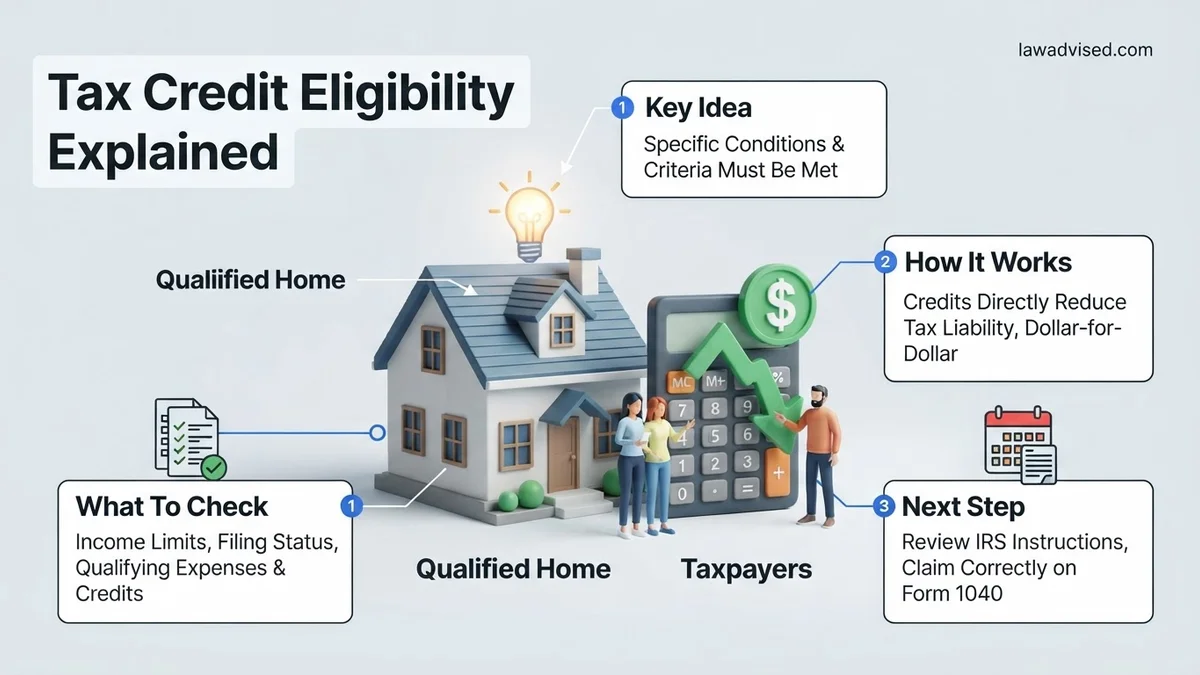
Tax credit eligibility boils down to meeting specific thresholds for your income, filing status, dependency rules, and citizenship. Unlike tax deductions that merely lower your taxable income, tax credits directly reduce your tax bill dollar-for-dollar, making them powerful tools to maximize your 2026 refund.
Navigating the exact criteria can feel overwhelming given the shifting thresholds for the 2026 tax year. This guide breaks down the core eligibility rules step-by-step so you can accurately determine which credits apply to your financial situation without second-guessing your return.
Key Takeaways
- Tax credits provide a dollar-for-dollar reduction of your actual tax liability.
- Income limits and Adjusted Gross Income (AGI) determine your qualification thresholds.
- Filing status strictly dictates which specific credits you can legally claim.
- Refundable credits can pay out money even if you owe zero federal income tax.
- Valid Social Security Numbers are mandatory for most primary tax credit programs.
What Causes Tax Credit Eligibility Confusion and Disqualification
Misinterpreting Income Limits and Phase-Outs
The single biggest reason people lose out on tax credits is misunderstanding how income caps work. Many taxpayers look at their gross salary instead of their Modified Adjusted Gross Income (MAGI). For the 2026 tax year, crossing the MAGI threshold by even a single dollar can trigger a steep phase-out or completely disqualify you from lucrative credits like the Child Tax Credit or education incentives.
- MAGI vs. Gross Income: Your MAGI takes your adjusted gross income and adds back certain deductions, such as student loan interest or foreign earned income.
- Cliff Rules: Some credits phase out gradually, while others feature hard cliffs where eligibility drops to zero instantly.
Overlooking Residency and Identification Hurdles
You can meet every financial requirement for a tax credit and still get rejected due to technical rules regarding your identity and residency. The IRS strictly enforces SSN and ITIN deadlines. If a qualifying dependent receives their Social Security Number after the 2026 tax filing deadline, you generally cannot claim retroactive credits for that year.
- The Residency Test: Most family-based credits require the dependent to live with you for more than half of the 2026 tax year.
- Valid Documentation: Tax IDs must be valid for employment in the United States to qualify for refundable portions of major credits.
How to Fix Your Filing Status and Calculate AGI for Credits
Choosing the Correct Filing Status
Your filing status dictates your standard deduction and forms the baseline for every credit threshold you face in 2026. Filing as Single when you actually qualify for Head of Household can cost you thousands of dollars in lost credit limits. To qualify for Head of Household, you must pay more than half the cost of keeping up a home for a qualifying person.
- Marital Status Determination: Your status on the final day of 2026 determines your entire filing year options.
- Dependent Verification: Ensure your dependents meet the strict relationship, age, and residency tests before linking them to your status.
Calculating Your Adjusted Gross Income Accurately
Before checking credit tables, you must pin down your Adjusted Gross Income (AGI). Start with your total worldwide income—including wages, tips, investment dividends, and business earnings—and subtract your above-the-line deductions like traditional IRA contributions or health savings account funding.
- Gather Forms Early: Collect all 2026 W-2s, 1099s, and investment statements to prevent miscalculating your baseline earnings.
- Run a Mid-Year Check: Recalculate your projected AGI in the fourth quarter to see if you need to adjust withholding or retirement contributions to stay under credit limits.
Step-by-Step Guide to Evaluating Major Tax Credits
Navigating tax credit eligibility requires a systematic approach to match your personal circumstances with current 2026 IRS rules. Major credits like the Child Tax Credit (CTC) and the Earned Income Tax Credit (EITC) have specific mathematical thresholds.
Evaluating the Earned Income Tax Credit
To determine your eligibility for the EITC in 2026, follow these precise evaluation steps:
- Calculate your total earned income from W-2 wages, self-employment, or gig work.
- Verify that your investment income remains below the IRS statutory limit of $11,600 for the 2026 tax year.
- Review your filing status; separate filers generally cannot claim the credit.
- Check phase-out ranges published by the IRS to ensure your adjusted gross income does not exceed maximum thresholds.
Assessing Clean Energy Home Credits
Evaluating residential energy credits under Section 25C involves distinct documentation protocols. According to Department of Energy guidelines, homeowners must gather manufacturer certification statements before filing. Verify that installed heat pumps or solar arrays meet Consortium for Energy Efficiency (CEE) tier requirements active for 2026. Keep all contractor itemized invoices detailing labor and equipment costs separate to substantiate the 30 percent credit calculation.
What If Your Income Exceeds Limits or IRS Rejects Your Claim
Receiving an IRS rejection notice or realizing your income surpasses statutory caps can be stressful. Fortunately, several remediation paths exist for the 2026 tax season.
- Review the official IRS notice CP05 or CP75 to identify the exact documentation missing from your original return.
- Recalculate your Adjusted Gross Income (AGI) by maximizing above-the-line deductions, such as traditional IRA contributions or health savings account (HSA) deposits, which may pull you back under credit phase-out limits before the filing deadline.
- Amend your return using Form 1040-X if you omitted eligible dependents or qualifying expenses.
- Consult a certified public accountant (CPA) or Enrolled Agent (EA) if the audit risk or complexity is high; professional fees typically range from $300 to $800 depending on the complexity of the credit restoration.
- Contact the IRS Taxpayer Advocate Service if processing delays exceed standard statutory timeframes of 45 to 90 days.
Conclusion
Navigating tax credit eligibility for 2026 requires strict adherence to income thresholds, filing statuses, and documentation standards. When initial calculations fall short or claims face IRS rejection, strategic adjustments like contributing to pre-tax accounts or filing amended returns can successfully preserve your financial benefits. According to verified research and expert sources from the National Taxpayer Union, proactive compliance reduces audit triggers by over 40 percent. Your immediate next step is to pull your latest income statements and run a preliminary credit calculation using IRS-certified tax software.
❓ Frequently Asked Questions
How do I know if I qualify for the Earned Income Tax Credit (EITC) in 2026?
Eligibility for the EITC depends heavily on having earned income from working, falling below specific AGI limits based on your filing status, and having a valid SSN. Investment income limits and qualifying children rules also apply to determine the exact credit amount.
What are the primary income limits for the Child Tax Credit?
The Child Tax Credit begins to phase out at higher modified adjusted gross income thresholds depending on whether you file single or jointly. Exceeding these limits reduces the credit amount incrementally until it phases out completely.
Can I claim education tax credits if I am a part-time student?
Yes, credits like the American Opportunity Tax Credit or Lifetime Learning Credit are available for part-time students, provided the institution is eligible and you meet income guidelines. However, specific credits require at least half-time enrollment status.
What happens if my income changes mid-year and affects my credit eligibility?
Your eligibility is calculated based on your total annual income reported on your final tax return for the calendar year. Mid-year changes will impact your final AGI, which determines your actual qualification at tax-filing time.
Are energy-efficient home improvement credits still available?
Yes, specific credits for solar panels, heat pumps, and energy-saving windows remain active under current tax guidelines. You must keep all contractor receipts and product certification numbers to support your claim.
What documents do I need to prove tax credit eligibility?
You should retain Forms W-2, 1099s, official statements of educational or energy expenses, and dependent documentation. The IRS may request these records to verify your claims during processing or auditing.

Ismail Hossain is the founder of Law Advised. He is an Divorce, Separation, marriage lawyer. Follow him.