Child and Dependent Care Credit Explained 2026 Guide
The Child and Dependent Care Credit is a tax break that helps working parents offset the cost of daycare, babysitters, and day camps. Unlike a tax deduction, a tax credit directly reduces your tax liability dollar-for-dollar based on your income and eligible expenses.
The Child and Dependent Care Credit is a tax break that helps working parents and guardians offset the high costs of daycare, babysitting, and day camps so they can maintain employment. Unlike deductions that merely lower your taxable income, this is a non-refundable tax credit that directly reduces your actual tax liability dollar-for-dollar based on a sliding scale tied to your income.
Navigating the rules for the 2026 tax year requires understanding who qualifies, what care expenses are actually eligible, and how your adjusted gross income dictates your final credit percentage. Getting these details right ensures you do not leave hundreds or thousands of dollars of eligible tax savings on the table when you file your return.
Key Takeaways
- The credit covers up to 35% of qualifying childcare expenses depending on your income level.
- Maximum eligible expenses are $3,000 for one dependent and $6,000 for two or more.
- Both you and your spouse (if filing jointly) must have earned income from a job or self-employment.
- You must report the care provider’s name, address, and Tax ID number on IRS Form 2441.
- This credit is separate from the standard Child Tax Credit and the Earned Income Tax Credit.

What Causes the Child and Dependent Care Credit to Apply: Eligibility and Qualifying Expenses
Who Qualifies for the Credit
To claim the Child and Dependent Care Credit in 2026, you must meet specific taxpayer and dependent criteria. You generally must have earned income from a job, business, or active looking for work, and your filing status cannot be married filing separately.
- Qualifying Individuals: Your dependent child must be under age 13 when the care is provided, or you must care for a spouse or dependent of any age who is physically or mentally incapable of self-care and lives with you for more than half the year.
- Earned Income Requirement: Both you and your spouse (if filing jointly) must have earned income. If one spouse is a full-time student or disabled, special rules apply to impute a monthly earned income.
Qualifying Expenses and Care Providers
Not every out-of-pocket payment for children qualifies for the credit. The expense must be incurred specifically to allow you (and your spouse, if married) to work or actively look for work.
- Eligible Care Types: Licensed daycares, nursery schools, before- and after-school care programs, summer day camps, and payments to babysitters or in-home care providers all count. Note that overnight camps do not qualify.
- Provider Requirements: You must report the care provider’s name, address, and Taxpayer Identification Number (SSN or EIN) on your tax return. Payments made to your own dependent children under age 19 or to your spouse do not qualify.
How to Calculate Your Child and Dependent Care Credit Step-by-Step
Expense Limits and Caps
The calculation of your credit starts with capping the total amount of care expenses you can claim each year. These limits depend entirely on the number of qualifying individuals you have.
- One Qualifying Individual: You can claim a maximum of 3,000 dollars in expenses per year.
- Two or More Qualifying Individuals: You can claim a maximum of 6,000 dollars in expenses per year.
- Employer-Provided Assistance: If your employer offers a dependent care flexible spending account (FSA), you must subtract any pre-tax dollars contributed to that account from your maximum allowable expense cap.
Applying the Sliding Scale Percentage
Once you determine your total eligible expenses up to the cap, you multiply that number by a percentage determined by your Adjusted Gross Income (AGI) for 2026. This percentage scales down as your income rises.
- Maximum Percentage: The credit percentage starts at 35 percent for families with an AGI of 15,000 dollars or less.
- Graduated Reduction: The percentage drops by one percentage point for each 2,000 dollars (or fraction thereof) of AGI above 15,000 dollars, until it floors at 20 percent for incomes above 43,000 dollars.
- Practical Example: If your AGI is 50,000 dollars (giving you the minimum 20 percent rate) and you spend 6,000 dollars on care for two children, your total credit is 1,200 dollars (20 percent of 6,000 dollars).
How to Claim the Child and Dependent Care Credit Using Form 2441
Claiming the Child and Dependent Care Credit requires filing Form 2441 along with your federal income tax return. According to Internal Revenue Service instructions, you must attach this form to Form 1040 or Form 1040-SR to properly calculate your allowable credit for the 2026 tax year.
Gathering Necessary Information
Before you begin filling out the paperwork, you must collect specific records from your childcare provider. Accurate record-keeping ensures your claim withstands potential IRS automated matching programs.
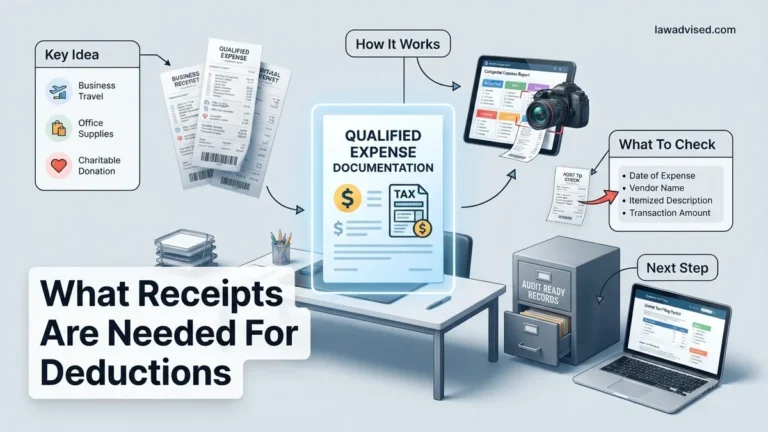
- Obtain the exact legal name, current address, and taxpayer identification number of your care provider.
- Locate your provider’s Employer Identification Number, or use their Social Security Number if they are an individual in-home provider.
- Compile all year-end statements, canceled checks, or digital payment receipts proving the exact amounts paid during 2026.
Completing the Form Sections
Form 2441 contains three distinct parts that require careful completion to maximize your tax savings. According to tax compliance guidelines, errors in reporting earned income frequently trigger processing delays.
- Complete Part I by listing the names, addresses, and taxpayer identification numbers of all qualifying persons and care providers.
- Proceed to Part II to calculate your earned income limitations and determine the smaller of your actual expenses or your earned income caps.
- Finish Part III by applying your adjusted gross income percentage to your qualified expenses to calculate your final credit amount.
What If It Still Doesn’t Work?
If your tax software rejects your Form 2441 or your calculated credit seems unexpectedly low, several systematic fallback steps can resolve the issue. Common filing roadblocks often stem from mismatched identification numbers or overlooked earned income thresholds.
- Double-check every digit of your care provider’s Employer Identification Number or Social Security Number against their official Form W-10 or year-end statement.
- Verify that both spouses have reported valid earned income on Form 1040, as unemployed or zero-income spouses generally invalidate the credit unless they are full-time students or disabled.
- Review your total expense calculations to ensure you have not accidentally included ineligible costs, such as overnight camp or educational tuition for kindergarten and above.
- Consult a certified public accountant or an enrolled agent if your household has complex self-employment income or multi-state care arrangements. Professional tax preparation assistance for 2026 generally ranges from $200 to $500 depending on regional complexity.
Conclusion
Navigating the rules for the Child and Dependent Care Credit ensures you retain more of your hard-earned income while working or looking for work. By accurately tracking your expenses, verifying provider identification details, and properly filing Form 2441, you can successfully claim your financial relief. According to verified research and expert financial sources, proactive documentation remains the single most effective way to prevent costly tax filing errors. Your next actionable step is to log into your childcare provider’s online portal today and download your official 2026 year-end payment summary.
❓ Frequently Asked Questions
What makes a dependent a qualifying individual for this tax credit?
A qualifying individual includes your dependent child under age 13, a spouse who is physically or mentally incapable of self-care, or another dependent who is incapable of self-care and lives with you for more than half the year.
What types of expenses actually qualify for the credit?
Qualifying expenses include amounts paid for daycare centers, nanny services, in-home babysitters, and before- or after-school care programs. Day camps and nursery schools also qualify, but overnight camp expenses are strictly excluded.
How does the sliding scale percentage work based on AGI?
The credit percentage ranges from 20% to 35% of your allowable expenses, depending on your Adjusted Gross Income (AGI). Higher earners receive the lowest percentage of 20%, while lower-income taxpayers can claim up to 35%.
What happens if my employer offers a dependent care flexible spending account (FSA)?
If you use a dependent care FSA through your job, you must subtract those pre-tax dollars from your maximum allowable expenses when calculating this tax credit. You cannot double-dip the same expenses for both the FSA and the credit.
Do I need the caregiver’s taxpayer identification number to claim the credit?
Yes, you must provide the caregiver’s correct name, address, and either their Social Security Number or Employer Identification Number (EIN) on Form 2441. If a provider refuses to supply this, you must complete specific sections showing you made a good-faith effort to obtain it.
Can stay-at-home parents qualify for the Child and Dependent Care Credit?
Generally, no, because both you and your spouse must have earned income from wages, salaries, tips, or self-employment to qualify. An exception is made if one spouse is a full-time student or is physically or mentally incapable of self-care.

Ismail Hossain is the founder of Law Advised. He is an Divorce, Separation, marriage lawyer. Follow him.