Dependent Tax Rules Explained Expert 2026 Guide
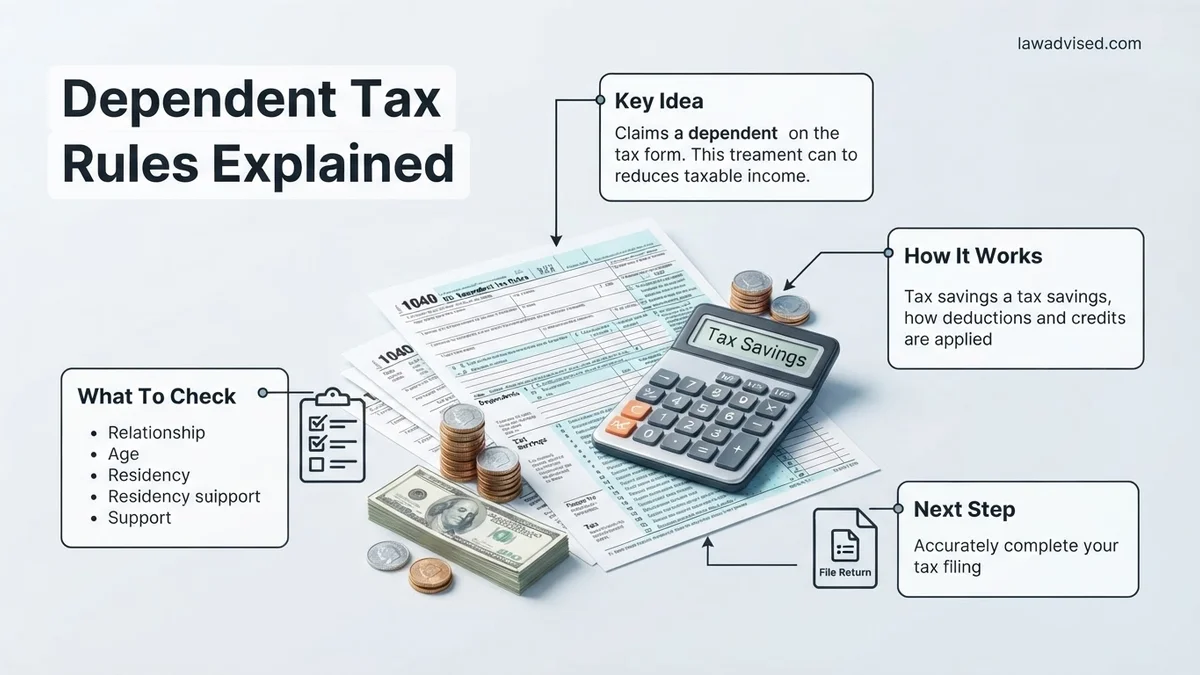
Navigating IRS dependency requirements can be complex, but dependent tax rules strictly divide dependents into two categories: Qualifying Child and Qualifying Relative. To legally claim someone, you must pass specific relationship, age, residency, income, and financial support tests.
Claiming a dependent on your 2026 tax return requires passing strict IRS tests that divide potential dependents into two categories: a qualifying child or a qualifying relative. If you miss even a single statutory requirement regarding age, residency, or financial support, the IRS will automatically reject your claim, strip away valuable credits like the Child Tax Credit, and assess back taxes with interest.
Navigating these exact IRS criteria protects you from costly audit adjustments. Whether you are supporting a college student, an aging parent, or a live-in partner, you must evaluate their specific financial situation against the federal rulebook for the 2026 tax year before filing.
Key Takeaways
- A qualifying child must pass five specific IRS tests including age, residency, and support.
- Qualifying relatives face strict gross income limits that restrict who you can claim.
- You must provide more than 50% of the dependent’s total financial support for the year.
- Claiming a dependent unlocks valuable tax benefits like the Child Tax Credit and Head of Household status.
- Married dependents generally cannot file a joint return unless it is only to claim a refund.
What Causes IRS Rejections Under Dependent Tax Rules
Failing the Tie-Breaker Rules
The most common trigger for an IRS audit or rejection happens when two different taxpayers try to claim the exact same dependent. This frequently occurs with divorced parents or multi-generational households. Under IRS tie-breaker rules, if a child qualifies as a dependent for more than one person, specific statutory hierarchies take effect. Parents always win over non-parents. Among parents, the parent with whom the child lived the longest during 2026 wins. If the child spent equal time with both, the parent with the highest adjusted gross income gets the deduction.
Income and Residency Discrepancies
Another major reason for rejection is miscalculating the gross income threshold for qualifying relatives or failing the physical residency test. If your relative earns more than the strict 2026 federal limit, or if your child lived outside your home for more than half the year without an approved temporary absence, the automated IRS matching systems will flag your return. Providing inaccurate support percentages—where you claim to pay over 50 percent of their living expenses without bank records to prove it—will instantly invalidate your claim.
How to Test and Qualify a Child Step-by-Step
The 5 Core Tests for a Qualifying Child
To successfully claim a child as your dependent for the 2026 tax year, they must pass five distinct IRS tests. If they fail any one of these, you cannot claim them under this category:
- Relationship Test: The child must be your son, daughter, stepchild, foster child, brother, sister, half-brother, half-sister, stepbrother, stepsister, or a descendant of any of them.
- Age Test: At the end of 2026, the child must be under age 19, or under age 24 if they are a full-time student for at least five months of the year. Permanently and totally disabled children have no age limit.
- Residency Test: The child must have lived with you for more than half of 2026, subject to temporary absences for school, medical care, or vacations.
- Support Test: The child cannot have provided more than half of their own financial support during 2026.
- Joint Return Test: The child cannot file a joint tax return for 2026 unless they are only filing to claim a refund of withheld income taxes.
Practical Example of the Student Age Exception
Consider a 21-year-old college student attending university full-time during the spring and fall semesters of 2026. Because they are under 24 and meet the student time requirement, they bypass the standard under-19 age cutoff. However, you must still prove that you provided over 50 percent of their total annual living costs, including housing, food, tuition, and books, keeping in mind that scholarships received by the student do not count as support provided by them.
How to Evaluate a Qualifying Relative for Tax Purposes
When an individual does not meet the strict age and relationship criteria for a qualifying child, they must be evaluated under the rules for a qualifying relative. According to IRS compliance data, this category frequently applies to aging parents, adult children, or extended household members living under your roof throughout the 2026 tax year.
The Gross Income Test
To successfully claim a qualifying relative in 2026, the individual’s gross taxable income must remain below the statutory threshold of $5,050 for the calendar year. Tax-exempt income, such as certain municipal bond interest or Supplemental Security Income (SSI), is excluded from this specific calculation by federal guidelines.
The Support Test
You must provide more than 50 percent of the individual’s total financial support for the entire calendar year. Financial support calculations encompass housing, food, medical care, clothing, transportation, and recreation. When multiple family members share support, a Multiple Support Declaration (IRS Form 2120) allows one eligible contributor to claim the dependent.
What If Your Dependent Claim Fails IRS Requirements
If your initial filing position or software audit reveals that your intended dependent fails the rigorous IRS dependency tests, immediate corrective action is necessary. Proceed through these verified alternative steps to resolve the discrepancy before submitting your return for the 2026 tax season.
- Review the specific support worksheet calculations again to ensure all household expenses, including fair rental value of lodging, were captured accurately.
- Verify whether a multiple support agreement can be executed with other contributing family members to legally shift the claim.
- Amend a previous filing or adjust current tax withholding via IRS Form W-4 if the dependent loss significantly impacts your anticipated tax liability.
- Consult a certified public accountant (CPA) or enrolled agent to evaluate alternative filing statuses, such as Head of Household, if you maintain a qualifying home.
- Engage specialized tax resolution counsel if the IRS issues a CP2000 notice or an automated underreporter inquiry regarding a disputed dependency claim.
Professional tax advisory fees for complex dependency disputes generally range from $250 to $600 per hour depending on CPA specialization and geographic market rates. Engaging qualified professionals early prevents costly audit penalties and ensures total compliance with current tax codes.
Conclusion
Navigating dependent tax rules requires strict adherence to income thresholds, support formulas, and residency timelines. When dependency claims fail, utilizing alternative filing statuses or amending withholding projections protects your financial standing. According to verified research and expert sources from the American Institute of CPAs (AICPA), proactive tax planning remains the most effective defense against costly IRS adjustments. Your actionable next step is to audit your dependent’s 2026 financial records today to confirm they satisfy all statutory tests before you officially file.
❓ Frequently Asked Questions
What are the five tests for a Qualifying Child?
The five tests are relationship, age, residency, support, and joint return. The child must be your son, daughter, sibling, or descendant, meet age requirements (under 19 or a full-time student under 24), live with you for more half the year, not provide over half of their own support, and not file a joint return with a spouse.
What are the four tests for a Qualifying Relative?
The four tests include not being a qualifying child, meeting the member of the household or relationship test, staying under the gross income limit, and meeting the support test where you provide over 50% of their financial needs.
What counts as financial support when calculating the 50% test?
Support includes food, lodging, clothing, education, medical and dental care, recreation, and transportation. You must compare the exact dollar amount you contributed against the total support provided by all sources, including the dependent themselves.
Can I claim my aging parent as a dependent?
Yes, parents often qualify as Qualifying Relatives if they meet the gross income test and you provide more than half of their total financial support for the year, even if they live in their own home or a care facility.
What happens if both parents try to claim the same child?
If parents file separately and claim the same child, the IRS applies tie-breaker rules. These favor the parent with whom the child lived longest, or the parent with the highest adjusted gross income if the child lived with both equally.
Are there citizenship or residency requirements for dependents?
Yes, a dependent generally must be a U.S. citizen, U.S. national, U.S. resident alien, or a resident of Canada or Mexico, with certain exceptions for adopted children.

Ismail Hossain is the founder of Law Advised. He is an Divorce, Separation, marriage lawyer. Follow him.