Qualifying Relative Rules 2026 Expert Step-by-Step Guide
Claiming a dependent requires passing four strict IRS dependency tests to avoid costly tax return rejections. This guide breaks down the relationship, gross income, support, and citizenship rules needed to qualify someone accurately in 2026.
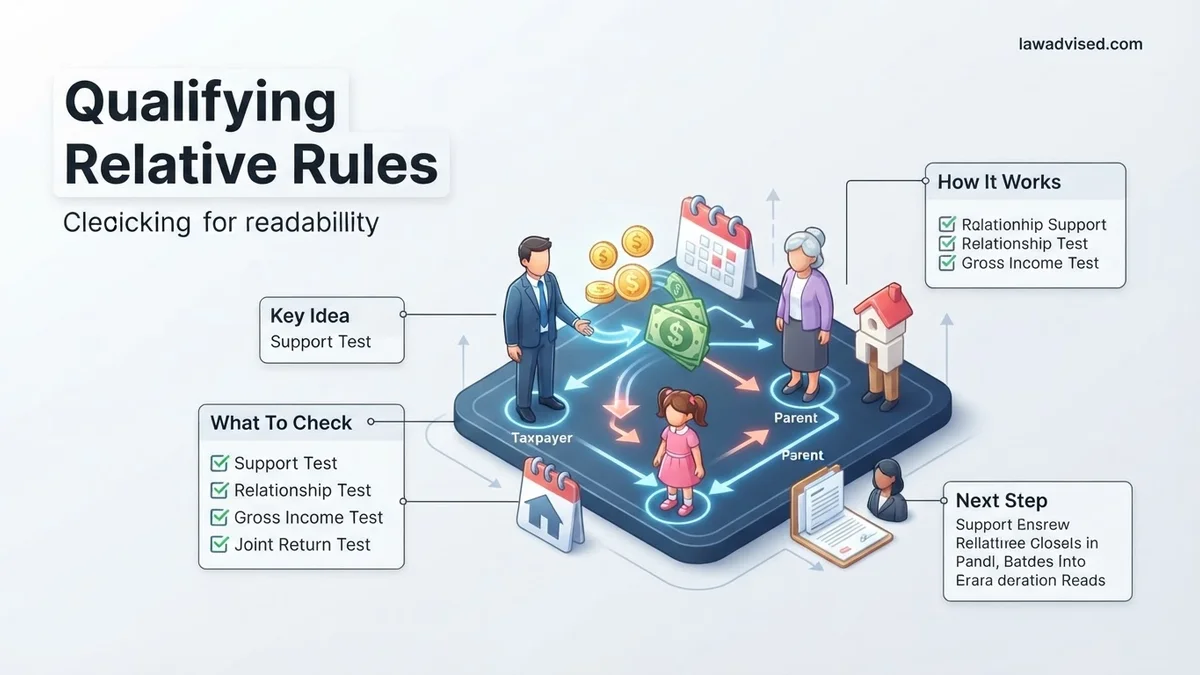
Claiming someone as a dependent under the qualifying relative rules for the 2026 tax year requires meeting four strict IRS tests: a relationship or household membership test, a gross income limit, a financial support test, and a citizenship or residency requirement. If you fail even one of these criteria, the IRS will automatically reject your claim, resulting in lost tax credits, audits, and delayed refunds.
Navigating these regulations accurately prevents costly tax mistakes. Whether you are supporting an aging parent, an adult child, or a roommate, understanding the exact legal thresholds keeps your tax filing compliant and maximizes your eligible deductions for 2026.
Key Takeaways
- Pass all four IRS tests before claiming a qualifying relative.
- Verify your dependent meets the specific gross income threshold for 2026.
- Calculate total living expenses to accurately prove the 50% support rule.
- Use a multi-support agreement if no single person provides over half of the support.
- Remember that qualifying relatives do not always need to live with you all year.
What Causes IRS Rejections Under Qualifying Relative Rules
Failing the Gross Income Limitation
The most common reason taxpayers fail qualifying relative claims is exceeding the income threshold. For the 2026 tax year, your potential dependent must have a gross income below the statutory limit set by the IRS (typically indexed around $5,000 to $5,300, depending on final cost-of-living adjustments). Gross income includes all taxable money received, such as wages, dividends, interest, rental income, and pensions. It does not include tax-exempt income like welfare benefits or social security (unless taxable under specific circumstances).
- Calculate total taxable income before making your final filing decision for 2026.
- Even earning one dollar over the threshold disqualifies the individual entirely.
- Tax-exempt assistance received by the relative does not count toward their gross income calculation.
Misunderstanding the Support Requirement
You must provide more than 50% of the individual’s total financial support for the entire calendar year 2026. Total support includes food, lodging, clothing, education, medical and dental care, recreation, and transportation. Taxpayers often assume paying for rent is enough, ignoring the total cost of living. If your relative spends their own savings or government benefits on their living expenses, those amounts count toward total support and must be factored into the math.
How to Test and Verify the Four Core Dependency Requirements
Test 1: Relationship or Member of Household Test
Your candidate must either fit an expanded family relationship or live with you all year as a member of your household. Unlike qualifying children, qualifying relatives do not need to be related to you by blood or marriage. If a friend or partner lives in your primary residence for the entire 365 days of 2026 and your relationship does not violate local law, they may pass this specific test.
- Approved relatives include children, parents, grandparents, brothers, sisters, uncles, aunts, nieces, nephews, and certain in-laws.
- Individuals who are not legally related must live in your home as their main residence for the entire year.
- Temporary absences for vacation, school, or medical treatment do not break the continuous household requirement.
Test 2: Citizenship, Residency, and Joint Return Tests
The final baseline rules dictate that your dependent must be a U.S. citizen, U.S. national, U.S. resident alien, or a resident of Canada or Mexico. Additionally, your dependent cannot file a joint tax return with a spouse for the 2026 tax year, unless they are filing solely to claim a refund of withheld income tax or estimated tax paid. Always review your dependent’s filing status alongside your own to ensure total compliance.
How to Calculate the 50% Support Test and Gross Income Limits
Mastering the mathematical thresholds is critical for successful dependency claims in 2026. The IRS requires you to account for all contributions made toward a qualifying relative’s total living expenses to pass the 50% support test.
Step-by-Step Support Calculation
- Total the annual costs: Add up all expenses for food, lodging, clothing, education, medical care, recreation, and transportation for the entire year of 2026.
- Calculate the dependent’s contribution: Determine how much of their own income the relative spent on their own support, including tax-exempt income, Social Security benefits, and borrowed funds spent on living expenses.
- Factor in lodging fair market value: If the relative lives in your home rent-free, calculate the fair rental value of the lodging and include it as part of your support contribution.
- Compare the ratios: Divide the amount you provided by the total support pool. Your contribution must equal or exceed 50.1 percent for the test to pass.
Gross Income Thresholds
According to Internal Revenue Service inflation adjustments for 2026, a qualifying relative cannot have gross income exceeding the statutory threshold, which typically tracks index figures near $5,100. Tax experts at the National Association of Tax Professionals emphasize that tax-exempt income, such as certain municipal bond interest, is excluded from this specific gross income calculation, but Social Security benefits count if taxable.
What If Your Dependent Claim Fails or Requires a Multi-Support Agreement
If financial contributions from multiple family members mean no single person crosses the 50% support threshold alone, you may still be able to claim the relative through specialized IRS mechanisms.
Implementing a Multiple Support Declaration
- Verify the baseline group contribution: Ensure the combined support provided by you and other eligible individuals totals more than 50 percent of the relative’s total support for 2026.
- Meet the individual minimum: Confirm that your personal contribution exceeds 10 percent of the total support costs for the tax year.
- Secure Form 2120: Obtain IRS Form 2120 (Multiple Support Declaration) from every other person who contributed more than 10 percent and agree who will take the exemption.
- Attach to your return: File the signed declarations with your 2026 federal income tax return to legally designate the claim.
What If It Still Doesn’t Work?
When complex family financial arrangements or overlapping claims prevent a successful qualifying relative deduction in 2026, taxpayers must pursue structured fallback options.
- Amend prior support records: Re-examine omitted expenses like medical bills or insurance premiums to see if your support percentage actually cleared the 50 percent mark.
- Explore Head of Household filing status: Check if you qualify for Head of Household status independently of the dependent claim if you paid more than half the cost of keeping up your home for a qualifying person.
- Consult a licensed CPA: Engage a certified public accountant or enrolled agent to untangle multi-source income streams and conflicting family claims. Professional tax advisory fees typically range from $300 to $600 for specialized dependency reviews.
- Utilize IRS Taxpayer Assistance Centers: Schedule an appointment with a local IRS office for official guidance on disputed dependency determinations before filing your return.
Conclusion
Navigating qualifying relative rules requires meticulous tracking of income thresholds, living expenses, and support ratios to withstand IRS scrutiny. By accurately calculating your financial contributions and utilizing multi-support agreements when necessary, you can secure valuable tax benefits while remaining fully compliant. According to verified research and expert tax advisory sources, proactive documentation remains the single most effective defense against filing errors and subsequent audits. Take the actionable next step today by auditing your potential dependent’s 2026 financial records against current IRS thresholds before tax season opens.
❓ Frequently Asked Questions
What counts as financial support when calculating the 50% support rule?
Support includes food, lodging, clothing, education, medical and dental care, recreation, and transportation. You must compare the total amount you provided against the total support the individual received from all sources, including their own income.
What happens if multiple family members contribute to someone’s support but no one reaches 50%?
If a group of people together provide more than 50% of the support—and any one of them could otherwise claim the person—you can use IRS Form 2120 to execute a multiple support agreement designating one person to claim the exemption.
Does tax-exempt income count toward the gross income test?
No, tax-exempt income such as welfare benefits or tax-free municipal bond interest is generally excluded when calculating the gross income limit for a qualifying relative.
Can a married person be claimed as a qualifying relative?
Generally, you cannot claim a married person as a qualifying relative if they file a joint return with their spouse, unless they are filing only to claim a refund of withheld income tax and no tax liability exists for either spouse.
Is citizenship or residency required to claim a qualifying relative?
Yes, the individual must be a U.S. citizen, U.S. national, U.S. resident alien, or a resident of Canada or Mexico for some part of the calendar year.
How does a qualifying relative differ from a qualifying child?
A qualifying child is bound by age limits, student status, and specific relationship rules without a strict gross income limit, whereas a qualifying relative has a strict gross income limit and no age restrictions.

Ismail Hossain is the founder of Law Advised. He is an Divorce, Separation, marriage lawyer. Follow him.