Charitable Contribution Deduction Explained 2026
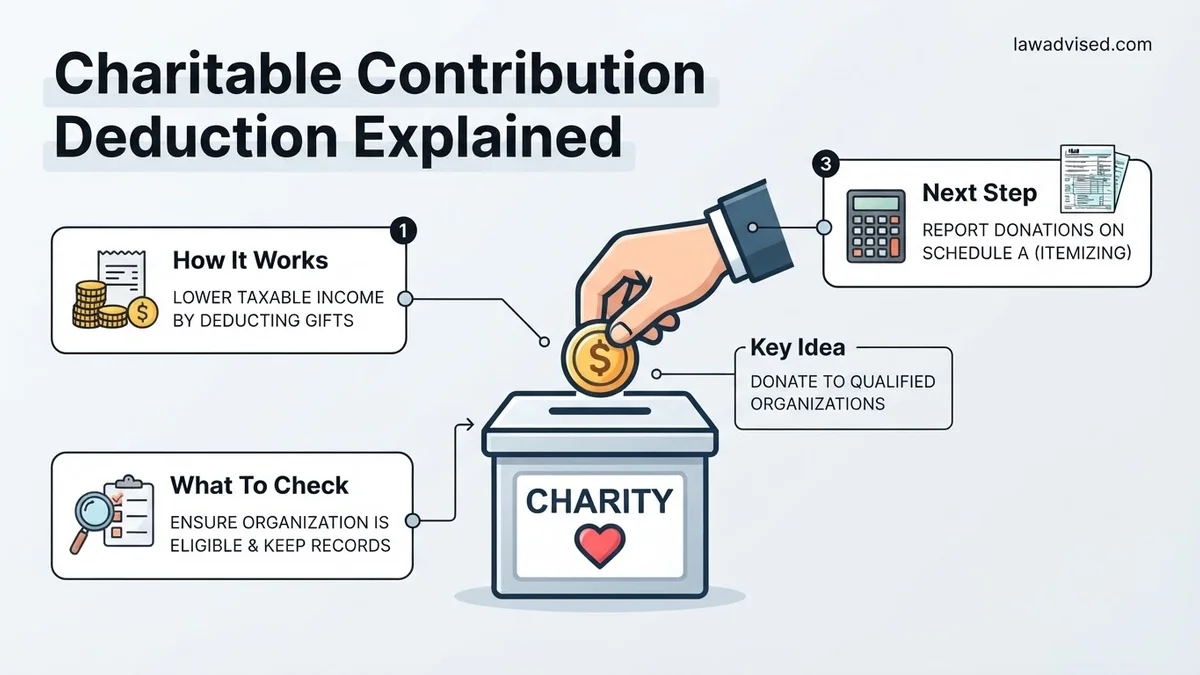
Navigating the rules for writing off donations requires understanding that you must itemize deductions on your tax return rather than taking the standard deduction to claim most charitable gifts. To qualify, contributions must go to IRS-recognized 501(c)(3) organizations, and you must maintain strict documentation like bank records and written acknowledgments for gifts over $250.
The charitable contribution deduction allows you to reduce your taxable income by donating money or property to qualifying organizations, provided you choose to itemize your deductions rather than take the standard deduction. For the 2026 tax year, claiming these write-offs requires navigating specific Adjusted Gross Income percentage caps, stringent 501(c)(3) entity rules, and strict IRS documentation thresholds that prevent you from losing your tax savings to an audit.
Maximizing this tax benefit depends entirely on matching your donation type with the correct IRS limitations and keeping meticulous proof of your generosity. Below, we break down the core mechanics, eligibility rules, and compliance requirements you need to know to successfully claim your charitable deductions on your 2026 tax return.
Key Takeaways
- You must itemize deductions on Schedule A to claim charitable contributions.
- Donations are only deductible if given to qualified 501(c)(3) tax-exempt organizations.
- Cash contributions are generally limited to 60% of your Adjusted Gross Income (AGI).
- You need written acknowledgment from the charity for any single donation of $250 or more.
- Form 8283 is required for non-cash property donations exceeding $500 in total value.
What Causes Confusion With Charitable Contribution Deductions
The Itemization Dilemma
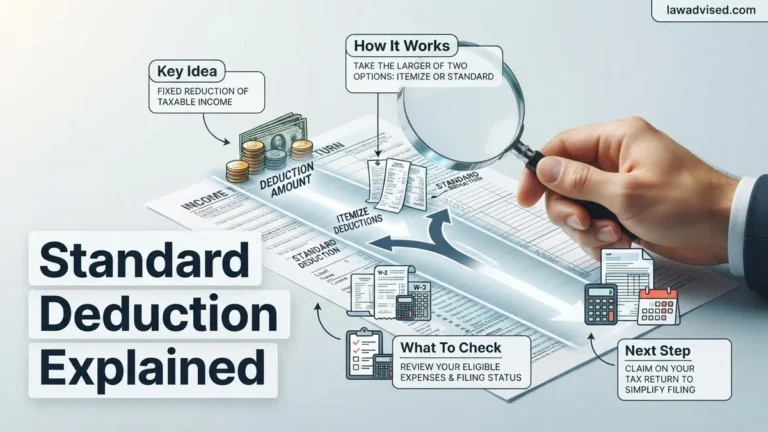
Many taxpayers assume they can claim a charitable deduction regardless of how they file. In reality, you must itemize your deductions on Schedule A to write off charitable gifts. If your total itemized deductions—including state and local taxes, mortgage interest, and medical expenses—do not exceed the standard deduction threshold for 2026, your charitable contributions will yield zero tax savings. You need to calculate whether itemizing makes financial sense before expecting a tax break.
Mixing Up Cash Versus Non-Cash Limits
Another frequent point of confusion is the sliding scale of Adjusted Gross Income limits. The IRS does not treat a cash donation the same way it treats a donation of used clothing, corporate stock, or real estate. Cash contributions to public charities generally face a generous limit of up to 60 percent of your AGI. Non-cash property, however, is subject to much tighter caps ranging from 20 percent to 30 percent depending on the type of asset and the holding period.
- Cash contributions to public charities are capped at 60 percent of AGI for 2026.
- Capital gain property donations (like appreciated stock) are typically capped at 30 percent of AGI.
- Private foundations carry lower limits, usually capped at 20 percent to 30 percent of AGI.
How to Determine If Your Donation Qualifies for a Tax Write-Off
The 501(c)(3) Rule
Your deduction is only as good as the organization receiving it. To qualify for a tax write-off in 2026, the recipient must hold official tax-exempt status under Section 501(c)(3) of the Internal Revenue Code. This includes public charities, religious organizations, nonprofit schools, and specific war veterans groups. Giving money directly to a struggling neighbor, a crowdfunding campaign for an individual, or a political candidate will never qualify as a deductible charitable contribution.
Evaluating Quid Pro Quo Contributions
If you receive goods or services in exchange for your donation—such as charity gala dinner tickets, a t-shirt, or a round of golf—you cannot deduct the full amount. This is known as a quid pro quo contribution. You may only deduct the portion of your payment that exceeds the fair market value of the benefit you received. Charities are legally required to provide a written disclosure statement for any quid pro quo contribution exceeding 75 dollars detailing this exact breakdown.
- Verify the organization has active 501(c)(3) status using the IRS Tax Exempt Organization Search tool.
- Subtract the fair market value of any goods or services received from your total payment.
- Ensure your contribution is irrevocable and transfers complete ownership to the charity.
Step-by-Step Guide to Calculating AGI Limits and Itemizing Your Gifts
Maximizing your tax savings in 2026 requires understanding how the Internal Revenue Service caps your annual deductions based on your Adjusted Gross Income (AGI). Different types of donations to qualified 501(c)(3) organizations carry distinct percentage limits that dictate how much you can write off in a single tax year.
Assessing Your Cash versus Non-Cash Limits
Cash contributions to public charities generally face a generous limit of up to 60 percent of your AGI. Contributions of appreciated capital gain property, such as stocks or real estate held for more than a year, are typically capped at 30 percent of your AGI. Follow this procedural framework to determine your exact deduction threshold:
- Calculate your total AGI for the 2026 tax year using your preliminary income and adjustment figures.
- Separate your total donations into cash gifts and non-cash property contributions.
- Apply the 60 percent AGI cap to your total qualified cash contributions.
- Apply the appropriate 30 percent or 20 percent AGI caps to your non-cash asset donations based on the recipient organization type.
- Compare your total combined deductions against the overarching 50 percent aggregate limitation rule for mixed contribution types.
If your total charitable gifts exceed these thresholds, the IRS allows you to carry forward the excess deduction for up to five subsequent tax years. Proper tracking ensures you never forfeit valuable tax relief.
What If Your Documentation Is Missing or Your Non-Cash Deduction Gets Flagged?
An incomplete paper trail or an unusually high non-cash valuation can trigger automated IRS notices or formal audits during the 2026 filing season. Maintaining strict compliance protects your financial standing. Implement these corrective measures if your return faces scrutiny or missing records:
Resolving Documentation Gaps and Audit Triggers
Substantiation rules become increasingly strict as the value of your gift rises. Execute these steps to resolve missing paperwork or audit flags:
- Contact the recipient charitable organization immediately to request a duplicate contemporaneous written acknowledgment for gifts valued at $250 or more.
- Gather alternative proof of payment, such as verified bank statements, credit card receipts, or canceled checks, to substantiate cash donations.
- Obtain a retroactive qualified appraisal if your non-cash deduction exceeded $5,000 and you initially failed to attach a completed Form 8283.
- Respond to IRS correspondence within the designated 30-day window by submitting your reconstructed documentation via certified mail or the official online portal.
- Engage a licensed Certified Public Accountant or a tax attorney if the disputed deduction exceeds $10,000 or involves complex asset valuations. Professional representation fees for audit defense typically range from $1,500 to $5,000 depending on complexity.
Conclusion
Navigating the complex rules of the charitable contribution deduction in 2026 requires rigorous attention to AGI thresholds, strict itemization limits, and flawless documentation. Failing to adhere to IRS substantiation standards can result in delayed refunds, disallowed deductions, and potential financial penalties. According to verified research and expert tax sources, maintaining a digital audit trail throughout the calendar year remains the single most effective safeguard against compliance errors. Your immediate actionable next step is to log into your donor portals, download all annual giving statements, and cross-reference your records against IRS Publication 526 before finalizing your tax return.
❓ Frequently Asked Questions
What are the exact AGI percentage limits for cash versus non-cash property donations?
Cash donations to public charities are generally limited to 60% of your Adjusted Gross Income (AGI). Non-cash property limits vary between 20%, 30%, and 50% depending on the type of asset, such as capital gain property or ordinary income property.
What triggers the requirement to file IRS Form 8283?
You must file Form 8283 (Noncash Charitable Contributions) if the total claimed value of all your non-cash donations for the year exceeds $500. For specific single items valued over $5,000, a qualified written appraisal is also required.
Are raffle tickets, charity auction items, or gala dinner tickets fully deductible?
No, you can only deduct the amount of your payment that exceeds the fair market value of the goods or benefits received. For example, if you buy a $100 gala ticket and the dinner is worth $40, your deductible contribution is $60.
How does the IRS define contemporaneous written acknowledgment?
A contemporaneous written acknowledgment is a receipt or letter from the charity received by the earlier of the date you file your tax return or the due date (including extensions) for filing the return, confirming the donation amount and whether any goods were provided in return.
Can I deduct out-of-pocket expenses incurred while volunteering?
Yes, you can deduct unreimbursed out-of-pocket expenses directly connected to volunteer work for a qualified organization, such as supplies, uniform costs, and the standard mileage rate for driving for charity work (currently 14 cents per mile).
What happens if I donate a used car to charity?
Vehicle donations have special rules. Your deduction is usually limited to the gross proceeds the charity receives when they sell the vehicle at auction, unless the charity significantly uses or improves the vehicle before selling it.

Ismail Hossain is the founder of Law Advised. He is an Divorce, Separation, marriage lawyer. Follow him.