W4 Form Explained W-4 Form Explained Step-by-Step 2026
Filling out a new W-4 form can be confusing with its multi-step structure, directly impacting whether you get a refund or owe money. This guide breaks down each section into plain English so you can accurately control your take-home pay.
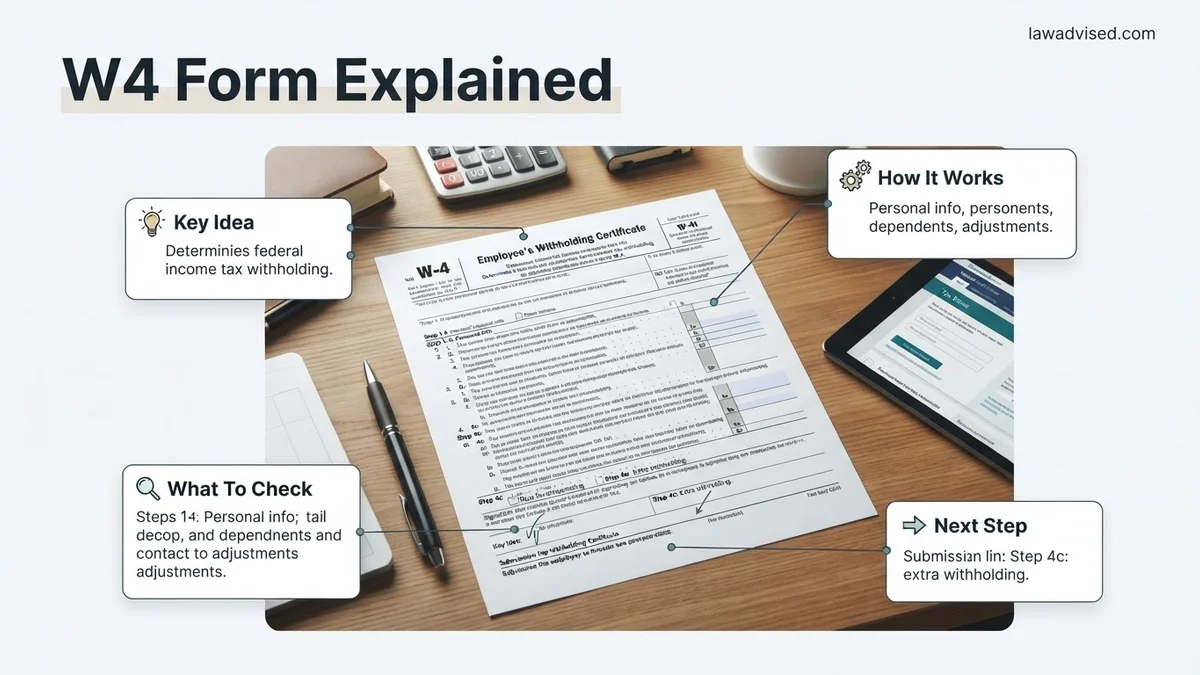
Filling out the IRS Form W-4 correctly determines exactly how much federal income tax your employer withholds from your paycheck. If you leave it blank or guess, you risk facing a massive tax bill or giving the government an interest-free loan.
The modern W-4 completely eliminated allowances in favor of a five-step process designed for the 2026 tax year. Understanding each section ensures your take-home pay matches your actual tax liability so you can avoid surprises next April.
Key Takeaways
- Steps 1 and 5 are mandatory for every employee to complete your basic tax filing status.
- Step 2 handles multiple jobs or working spouses to prevent severe under-withholding.
- Step 3 lets you claim child and dependent tax credits to increase immediate take-home pay.
- Step 4 allows you to request extra withholding or account for non-wage income.
- Use the online IRS Tax Withholding Estimator for personalized, highly accurate form inputs.
What Causes Confusion on the Modern W-4 Form
The Shift Away From Allowances
Older versions of the W-4 relied heavily on claiming allowances. The current design uses a dollar-amount approach tied directly to standard deductions and tax credits.
- Allowances no longer exist on the form
- Calculations focus on actual anticipated dollar amounts
- The goal is to hit a tax liability of zero when you file
The Multiple Job and Working Spouse Trap
Step 2 causes the most errors for taxpayers. If you hold two jobs or file jointly with a working spouse, failing to account for both incomes will result in severe under-withholding.
- Tax brackets are progressive, meaning a second income stacks on top of the first
- Standard deductions are split across households
- Ignoring Step 2 guarantees a surprise tax debt
How to Fix Your Withholding With a Step-by-Step W-4 Walkthrough
Completing Steps 1 and 5: Personal Info and Signature
Every single employee must complete Step 1 and Step 5, regardless of your tax situation. These sections establish your identity and legal filing status for the 2026 tax year.
- Step 1: Enter your legal name, current address, Social Security number, and accurate filing status (Single, Married Filing Jointly, or Head of Household).
- Step 5: Sign and date the form. An unsigned W-4 is legally invalid, and your employer will default to treating you as a single filer with no adjustments.
Tackling Steps 2, 3, and 4: Adjustments and Deductions
These optional steps fine-tune your withholding. Skip them only if you have a single job, no dependents, and take the standard deduction.
- Step 2: Use the IRS Tax Estimator online, use the worksheet on page 3, or check box 2(c) if you and your spouse earn roughly equal amounts.
- Step 3: Claim dependents by multiplying qualifying children under 17 by 2,000 dollars, and other dependents by 500 dollars.
- Step 4: Account for other income like investments, itemized deductions that exceed the standard deduction, or request an extra dollar amount withheld per paycheck.
How to Handle Multiple Jobs and Working Spouses Correctly
Managing tax withholding becomes significantly more complex when you hold multiple jobs simultaneously or file a joint return with a working spouse. According to the IRS, failing to account for dual-income households is the leading cause of unexpected tax bills during the 2026 filing season. Standard withholding calculations assume a single income stream per form, which leads to severe under-withholding if uncorrected.
Using the Multiple Jobs Worksheet
Step 2 of the 2026 Form W-4 provides three distinct methods to balance your household withholding. For households with only two jobs total, the most accurate approach is using the IRS Tax Withholding Estimator online. Alternatively, you can use the tiered table found on page three of the official instructions.
- Locate the higher-paying job and the lower-paying job from the dual-income pair.
- Cross-reference the respective pay ranges on the Step 2 table to find the appropriate adjustment amount.
- Enter the resulting dollar figure on Step 4(c) of the Form W-4 for the higher-paying job only.
- Leave Step 2 and Step 4 blank on the lower-paying job’s form to prevent compounding errors.
Applying the Smart Estimator Alternative
According to tax planning experts at the American Institute of Certified Public Accountants (AICPA), manual worksheets can still result in slight variances. Using the official IRS online estimator tool at irs.gov/individuals/tax-withholding-estimator takes approximately 10 minutes. This digital tool accounts for specific 2026 tax brackets, child tax credits, and exact year-to-date withholding figures pulled from your most recent pay stubs.
What If Your Tax Situation Still Does Not Match Your Paycheck
Even after carefully completing every section of the Form W-4, discrepancies can still arise between your anticipated tax liability and your actual take-home pay. Economic shifts, unexpected bonuses, or sudden changes in local tax jurisdictions often disrupt calculated withholding goals throughout the fiscal year.
Troubleshooting Persistent Discrepancies
If your end-of-year tax outcome misses the mark by more than five hundred dollars, execute these precise fallback steps to regain control over your cash flow:
- Review your year-to-date pay stubs monthly to verify that payroll departments implemented your submitted W-4 changes correctly.
- Adjust the specific dollar amount in Step 4(c) for extra withholding upward or downward in fifty-dollar increments until your net pay reflects your target.
- Submit a mid-year updated Form W-4 whenever life events alter your dependency status or deduction totals.
- Consult a certified public accountant (CPA) or enrolled agent if your investment income or self-employment side ventures complicate your primary W-2 withholding.
Professional tax advisory services typically charge between $150 and $400 for a targeted W-4 optimization and mid-year withholding review, according to national fee surveys published by the National Society of Accountants.
Conclusion
Mastering the Form W-4 prevents unpleasant financial surprises and keeps your hard-earned cash working for you throughout the year instead of acting as an interest-free loan to the government. By accurately accounting for multiple incomes, dependents, and specific deductions, you align your paycheck directly with your actual tax liability. According to verified research and expert sources from the IRS and the AICPA, reviewing your withholding annually is the single most effective way to optimize household cash flow. Take your next actionable step today by downloading the official 2026 Form W-4 and running your numbers through the online IRS estimator.
❓ Frequently Asked Questions
How does filling out Step 2 for multiple jobs affect my take-home pay?
Step 2 ensures that taxes are calculated accurately across combined incomes, preventing the common issue of under-withholding that leads to a big tax bill.
Can I request a specific extra dollar amount to be withheld from each paycheck?
Yes, Step 4(c) allows you to write in an exact dollar amount you want your employer to withhold per pay period for extra security.
What should I do if my marital status changes during the year?
You should submit an updated W-4 to your payroll department within 10 days of your status change to adjust your tax bracket calculations.
Do I need to list non-wage income like freelance earnings on my W-4?
While not strictly required on the form, you can use Step 4(a) to account for other income so enough tax is withheld overall.
How can I check if my current W-4 withholding is correct?
You can use the official IRS Tax Withholding Estimator online tool alongside your most recent pay stub to review your progress.
What happens if I claim dependents I am not eligible for on Step 3?
Claiming ineligible dependents will result in too little tax being withheld, leaving you with a surprise tax liability and potential penalties when you file.

Ismail Hossain is the founder of Law Advised. He is an Divorce, Separation, marriage lawyer. Follow him.