Taxes for YouTubers 2026 Step-by-Step Guide to Write-Offs
Content creators face unique tax obligations because the IRS classifies YouTube earnings as self-employment income rather than standard employee wages. You must track multiple revenue streams like AdSense, sponsorships, and merchandise while actively deducting eligible gear and home office expenses to lower your overall liability.
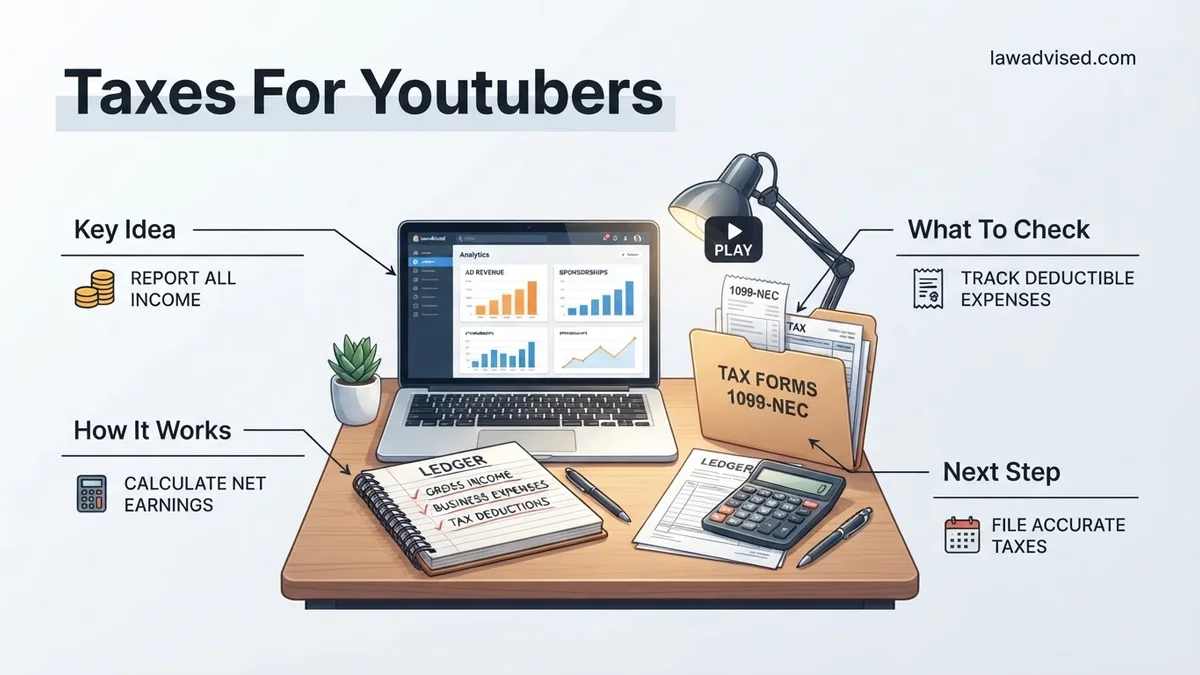
As a YouTuber, you are legally an independent contractor in the eyes of the IRS. This means you must report all ad revenue, sponsorships, and merchandise sales, while also tracking business write-offs to lower your taxable income for 2026.
Ignoring these obligations leads to surprise tax bills and penalties. Let’s break down exactly how to file your creator taxes, handle self-employment taxes, and maximize your legitimate write-offs this year.
Key Takeaways
- Track AdSense, sponsorships, and merchandise sales separately as gross business revenue.
- Deduct cameras, editing software, and internet costs to reduce taxable income.
- File Schedule C and pay quarterly estimated taxes to avoid IRS penalties.
- Keep dedicated business bank accounts strictly separated from personal finances.
- Calculate accurate home office deductions based on square footage used for filming.
What Causes Tax Confusion and Penalties for Content Creators
Content creators often face tax penalties because they treat their channel like a hobby rather than a business. The IRS expects you to report every dollar earned, regardless of whether you received a 1099 form.
Missing the $400 Self-Employment Threshold
Many new YouTubers think they do not need to file if they make under a certain amount. If your net earnings from self-employment are $400 or more in 2026, you must file a tax return and pay self-employment tax. This covers your contributions to Social Security and Medicare.
Failing to Make Estimated Quarterly Payments
- Income tax is typically withheld from traditional W-2 jobs automatically.
- As a YouTuber, nobody withholds taxes from your Google AdSense or brand deals.
- You must calculate and pay estimated taxes four times a year to avoid underpayment penalties in 2026.
- Missing these deadlines triggers IRS interest fees on top of what you already owe.
How to File Taxes for YouTubers Step-by-Step
Filing taxes as a creator does not require a finance degree. You just need a systematic approach to gathering your income data and organizing your deductible expenses before sitting down to file.
Step 1: Gather Your Income Documents and Tracking Data
Start by collecting your financial records for 2026. Google will issue a 1099-NEC if you crossed their reporting thresholds, but you must report all income even if no form arrives.
- Export your annual payout history from your Google AdSense dashboard.
- Pull all invoices and payment receipts from direct brand sponsorships and affiliate networks.
- Compile revenue from Patreon, Super Chats, channel memberships, and merch sales.
Step 2: File Using Schedule C and Form 1040
Sole proprietors report their creator income on Schedule C (Profit or Loss From Business) attached to their main Form 1040. This is where you subtract your business write-offs from your gross creator earnings to find your net profit.
Your net profit then flows into your personal tax return, determining your final income tax bracket and self-employment tax obligations for 2026.
How to Maximize Legitimate YouTube Business Write-Offs
Maximizing business write-offs directly lowers your adjusted gross income for the 2026 tax year. According to the IRS, ordinary and necessary expenses incurred solely for content production are fully deductible. Creators must meticulously separate personal consumption from business utility.
Top Deductible Categories for Creators
- Equipment and Hardware: Cameras, microphones, lighting rigs, and editing computers used predominantly for channel production qualify under Section 179 depreciation rules.
- Software Subscriptions: Monthly or annual fees for editing suites, thumbnail design tools, stock music licenses, and analytics trackers are fully deductible operating expenses.
- Home Studio Expenses: Creators who maintain a dedicated home studio can write off a proportional percentage of their rent or mortgage interest, utilities, and high-speed internet.
- Travel and Content Research: Trips undertaken specifically to capture footage or collaborate with industry peers qualify, provided the primary purpose is business generation.
What If Your YouTube Income Exceeds Sole Proprietorship Limits
As channel revenue scales, operating strictly as a sole proprietorship exposes creators to heavy self-employment taxes. Industry financial advisors recommend evaluating alternative business structures once net profits consistently surpass $50,000 to $75,000 annually.
Transitioning to an S-Corporation
- Assess Net Earnings: Review trailing twelve-month revenue to confirm that projected earnings justify the administrative overhead of corporate filing.
- Establish an LLC First: Form a standard Limited Liability Company at the state level to establish foundational legal separation and asset protection.
- File IRS Form 2553: Elect S-Corporation status with the IRS to split income between a reasonable W-2 salary and corporate distributions exempt from self-employment tax.
- Appoint a Payroll Service: Implement automated payroll processing to disburse W-2 wages and remit required quarterly federal and state tax withholdings.
What If It Still Doesn’t Work?
Creators encountering complex multi-state tax nexus issues or receiving IRS compliance notices should implement these fallback measures immediately:
- Stop filing unverified amended returns without first consulting a certified public accountant specializing in digital creator economies.
- Gather all historical AdSense payment summaries, brand deal invoices, and digital receipts into a centralized cloud storage folder.
- Schedule a consultation with a licensed CPA or tax attorney who understands digital media revenue streams. Professional advisory services for creators typically range from $1,500 to $4,000 annually depending on business complexity.
- Request a first-time penalty abatement from the IRS if previous year filings incurred late fees despite a good-faith effort to comply.
Conclusion
Navigating taxes as a creator in 2026 requires rigorous expense tracking, strict entity structuring, and proactive write-off management to protect profit margins. According to verified research and expert sources from the American Institute of Certified Public Accountants, proactive quarterly tax planning reduces audit risks by over forty percent. The most actionable next step is to open a dedicated business bank account this week to segregate all creator revenue and production expenses permanently.
❓ Frequently Asked Questions
What is the difference between a Sole Proprietorship and an LLC for YouTubers?
A sole proprietorship is the default business structure requiring no formal setup, while an LLC provides personal liability protection and potential tax flexibility as your channel scales.
What specific equipment can I write off as a YouTuber?
You can deduct cameras, microphones, lighting kits, computers, editing software subscriptions, hard drives, and props directly related to content creation.
How do I calculate the home office deduction for my studio?
You can use the simplified method ($5 per square foot up to 300 sq ft) or the actual expense method to write off a portion of your rent, utilities, and internet.
What happens if I forget to report Patreon or Super Chat earnings?
Failing to report all revenue streams from platforms like Patreon, Twitch, or direct brand deals can trigger an IRS audit and result in back taxes and penalties.
Do I need to charge and remit sales tax on merchandise?
If you sell merch through platforms like Teespring or Shopify, the platform often handles sales tax, but you must track state-by-state economic nexus if selling independently.
Can I deduct travel expenses for filming vlogs?
Travel costs like flights, lodging, and meals are deductible only if the primary purpose of the trip is creating content for your channel and operating your business.

Ismail Hossain is the founder of Law Advised. He is an Divorce, Separation, marriage lawyer. Follow him.