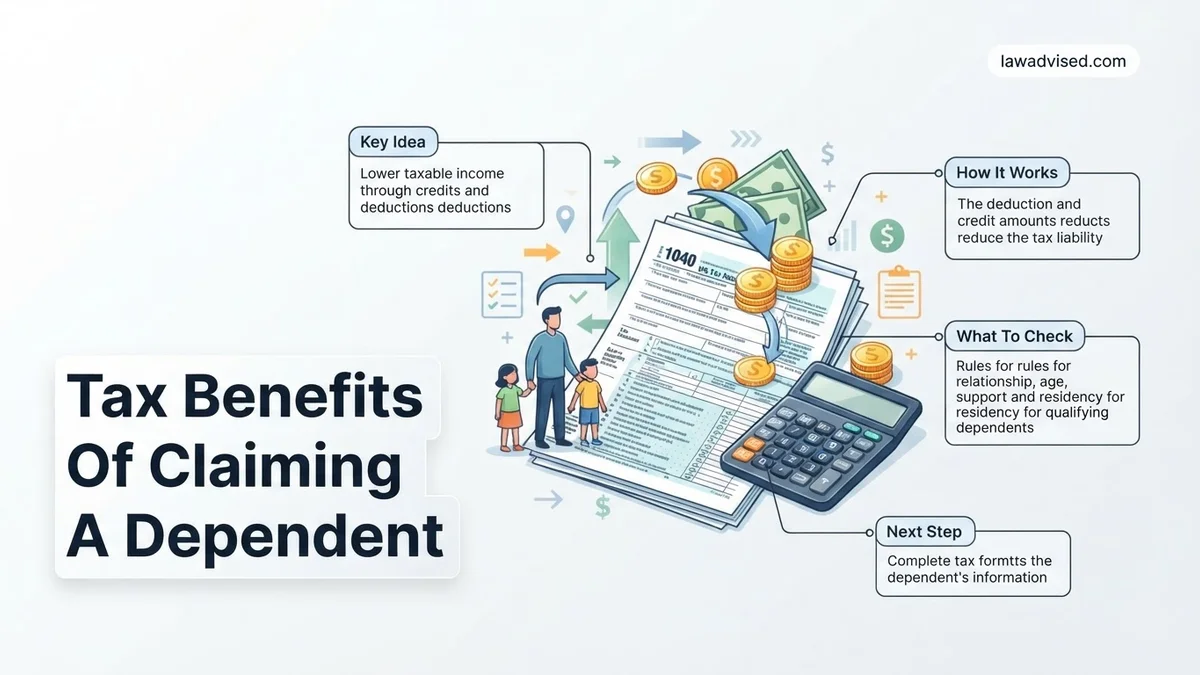
Tax Benefits of Claiming a Dependent Expert 2026 Guide
Claiming a dependent on your tax return unlocks substantial financial savings through valuable credits and deductions. Major tax credits like the Child Tax Credit and EITC directly lower your tax liability, while specific filing statuses reduce your overall taxable income.
Claiming a dependent on your tax return unlocks thousands of dollars in direct savings through powerful federal credits, tax-advantaged deductions, and lower tax brackets. For the 2026 tax year, eligible filers can substantially lower their overall tax liability by leveraging major tax breaks like the Child Tax Credit, the Earned Income Tax Credit, and Head of Household filing status.
Missing out on these financial opportunities happens easily when IRS dependency tests or phase-out thresholds are misunderstood. This guide breaks down the exact savings you can claim, the qualification rules for 2026, and how to structure your filing status to keep more money in your pocket.
Key Takeaways
- The Child Tax Credit provides direct dollar-for-dollar tax savings for eligible children.
- Qualifying as Head of Household significantly increases your standard deduction amount.
- The Child and Dependent Care Credit offsets expenses for working parents.
- Income phase-outs apply to higher earners, reducing available credit amounts.
- Meeting IRS dependency tests is mandatory to claim any dependent-based benefit.
What Causes Lost Savings in Tax Benefits of Claiming a Dependent
Failing the Support and Residency Tests
The most common reason taxpayers lose out on valuable dependent credits is a miscalculation of the financial support and residency rules. To claim a qualifying child in 2026, the individual must have lived with you for more than half of the year and cannot have provided more than half of their own financial support.
- Residency exception: Temporary absences for school, medical care, or vacations still count as time living in your home.
- Support calculation: Food, lodging, clothing, education, and medical expenses provided by you are weighed against the dependent’s own income.
Overlooking Income Phase-Out Thresholds
Tax credits tied to dependents frequently feature strict income phase-outs that reduce your benefit as your adjusted gross income climbs. For the 2026 tax year, high earners often lose portions of the Child Tax Credit if their modified adjusted gross income exceeds statutory limits. Monitoring your income streams and utilizing pre-tax retirement accounts can help keep your adjusted gross income below these reduction cliffs.
How to Fix Your Filing Status to Maximize Dependent Credits
Switching to Head of Household Status
If you unmarried and pay more than half the cost of keeping up a home for a qualifying dependent, filing as Head of Household offers a significantly larger standard deduction than single filing status. For 2026, this adjustment immediately lowers your taxable income baseline before any credits are even applied.
- Cost of upkeep: Rent, mortgage interest, property taxes, utilities, repairs, and groceries all count toward maintaining the home.
- Marital test: You must be considered unmarried on the last day of the tax year or lived apart from your spouse for the last six months of 2026.
Claiming the Child and Dependent Care Credit
Working parents and guardians often leave money on the table by failing to claim expenses paid for daycare, babysitters, or after-school programs. The Child and Dependent Care Credit allows you to claim a percentage of qualifying care expenses up to specific dollar caps, directly reducing your tax bill dollar-for-dollar based on your 2026 income level.
Step-by-Step Guide to Claiming Child and Dependent Care Credits
Maximizing your tax savings requires careful execution when claiming the Child and Dependent Care Credit for the 2026 tax year. According to Internal Revenue Service guidelines, you must maintain meticulous records to substantiate your expenses and avoid costly processing delays.
Gathering Documentation and Provider Information
Before filing your return, you must secure specific details from every care provider you utilized during the tax year. Missing information will trigger an immediate mathematical error notice from the IRS.
- Locate the full name, exact street address, and valid Taxpayer Identification Number (TIN) or Employer Identification Number (EIN) for your daycare facility, babysitter, or camp.
- Compile all year-end statements, canceled checks, or digital payment receipts that prove the exact amounts you paid for qualifying care.
- Ensure your total expenses do not exceed the statutory limits of $3,000 for one qualifying individual or $6,000 for two or more individuals.
Completing Form 2441
Once your documentation is organized, you must file the correct tax form alongside your individual income tax return. Precision is critical for this calculation.
- Complete IRS Form 2441, “Child and Dependent Care Expenses,” entering the provider details in Part I of the document.
- Calculate your earned income and your spouse’s earned income, as the credit cannot exceed your individual earned income thresholds.
- Apply the applicable credit percentage—ranging from 20% to 35% based on your adjusted gross income—to your total allowable expenses, and transfer the final figure to your Form 1040.
What If It Still Doesn’t Work and Your Dependency Claim is Denied?
Receiving an IRS notice denying your dependency claim or dependent care credit can disrupt your financial planning. When standard filing adjustments or initial appeals fail, taxpayers must escalate their resolution strategy to protect their rightful refunds.
- Review the specific rejection code on the IRS CP-series notice to determine whether the denial stems from a Social Security number mismatch, a residency dispute, or a tie-breaker rule conflict with another filer.
- File an amended return using Form 1040-X along with missing proof of residency, such as school records or medical bills, if the initial rejection was due to a documentation error.
- Respond formally in writing within the mandated 30-day window if the IRS issued a statutory notice of deficiency regarding a tie-breaker rule audit.
- Consult a certified public accountant (CPA) or an Enrolled Agent specializing in tax resolution if the dispute involves complex custody decrees or multi-state filings. Professional representation fees typically range from $200 to $500 per hour, or $1,500 to $3,500 for full audit defense.
Conclusion
Claiming a dependent and securing associated credits for the 2026 tax year requires strict adherence to residency, support, and documentation guidelines. When discrepancies or denials occur, swift intervention through amended filings or professional representation prevents permanent loss of valuable tax benefits. According to verified research and expert sources from the American Institute of CPAs, proactive tax planning and flawless record-keeping remain the most effective defenses against IRS audits and rejections. Take your next actionable step today by auditing your dependent’s support records against current IRS gross income tests before submitting your final return.
❓ Frequently Asked Questions
What are the core requirements to claim a dependent?
A dependent must meet either the Qualifying Child or Qualifying Relative tests, which involve relationship, residency, age, and financial support criteria set by the IRS.
How much is the Child Tax Credit worth per child?
The specific credit amount varies by tax year and legislative updates, but it provides substantial financial relief directly against your tax bill.
What is the difference between a tax credit and a tax deduction?
A tax credit reduces your tax liability dollar-for-dollar, whereas a tax deduction simply lowers the total amount of your income that is subject to taxation.
Can two people claim the same dependent?
No, the IRS ties each dependent to a single taxpayer per tax year. Tie-breaker rules apply if multiple individuals attempt to claim the same person.
Does claiming a dependent affect my withholding?
Yes, you can update your Form W-4 with your employer to account for dependents, which increases your take-home pay throughout the year.
What happens if my dependent has income of their own?
A dependent’s earned and unearned income can impact whether they meet the gross income or support tests, particularly for qualifying relatives.

Ismail Hossain is the founder of Law Advised. He is an Divorce, Separation, marriage lawyer. Follow him.