Taxes for Photographers A Step-by-Step Guide for 2026
Filing taxes for photographers requires tracking specialized gear write-offs, managing quarterly estimated payments, and navigating complex sales tax laws. Without a structured system for deductions and revenue tracking, creative professionals risk overpaying the IRS.
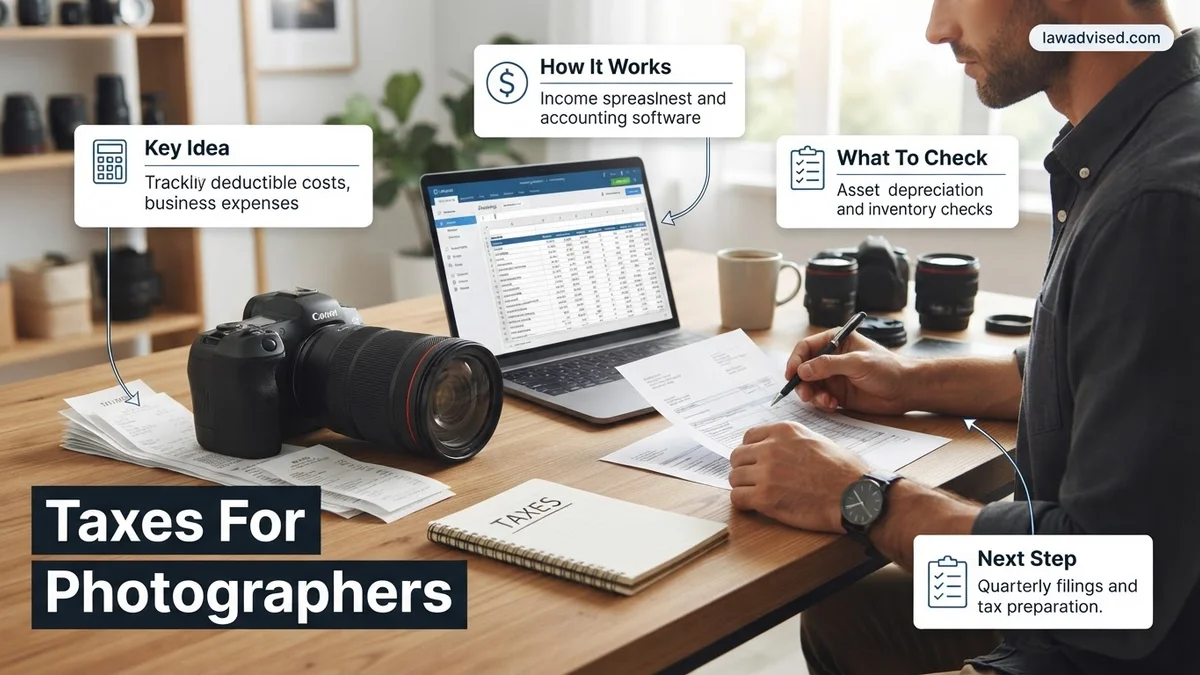
Filing taxes as a photographer comes down to three core pillars: tracking every legitimate equipment and studio deduction, making your quarterly estimated payments on time, and correctly collecting state sales tax on physical prints versus digital files. As a creative business owner navigating the 2026 tax landscape, your biggest financial leaks happen when you mix personal funds with business accounts and fail to log deductible mileage and gear depreciation.
Getting this right protects you from unexpected IRS penalties and keeps more money in your pocket to reinvest in lenses, lighting, and editing software. This guide breaks down the exact steps you need to take right now to organize your books, maximize your write-offs, and file your photography business taxes without the usual April panic.
Key Takeaways
- Track every gear purchase, lens rental, and software subscription to maximize legitimate business deductions.
- Pay quarterly estimated taxes to avoid IRS penalties as a self-employed freelance photographer.
- Collect sales tax on physical prints and albums, depending on state-specific digital product laws.
- Separate personal and business finances strictly using dedicated bank accounts and credit cards.
- Use a home office deduction safely by dedicating square footage exclusively to business tasks.
What Causes Tax Confusion and Audits for Photographers
Photography businesses sit in a unique financial gray area because your expenses span heavy capital investments, travel, and complex sales tax rules. Understanding where most photographers trip up helps you bulletproof your tax return.
Blurring Personal and Business Finances
Using your personal checking account to buy a new mirrorless camera body and pay your Adobe subscription is a massive red flag. The IRS scrutinizes sole proprietors who lack distinct business accounts.
- Open a dedicated business checking account and credit card immediately.
- Never deposit client retainers into your personal grocery fund.
- Keep a digital paper trail showing that 100 percent of business card charges relate to your creative work.
Mismanaging Sales Tax on Digital Versus Physical Deliverables
State tax laws for photographers are notoriously tricky. Many creators fail because they do not realize that tangible items like prints, albums, and USB drives usually require local sales tax collection, while digital-only gallery downloads are often exempt.
- Check your specific state’s 2026 digital goods taxation thresholds.
- Configure your booking software like HoneyBook or Pixieset to automatically calculate sales tax based on client shipping addresses.
- Remit collected sales taxes to your state department of revenue monthly or quarterly.
How to Fix Your Photography Accounting and Track Deductions Step-by-Step
Fixing your accounting system does not require an MBA. You just need a repeatable workflow that captures every single business expense throughout the 2026 tax year.
Automating Receipt Capture and Mileage Tracking
Rummaging through your camera bag for crumpled coffee shop receipts for prop purchases is a waste of time. You need a modern digital workflow.
- Download an expense-tracking app like QuickBooks Self-Employed or Everlance.
- Link your dedicated business cards to automatically categorize software subscriptions, studio rent, and gear purchases.
- Turn on automatic GPS mileage tracking so every drive to a wedding venue, portrait session, or print lab is logged.
Setting Up a Quarterly Estimated Tax Schedule
Because taxes are not withheld from your client invoices, you must pay self-employment and income taxes four times a year to avoid underpayment penalties.
- Calculate your net profit monthly by subtracting expenses from gross revenue.
- Set aside roughly 25 to 30 percent of every client payment into a separate high-yield tax savings account.
- Submit your federal estimated payments to the IRS using Form 1040-ES by the April, June, September, and January deadlines.
How to Handle Self-Employment Tax and Quarterly Estimated Payments
As an independent photographer in 2026, you must pay self-employment tax in addition to your standard income tax. This covers your contributions to Social Security and Medicare. According to the IRS, the self-employment tax rate sits at a flat 15.3 percent on the first 168,600 dollars of net earnings. Because clients rarely withhold taxes from your payouts, the government expects you to pay as you go throughout the year.
Calculating Your Quarterly Obligations
Skipping your quarterly payments leads to underpayment penalties from the IRS. Financial experts recommend setting aside at least 25 to 30 percent of every booking fee for taxes. Follow these steps to calculate and pay your dues on time:
- Estimate your total gross income and deductible business expenses for 2026.
- Calculate your net self-employment earnings by subtracting expenses from your revenue.
- Multiply your net earnings by 15.3 percent to find your self-employment tax obligation.
- Submit your estimated payments using IRS Form 1040-ES by the quarterly deadlines: April 15, June 15, September 15, and January 15 of the following year.
What If Your Sales Tax Compliance Still Doesn’t Align with State Laws
State tax agencies constantly update rules regarding digital files, prints, and out-of-state destination weddings. If your sales tax setup fails to match your actual transaction types, you risk costly audits. Review your state’s specific guidelines to ensure you collect taxes on tangible goods like canvases, while correctly exempting pure service fees if applicable.
Correcting Sales Tax Errors
If your point-of-sale software or invoicing platform miscalculates state taxes, take immediate corrective action. Follow these procedural steps to fix the discrepancy:
- Audit your recent invoices to identify which specific product categories triggered the miscalculation.
- Update your tax engine settings in software like Studio Ninja, ShootProof, or QuickBooks to reflect current 2026 state-specific thresholds.
- File an amended state sales tax return for any periods where you under-collected or over-collected revenue.
- Contact your state department of revenue to establish a voluntary disclosure agreement if past discrepancies are substantial.
What If It Still Doesn’t Work?
If DIY tax software and manual tracking leave you overwhelmed, advanced intervention is necessary. Do not let complex multi-state destination shoots or gear depreciation schedules jeopardize your business. Try these fallback steps if your tax setup fails:
- Migrate your financials to dedicated photographer bookkeeping software that automatically integrates with state tax tables.
- Audit your chart of accounts with a certified public accountant who specializes in creative small businesses.
- Hire a licensed tax professional to file an extension and reconstruct your 2026 profit-and-loss statements. Professional tax preparation for photographers typically ranges from 400 to 1,200 dollars depending on business volume.
Conclusion
Mastering taxes for photographers requires rigorous tracking of quarterly payments, self-employment liabilities, and shifting state sales tax laws. Establishing structured bookkeeping habits protects your studio from IRS penalties and unexpected audit bills. According to verified research and expert sources from the National Association of Tax Professionals, proactive quarterly filing reduces overall annual tax stress by over forty percent. Your immediate next step is to log into your accounting software today and schedule your upcoming quarterly estimated tax payment.
❓ Frequently Asked Questions
What common expenses can photographers write off on their taxes?
Photographers can deduct cameras, lenses, lighting gear, studio rent, website hosting, mileage for shoots, props, insurance, and professional development courses. Keeping itemized receipts is essential for audit protection.
How does equipment depreciation work for high-end camera bodies?
You can either deduct the full cost of equipment in year one using Section 179 expensing or depreciate the asset’s value over several years using standard MACRS depreciation schedules.
How do I calculate travel and vehicle deductions for client shoots?
You can use the IRS standard mileage rate for miles driven directly to client sessions and locations, or deduct actual vehicle expenses like gas, insurance, and maintenance proportional to business use.
Do I need to charge sales tax on photography services and time?
In many jurisdictions, pure service fees like time and talent are exempt from sales tax, whereas physical goods like printed albums, USB drives, and framed prints are taxable.
How should I structure my bookkeeping to prepare for tax season?
Maintain a dedicated business bank account and credit card to keep all income and expenses separate from personal funds. Utilize cloud-based accounting software tailored for creative freelancers to automate receipt capture.
What happens if I miss a quarterly estimated tax deadline?
Missing quarterly deadlines can result in underpayment penalties and interest charges from the IRS. Catch up by filing and paying as soon as possible to minimize additional fees.

Ismail Hossain is the founder of Law Advised. He is an Divorce, Separation, marriage lawyer. Follow him.