Estimated Tax Payment Schedule 2026 Expert Guide & Due Dates
Missing your estimated tax payment schedule can result in steep IRS penalties and interest charges. You must make quarterly federal tax payments four times a year if you expect to owe $1,000 or more in taxes when filing your return.
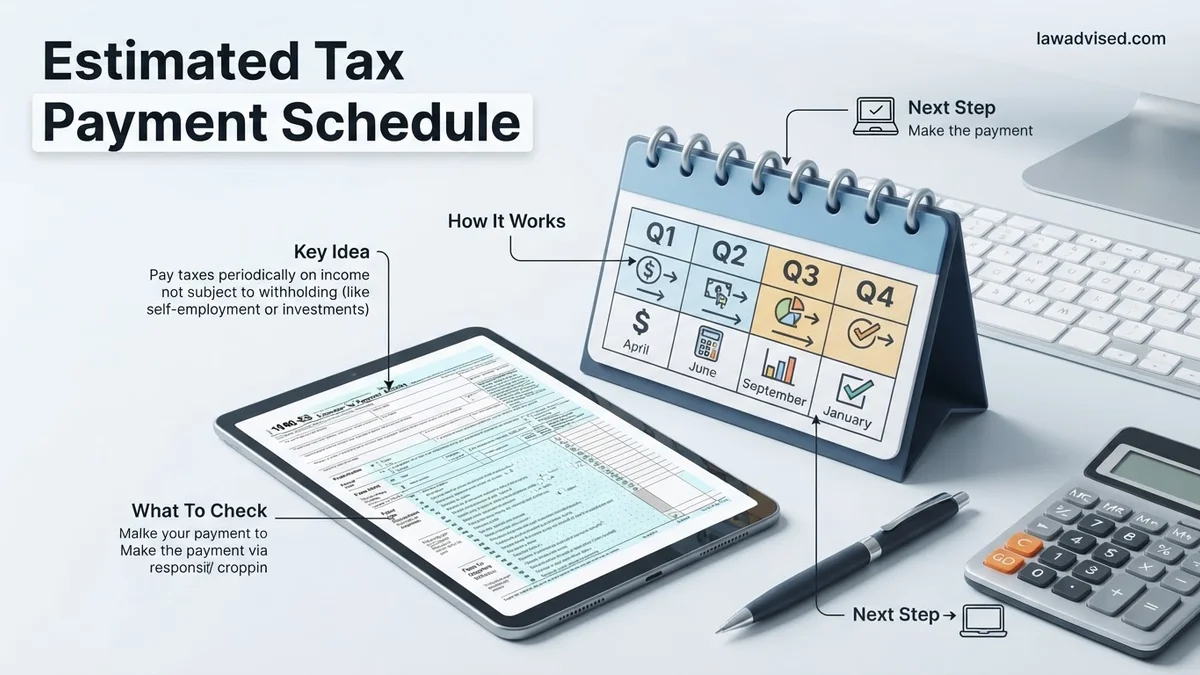
The federal estimated tax payment due dates for the 2026 tax year are April 15, 2026 (for Q1), June 15, 2026 (for Q2), September 15, 2026 (for Q3), and January 15, 2027 (for Q4). State estimated tax deadlines generally mirror these federal dates, though certain states adjust schedules based on local legislative calendars or natural disaster extensions.
Missing these specific quarterly deadlines triggers immediate IRS underpayment penalties and accumulating interest charges. If you earn income not subject to traditional employer withholding—such as freelance revenue, rental proceeds, or investment gains—following the 2026 estimated tax payment schedule keeps you compliant and prevents costly year-end surprises.
Key Takeaways
- Federal estimated taxes are paid quarterly using IRS Form 1040-ES.
- The first 2026 quarterly payment is due on April 15, 2026.
- Self-employed individuals, freelancers, and small business owners typically must pay quarterly.
- You can avoid penalties by paying at least 90% of your current tax or 100% of last year’s tax.
- State tax due dates often match federal deadlines, but verify with your state department.
What Causes IRS Penalties Under the Estimated Tax Payment Schedule
The IRS does not penalize you simply for owing money at tax time; they penalize you for failing to pay enough throughout the year. Understanding the precise triggers for these financial penalties helps you protect your bottom line in 2026.
The $1,000 Threshold and Underpayment Triggers
You will trigger an IRS penalty if you owe more than $1,000 in tax when you file your 2026 return, after subtracting your withholding and refundable credits. To avoid this entirely, your total payments through the estimated tax payment schedule must meet specific safe harbor criteria.
Safe Harbor Rules to Avoid 2026 Penalties
- Pay at least 90 percent of the tax shown on your current 2026 tax return.
- Pay 100 percent of the tax shown on your 2025 tax return (if your adjusted gross income was $150,000 or less).
- Pay 110 percent of your 2025 tax liability if your 2025 adjusted gross income exceeded $150,000.
How to Fix Your Quarterly Tax Strategy with Step-by-Step Calculations
Guessing your quarterly tax amounts is a recipe for either overpaying and giving the government an interest-free loan, or underpaying and facing penalties. You need a reliable mathematical framework to determine your exact payment obligations for the 2026 tax year.
Step 1: Project Your 2026 Net Income and Deductions
Start by calculating your expected gross business or freelance revenue for 2026. Subtract all legitimate business expenses, standard or itemized deductions, and qualified business income deductions to arrive at your estimated taxable income.
Step 2: Apply the Correct Tax Brackets and Self-Employment Tax
- Calculate your federal income tax based on the 2026 marginal tax brackets for your filing status.
- Add self-employment tax, which is 15.3 percent on your net self-employment earnings up to the Social Security wage base limit.
- Divide your total annual estimated tax liability by four to find your baseline quarterly payment.
Adjusting for Seasonal Income Fluctuations
If your income fluctuates heavily throughout the year—common in freelance and seasonal businesses—relying on a rigid four-part split can drain your cash flow. You can use the annualized income installment method to calculate lower payments for quarters with lower revenue and higher payments when your business booms.
What If It Still Doesn’t Work and You Miss a Quarterly Tax Deadline
Missing an estimated tax payment deadline for the 2026 tax year can trigger IRS penalties, but the situation is manageable if you act quickly. The IRS assesses underpayment interest and penalties for missed quarters, calculated daily based on prevailing federal rates. According to compliance experts at the American Institute of CPAs (AICPA), paying late is always cheaper than not paying at all, as it stops the accrual of additional penalties.
When your initial plan to meet the estimated tax payment schedule fails, immediate troubleshooting is required. Implementing a structured recovery process minimizes financial damage and keeps your tax compliance on track.
Immediate Recovery Steps
- Calculate your current liability: Determine exactly how much you underpaid for the specific quarter to understand the baseline penalty scope.
- Submit a catch-up payment: Send the missed payment immediately via IRS Direct Pay or the Electronic Federal Tax Payment System (EFTPS) to halt daily penalty accruals.
- Adjust future payments: Increase your upcoming Q3 or Q4 estimated payments for 2026 to compensate for the previous shortfall, if safe under safe-harbor rules.
- Evaluate penalty abatement: Check if you qualify for First-Time Penalty Abatement if you have a clean compliance history for the preceding three tax years.
- Consult a tax professional: Engage a Certified Public Accountant (CPA) or Enrolled Agent (EA) if the calculation is complex or if you face severe underpayment penalties. Professional advisory fees typically range from $200 to $600 depending on the complexity of the adjustment.
Conclusion
Navigating the estimated tax payment schedule for 2026 requires strict adherence to IRS quarterly deadlines to avoid compounding penalties and interest charges. By utilizing safe-harbor rules, leveraging digital payment portals, and immediately correcting any missed installments, taxpayers can maintain compliance and protect their financial standing. According to verified research and expert sources from major accounting associations, proactive planning remains the most effective defense against unexpected tax liabilities. Your immediate next step is to review your year-to-date income against the 2026 thresholds and schedule your next quarterly remittance today.
❓ Frequently Asked Questions
What is the official 2026 estimated tax payment schedule for the IRS?
For the 2026 tax year, quarterly payments are due on April 15, 2026 (for Q1), June 15, 2026 (for Q2), September 15, 2026 (for Q3), and January 15, 2027 (for Q4). If any of these dates fall on a weekend or holiday, the deadline shifts to the next business day.
How do I calculate how much I need to pay each quarter?
You can calculate your quarterly payments using Form 1040-ES by estimating your total expected adjusted gross income, deductions, and taxes for the year, then dividing by four. Alternatively, you can use the safe harbor rule by paying 100% of your prior year’s total tax liability split evenly across four payments.
Am I required to pay estimated taxes if my income fluctuates?
Yes, if you expect to owe more than $1,000 in net tax for the year. If your income fluctuates significantly throughout the year, you can use the annualized income installment method to calculate lower payments during lower-earning quarters.
What is the ‘safe harbor’ rule for estimated taxes?
The safe harbor rule protects you from underpayment penalties if your total timely tax payments equal at least 90% of the tax shown on your current year’s return or 100% of the tax shown on your previous year’s return (110% if your adjusted gross income exceeds $150,000).
Can I make my estimated tax payments online?
Yes, the IRS offers several electronic payment methods including IRS Direct Pay from a checking or savings account, the Electronic Federal Tax Payment System (EFTPS), or paying by credit or debit card through a third-party processor.
What should I do if I cannot afford to make my quarterly tax payment?
You should still pay as much as you can by the deadline to minimize penalties and interest. Once you file your annual tax return, you can set up an IRS installment agreement or payment plan for any remaining balance.

Ismail Hossain is the founder of Law Advised. He is an Divorce, Separation, marriage lawyer. Follow him.