CD Interest Tax Explained Real Guide for 2026
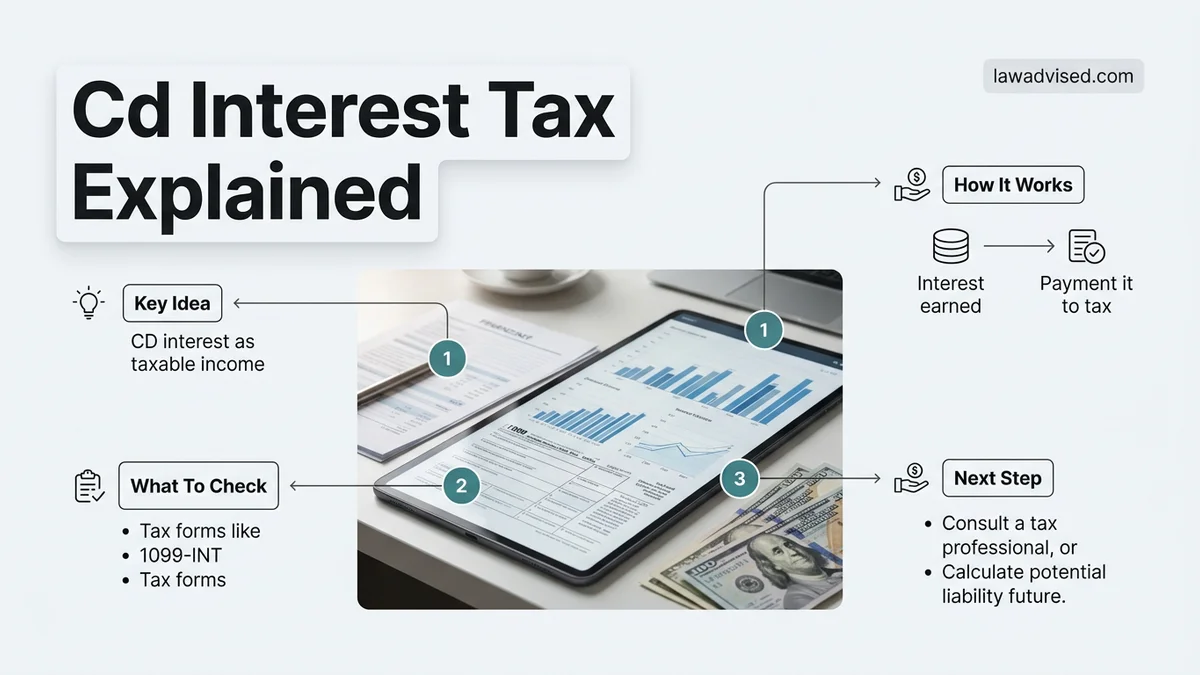
Certificate of Deposit earnings are taxed as ordinary income rather than capital gains. Even if your funds are locked in a multi-year CD and you cannot withdraw the earnings, you must report and pay taxes on the interest annually based on Form 1099-INT.
Certificate of deposit interest is taxed as ordinary income at your standard federal and state income tax rates, and you must report it in the year it is earned—even if the funds remain locked inside a multi-year term. Unlike stocks or real estate that trigger lower capital gains tax rates, the bank treats your annual CD earnings just like a paycheck or freelance income.
Navigating these rules correctly prevents unexpected tax bills when filing your 2026 tax return. Because banks report your interest earnings directly to the IRS, failing to account for unwithdrawn or compounding interest can trigger automated discrepancies and delay your tax refunds.
Key Takeaways
- CD interest is always taxed as ordinary income, matching your federal income tax bracket.
- You receive a Form 1099-INT and must pay taxes annually, even on locked, unwithdrawn interest.
- Multi-year CDs require annual tax reporting on accrued interest, despite no cash payout.
- Holding CDs inside tax-advantaged accounts like IRAs defers or eliminates annual tax liabilities.
- Early withdrawal penalties can be deducted, reducing your overall net taxable CD earnings.
Why CD Interest Is Taxed as Ordinary Income and Not Capital Gains
Many savers assume that because a CD is an investment product, its returns qualify for lower capital gains tax rates. That is incorrect. The IRS classifies CD earnings strictly as interest income, which means it joins your wages, salary, and business revenue as ordinary income.
How Ordinary Income Brackets Apply to Your CD
Your total taxable income dictates the exact percentage you pay on your CD earnings. For the 2026 tax year, federal income tax brackets range from 10 percent up to 37 percent. Your CD interest simply stacks on top of your other earnings, potentially pushing a portion of your income into a higher tax bracket if you earned a large payout.
- Federal taxes apply based on your filing status and total taxable income.
- State and local income taxes may also apply, though some states exempt specific types of interest.
- Your effective tax rate on the CD is determined by your marginal tax bracket for 2026.
The Rule for Multi-Year CDs and Unwithdrawn Interest
A common misconception is that you only pay taxes when your CD matures and you withdraw the principal plus accumulated earnings. In reality, the IRS enforces constructive receipt rules. If your 3-year or 5-year CD credits interest to your account annually—or allows you to withdraw it without a severe penalty—you owe taxes for that specific year, even if you leave the money to compound inside the account.
Step-by-Step Guide to Reporting CD Interest Using Form 1099-INT
Banks and credit unions are legally required to track your earnings and report them to both you and the federal government. Understanding the mechanics of your tax documents ensures your numbers match what the IRS receives for the 2026 tax season.
Understanding Box 1 and Box 3 on Your Form
By late January 2027, your financial institution will issue IRS Form 1099-INT detailing the interest you accrued during the previous calendar year. You need to look closely at specific boxes on this form to report your numbers accurately on your tax software or paper return.
- Box 1 (Interest Income): This shows the total taxable CD interest credited to your account during 2026.
- Box 2 (Early Withdrawal Penalty): If you broke a CD early and forfeited interest, this penalty can often be deducted as an adjustment to income.
- Box 3 (Interest on U.S. Savings Bonds and Treasury Obligations): Rarely applicable to standard bank CDs, but good to double-check.
What to Do If Your Interest Is Under 10 Dollars
If your CD earned less than 10 dollars in total interest for the year, the bank is not legally required to mail you a Form 1099-INT. However, federal tax law still requires you to report every single dollar of interest earned. You must manually calculate your total earnings from your monthly or annual bank statements and add that figure to your taxable interest line.
How to Fix Surprise Tax Bills on Multi-Year and Accrued CD Interest
Filing your 2026 taxes can bring an unwelcome shock if you hold a multi-year Certificate of Deposit. Many savers assume taxes are only due when a CD matures. However, the IRS requires you to report accrued interest annually. This rule applies even if you cannot withdraw the funds without steep early withdrawal penalties.
Managing this liability requires proactive tax planning throughout the year. Financial experts recommend several procedural steps to prevent unexpected tax bills from derailing your budget.
- Request Form 1099-INT early: Monitor your bank portal in January to track exactly how much interest accrued during the prior tax year, ensuring your accountant has the correct figures before filing.
- Set aside funds monthly: Calculate your estimated tax bracket and automatically transfer a corresponding percentage of your monthly accrued interest into a high-yield savings account.
- Opt for monthly interest payouts: Instruct your bank to deposit your earned interest directly into your checking account rather than compounding it inside the CD, giving you immediate liquidity to cover tax obligations.
What If Taxable CD Earnings Push You Into a Higher Tax Bracket
A large lump-sum interest payout from a maturing CD can occasionally spike your adjusted gross income. This unexpected jump might push you into a higher federal income tax bracket. It can also trigger surtaxes on net investment income or impact your eligibility for specific tax credits.
Mitigating this financial risk involves specific strategic maneuvers to smooth out your taxable income across multiple tax years.
- Utilize tax-advantaged accounts: Maximize contributions to a Traditional IRA, 401(k), or HSA to actively lower your adjusted gross income and offset the additional CD earnings.
- Stagger your maturity dates: Implement a CD ladder strategy to distribute your interest earnings evenly across multiple tax years instead of triggering one massive payout date.
- Explore municipal bonds: Reallocate a portion of your fixed-income portfolio into municipal bonds, which generate federal tax-free income and sometimes state tax-free income as well.
What If It Still Doesn’t Work?
If you have implemented standard tax-planning strategies and still face a massive, unmanageable tax liability from your CD earnings, specialized intervention may be required. Consider these fallback steps to resolve the issue:
- File for an IRS installment agreement: If you cannot pay your tax bill in full, request a short-term payment plan or an installment agreement directly through the IRS online portal.
- Consult a Certified Public Accountant: Schedule a consultation with a licensed CPA to review your portfolio and identify overlooked deductions or loss-harvesting opportunities. Professional tax advisory services typically cost between $200 and $500 per hour depending on complexity.
- Request penalty abatement: If inaccurate 1099 forms or bank errors caused your underpayment, formally request a first-time penalty abatement from the IRS.
Conclusion
Navigating CD interest taxes requires a clear understanding of annual accrual rules and proactive income management. By anticipating tax liabilities before they materialize, you protect your overall investment returns from unexpected erosion. According to verified research and expert sources from the American Institute of Certified Public Accountants, aligning your savings vehicle maturity schedule with your broader tax strategy remains the most effective defense against surprise bills. Your immediate next step is to log into your banking portal today, review your 1099-INT projections for 2026, and set aside the appropriate percentage for taxes.
❓ Frequently Asked Questions
Why did I receive a Form 1099-INT for a multi-year CD when I cannot withdraw the interest yet?
The IRS considers CD interest constructively received as it credits to your account annually. Banks must report this accrued interest on a Form 1099-INT every year, requiring you to report it on your federal tax return even though the cash is locked.
How does CD interest impact my overall tax bracket?
CD interest is added directly to your other sources of ordinary income, such as W-2 wages or business earnings. If this combined total pushes you across a federal income tax bracket threshold, the portion exceeding the threshold is taxed at the higher rate.
Can I deduct early withdrawal penalties if I cash out a CD before maturity?
Yes, if you pay an early withdrawal penalty for breaking a CD, you can deduct that penalty amount on your tax return. This adjustment to income reduces your overall adjusted gross income, offsetting some of the taxes paid on prior earnings.
What happens if my bank does not send me a Form 1099-INT?
Even if your interest earnings total less than $10 and the bank is not legally required to issue a Form 1099-INT, you are still legally obligated to report all interest earned on your tax return. Check your year-end bank statements to calculate the exact interest accrued.
Are brokered CDs taxed differently than traditional bank CDs?
Brokered CDs purchased through a brokerage firm follow the exact same ordinary income tax rules as bank CDs. You will typically receive a consolidated Form 1099 reporting your interest earnings at the end of the tax year.
How do Roth IRAs eliminate taxes on Certificate of Deposit interest?
When you hold CDs inside a Roth IRA, your contributions are made with after-tax dollars, but all interest growth accumulates completely tax-free. Qualified withdrawals in retirement are also entirely tax-free, eliminating the annual reporting requirement.

Ismail Hossain is the founder of Law Advised. He is an Divorce, Separation, marriage lawyer. Follow him.