Education Tax Deductions Explained Step-by-Step Guide 2026
Navigating higher education costs can be overwhelming, but education tax deductions and credits offer a real way to lower your tax liability. Understanding the differences between tax credits and deductions helps you claim the maximum savings you qualify for. This guide breaks down the major federal tax benefits, income limits, and essential forms needed for filing.
Navigating the tax code while paying for school is stressful, but the federal government offers major financial relief through targeted tax credits and deductions. If you or your dependents are enrolled in higher education—or if you are currently paying back student loans—you can potentially save thousands of dollars on your 2026 federal income tax return.
The primary education tax benefits include the American Opportunity Tax Credit (AOTC), the Lifetime Learning Credit (LLC), and the Student Loan Interest Deduction. Each program has strict rules regarding income limits, eligible expenses, and who can claim them. Understanding these distinctions is the key to maximizing your refund and avoiding costly filing mistakes.
Key Takeaways
- Credits reduce your tax bill dollar-for-dollar, while deductions lower your overall taxable income.
- The American Opportunity Tax Credit (AOTC) provides up to $2,500 per eligible student for the first four years of higher education.
- The Lifetime Learning Credit offers up to $2,000 per tax return for undergraduate, graduate, and professional degree courses.
- You can deduct up to $2,500 of student loan interest annually without itemizing your deductions.
- Review IRS Modified Adjusted Gross Income (MAGI) phase-out limits before filing to ensure you qualify.
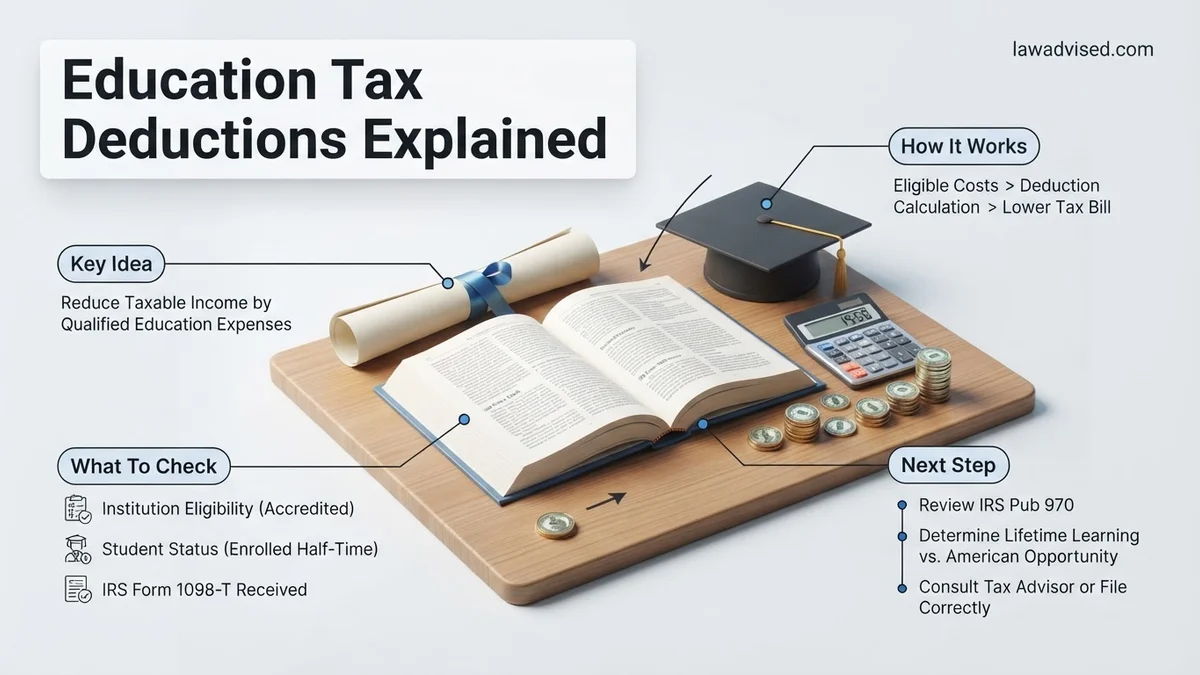
What Causes Confusion With Education Tax Deductions Explained
Credits Versus Deductions
Taxpayers often confuse deductions with credits, which completely changes the math on your return. A tax deduction lowers your overall taxable income, while a tax credit reduces your actual tax liability dollar-for-dollar. For education expenses, credits generally provide a much higher financial return than deductions.
The Double-Benefit Prohibition Rule
Another major trap involves trying to double-dip with your expenses. You cannot claim the AOTC and the LLC for the same student in the same tax year. Furthermore, you cannot use tax-free educational assistance—such as employer-provided educational assistance, scholarships, or Pell Grants—to calculate your eligible tax credits. You must subtract these tax-free amounts from your total qualified expenses before you run the numbers.
- Scholarships and grants reduce your out-of-pocket expenses.
- You cannot use the same exact dollar of expenses for multiple tax breaks.
- Tax-free distributions from a 529 plan also cannot trigger a credit for the same expenses.
How to Fix Your Filing Strategy Using the AOTC and LLC
Maximizing the American Opportunity Tax Credit (AOTC)
The AOTC is your best option if you or your dependent is pursuing an undergraduate degree. It provides a maximum annual credit of $2,500 per eligible student. To qualify in 2026, the student must be enrolled at least half-time for at least one academic period during the tax year. Up to 40 percent of this credit (meaning up to $1,000) is refundable, meaning the IRS will send you a check even if you owe zero tax.
- Covers 100 percent of the first $2,000 of qualified tuition and related expenses, plus 25 percent of the next $2,000.
- Available only for the first four years of higher education.
- Phases out for single filers with a Modified Adjusted Gross Income (MAGI) between $80,000 and $90,000 ($160,000 to $180,000 for joint filers).
Leveraging the Lifetime Learning Credit (LLC)
If you do not qualify for the AOTC because you are taking graduate courses, professional development classes, or attending school less than half-time, the LLC steps in. This credit offers up to $2,000 per tax return (calculated as 20 percent of the first $10,000 of qualified expenses). Unlike the AOTC, there is no limit on the number of years you can claim the LLC, and it is non-refundable.
- Applies to undergraduate, graduate, and professional degree courses.
- Includes courses taken to acquire or improve job skills.
- Phases out for single filers with a MAGI between $80,000 and $90,000 for the 2026 tax year ($160,000 to $180,000 for joint filers).
Step-by-Step Instructions to Claim Your Student Loan Interest Deduction
Claiming the student loan interest deduction for the 2026 tax year does not require itemizing your deductions. You can take this above-the-line deduction even if you choose the standard deduction on your federal tax return.
Gathering Your Documentation
Lenders are legally required to issue Form 1098-E by January 31 if you paid more than $600 in interest during the previous calendar year. Follow these procedural steps to secure your paperwork:
- Log into your federal or private loan servicer online portal by early February 2026.
- Download the digital copy of Form 1098-E or verify that a physical copy has been mailed to your current address.
- Confirm that the total interest paid listed on the form matches your own bank statements or year-end loan summaries.
Entering Data Into Tax Software
Most modern tax preparation platforms streamline this process automatically. Navigate to the deductions and credits section of your software, locate the education subcategory, and input the exact figures shown in Box 1 of your Form 1098-E. Ensure your modified adjusted gross income stays beneath the 2026 IRS phase-out thresholds to retain the full deduction amount.
What If It Still Doesn’t Work and You Face Double-Benefit Restrictions
Taxpayers frequently run into roadblocks when trying to combine multiple education tax benefits for the same student in the same year. According to IRS regulations, you cannot use the exact same educational expenses to claim both a tax credit and deduct student loan interest, a restriction known as the double-benefit rule.
If your deductions are rejected or reduced by automated IRS error-checking systems, utilize these fallback steps to resolve the issue:
- Review your Form 1098-T and Form 1098-E side-by-side to ensure qualified tuition expenses and loan interest payments are strictly separated.
- Allocate specific out-of-pocket expenses to tax credits like the Lifetime Learning Credit while designating loan repayments exclusively for the interest deduction.
- Amend your prior returns using Form 1040-X if you inadvertently claimed overlapping benefits in a previous tax filing.
- Consult a certified public accountant or enrolled agent if your modified adjusted gross income falls precisely within complex phase-out ranges. Professional tax preparation services typically charge between $200 and $500 for individual returns involving education tax optimizations.
Conclusion
Navigating education tax deductions for the 2026 tax year requires careful coordination between Form 1098-T, Form 1098-E, and your household modified adjusted gross income limits. By avoiding double-benefit traps and properly timing your qualified educational expenses, you can significantly lower your overall tax liability. According to verified research and expert sources from the IRS and national CPA associations, proactive record-keeping remains the single most effective strategy for maximizing legitimate education tax savings. Your immediate actionable next step is to log into your loan servicer portals today to download your most recent 1098 statements.
❓ Frequently Asked Questions
What qualified education expenses are eligible for tax credits?
Qualified expenses typically include tuition and required enrollment fees paid to an eligible educational institution. Books, supplies, and equipment are also covered under specific credits like the AOTC if required for enrollment.
Can parents claim education tax credits if they pay for their child’s college?
Yes, if you claim the student as a dependent on your tax return, you are eligible to claim the education tax credits for the qualified expenses you paid.
How much can I save with the Lifetime Learning Credit?
The Lifetime Learning Credit provides a maximum of 20% of the first $10,000 of qualified education expenses, yielding up to $2,000 per tax return with no limit on the number of years you can claim it.
What happens if my income exceeds the phase-out limits for education tax breaks?
If your MAGI exceeds the upper limits set by the IRS for a specific credit or deduction, your eligibility will gradually phase out and eventually drop to zero.
Do I need to itemize deductions to claim the student loan interest deduction?
No, the student loan interest deduction is an above-the-line deduction, meaning you can claim it even if you take the standard deduction on your tax return.
Are room and board considered qualified education expenses?
No, costs for room and board, insurance, medical expenses, and transportation are generally considered personal expenses and do not qualify for education tax credits.

Ismail Hossain is the founder of Law Advised. He is an Divorce, Separation, marriage lawyer. Follow him.