Estimated Tax Penalty Explained Real Guide for 2026
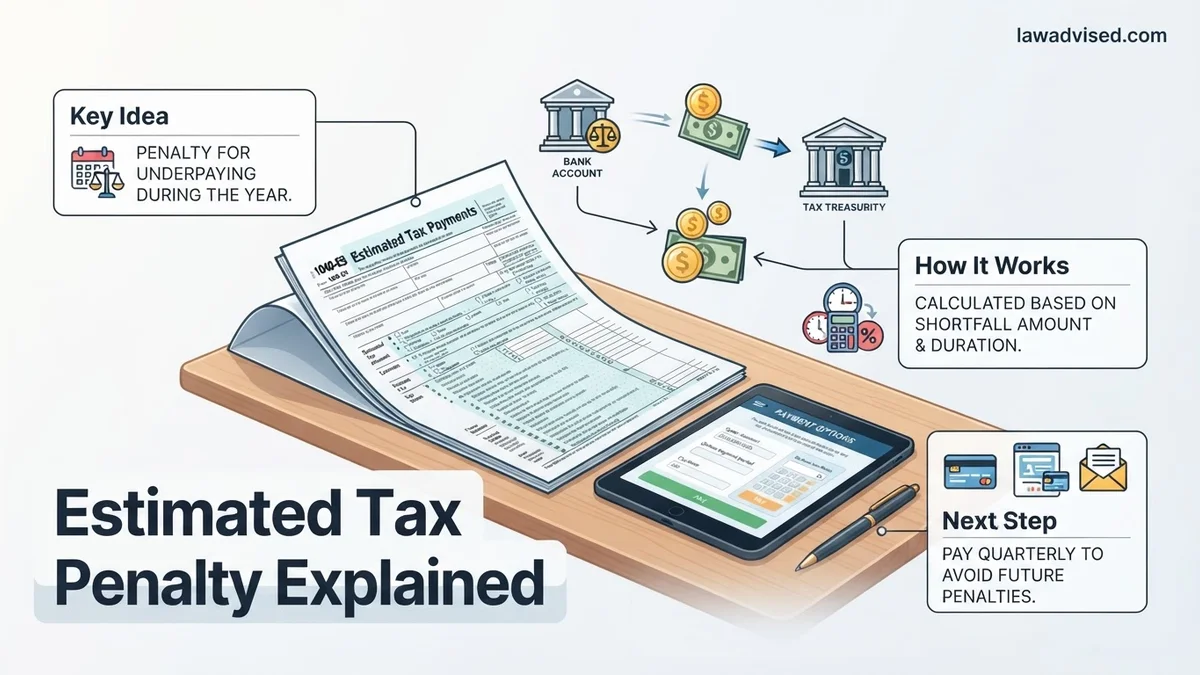
The estimated tax penalty is charged by the IRS when you fail to pay enough tax throughout the year via withholding or quarterly payments. You can easily avoid this fee by utilizing the safe harbor rule, which ensures you pay a minimum percentage of your prior or current year tax liability.
The IRS expects you to pay your income taxes as you earn or receive income throughout the year, rather than waiting until the April deadline. If you fall short of what you owe through withholding or quarterly payments, you may face an estimated tax penalty for underpayment. This happens frequently to freelancers, self-employed individuals, investors, and anyone with significant non-wage income.
Managing this penalty comes down to understanding how the IRS calculates shortfalls and utilizing specific rules designed to protect you from unexpected charges. By navigating the mechanics of quarterly taxes and leveraging the safe harbor guidelines for 2026, you can completely eliminate or drastically reduce these extra costs.
Key Takeaways
- Pay at least 90% of your current year tax liability to avoid penalties.
- Use the 100% (or 110%) prior-year safe harbor rule for guaranteed penalty protection.
- Freelancers and high-income investors are the most common targets for underpayment fees.
- The IRS calculates penalties based on short-term interest rates applied to unpaid amounts.
- File Form 2210 to calculate your penalty or request a penalty waiver from the IRS.
What Causes the Estimated Tax Penalty and Who Owes It
How Pay-As-You-Go Taxes Trigger Penalties
The United States tax system operates on a pay-as-you-go structure. If you are a traditional W-2 employee, your employer automatically withholds taxes from every paycheck. However, if you run a business, earn freelance income, or collect substantial capital gains, nobody is withholding money for you.
To stay compliant, the IRS requires you to make estimated tax payments four times a year. If you fail to make these payments, or if you pay significantly less than you owe, the IRS calculates an underpayment penalty. This penalty is not a flat fee; it functions as an interest charge on the money you failed to pay on time.
Common Triggers for Freelancers and Investors
You might trigger an estimated tax penalty in 2026 if your situation involves specific financial shifts:
- Your freelance business grew significantly compared to the previous year.
- You realized large profits from selling stocks, cryptocurrency, or real estate.
- You transitioned from a W-2 position to full-time self-employment without setting up quarterly payments.
- Your spouse started a new business or increased their independent contract work.
Even if you pay your entire tax bill in full by April 15, 2027, you can still owe an underpayment penalty if you skipped your quarterly payments during 2026. The penalty accrues for each quarter that the payment was late or missing.
How to Fix Underpayment by Using the Safe Harbor Rule
The 90 Percent and 100 Percent Safe Harbor Formulas
The most practical way to avoid the estimated tax penalty is by utilizing the IRS safe harbor rule. If your total withholding and estimated payments meet specific minimum thresholds, the IRS will not assess an underpayment penalty, regardless of how much you end up owing on your final return.
For the 2026 tax year, you completely bypass the estimated tax penalty if you satisfy either of these two primary conditions:
- You pay at least 90 percent of the tax liability shown on your 2026 tax return through withholding and quarterly estimates.
- You pay 100 percent of the tax liability shown on your 2025 tax return (covering the prior 12-month tax period).
If your adjusted gross income on your 2025 tax return exceeded $150,000 (or $75,000 if married filing separately), the high-income rule applies. In that case, you must pay 110 percent of your 2025 tax liability to meet the safe harbor requirement for 2026.
Practical Examples of Safe Harbor in Action
Applying the safe harbor rule protects your cash flow and simplifies your planning. Imagine your total tax liability for 2025 was $20,000. Your adjusted gross income was well under the $150,000 threshold, meaning your safe harbor target for 2026 is exactly $20,000 (100 percent of the prior year).
Suppose your business booms in 2026, and your actual tax bill balloons to $40,000. Without safe harbor, you would face steep penalties for underpaying your quarterly estimates based on that $40,000 total. However, because you made timely quarterly payments and withholding that totaled at least $20,000 throughout 2026, the safe harbor rule protects you. You will still owe the remaining $20,000 to the IRS when you file, but you will pay zero estimated tax penalties.
Step-by-Step Guide to Calculating the Penalty with Form 2210
Calculating the estimated tax penalty yourself requires precision and IRS Form 2210. According to official guidelines from the Internal Revenue Service, this form helps taxpayers determine if they underpaid their quarterly installments. Tax software typically automates this calculation for 2026 filers, but manual calculation is sometimes necessary for complex income situations.
Gathering Your Documentation
Before filling out any paperwork, you must collect specific records to ensure accuracy. Financial experts recommend having these items ready before starting the process:
- Your filed 2025 federal income tax return to verify prior-year safe harbor thresholds.
- Records of all quarterly estimated tax payments made to the IRS for the 2026 tax year, including confirmation numbers and dates.
- Your final 2026 income statements, such as W-2s, 1099s, and investment distribution records.
- A calendar detailing the exact dates you received irregular income if you plan to use the annualized income installment method.
Completing the Calculation Process
Once your documents are organized, follow these steps to complete the evaluation:
- Complete Part I of Form 2210 to establish whether you meet one of the automatic waiver exceptions or the basic safe harbor rules.
- If you do not meet the safe harbor criteria, proceed to Part II to calculate the short method penalty or complete Part III for the regular method.
- Apply the applicable quarterly short-term federal interest rate plus three percentage points, as mandated by tax regulations for 2026.
- Transfer the final calculated penalty amount to the designated line on your main 2026 federal income tax return.
What If It Still Doesn’t Work and You Need a Penalty Waiver
If your calculation shows a substantial penalty and the safe harbor rules do not apply, you may still qualify for administrative relief. The IRS grants penalty waivers under specific statutory conditions. If standard calculation methods fail to resolve your underpayment issue, evaluate these fallback steps:
- Check eligibility for a casualty, disaster, or other unusual circumstance waiver under Internal Revenue Code Section 6654(e)(3)(A).
- Review whether you retired after reaching age 62 or became disabled during the 2026 tax year, which allows for a reasonable cause waiver.
- Attach a detailed written statement and supporting documentation to your tax return explaining why the underpayment was due to reasonable cause rather than willful neglect.
- Consult a certified public accountant or enrolled agent if your penalty calculation involves complex annualized income exceptions. Professional tax representation typically costs between 300 dollars and 1,000 dollars depending on the complexity of your financial portfolio.
Conclusion
Navigating estimated tax obligations prevents costly financial surprises when filing your annual return. By leveraging safe harbor provisions or utilizing Form 2210 accurately, you can minimize or eliminate unexpected 2026 penalty charges. According to verified research and tax compliance experts, proactive quarterly tracking remains the most effective defense against IRS assessments. Your next actionable step is to review your current year income projections and adjust your upcoming quarterly payments immediately to prevent further underpayment liabilities.
❓ Frequently Asked Questions
What are the quarterly deadlines for estimated tax payments?
Estimated tax payments are generally due four times a year: April 15, June 15, September 15, and January 15 of the following year. If a deadline falls on a weekend or holiday, the due date moves to the next business day.
Does the safe harbor rule apply to high-income earners?
Yes, but with an adjustment. If your adjusted gross income for the previous year exceeds $150,000 (or $75,000 if married filing separately), you must pay 110% of your prior year’s tax instead of 100% to meet the safe harbor.
What happens if I miss a single quarterly payment?
Missing a single quarterly payment can trigger an underpayment penalty for that specific quarter, even if you make a larger payment later. The penalty accrues daily until the underpayment is resolved or the filing deadline arrives.
Do W-2 employees ever have to pay estimated tax penalties?
Generally, W-2 employees do not owe estimated taxes because their employers withhold taxes from each paycheck. However, if they have significant side hustle income, capital gains, or investments without withholding, they may face the penalty.
How do I report the estimated tax penalty on my tax return?
You can calculate the penalty yourself using IRS Form 2210 and attach it to your tax return. Alternatively, you can let the IRS calculate the penalty and send you a bill for the exact amount owed.
Are state estimated tax penalties separate from federal penalties?
Yes, most states with a personal income tax have their own estimated tax rules and underpayment penalties that operate independently of IRS regulations. You must check your specific state tax agency guidelines.

Ismail Hossain is the founder of Law Advised. He is an Divorce, Separation, marriage lawyer. Follow him.