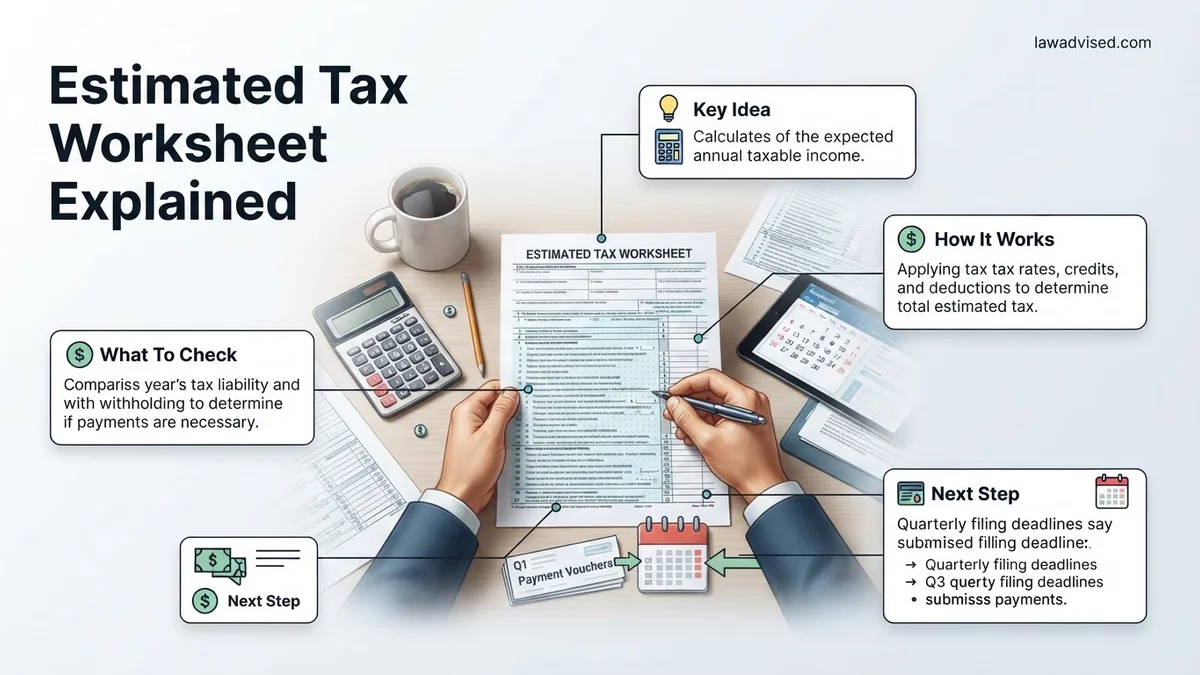
Estimated Tax Worksheet Explained Step-by-Step Guide 2026
Navigating quarterly taxes can be confusing without the right tools. This guide breaks down the IRS Form 1040-ES estimated tax worksheet to help you accurately calculate your income, deductions, and quarterly liabilities for 2026. Learn how to complete every line and avoid underpayment penalties.
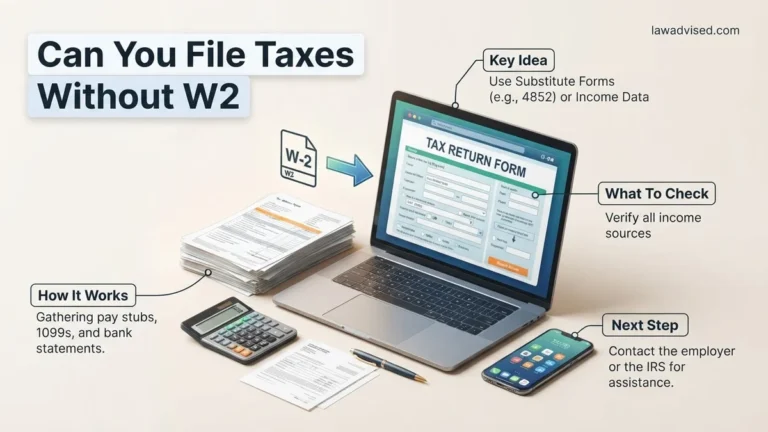
The IRS Form 1040-ES Estimated Tax Worksheet is your primary tool for calculating quarterly tax payments when income isn’t subject to automatic withholding. If you are a freelancer, independent contractor, or business owner navigating the 2026 tax year, relying on guesswork leads directly to underpayment penalties or tied-up cash.
You use this worksheet to project your adjusted gross income, deductions, and total tax liability for the upcoming year, then divide that number into four equal payments. Filling it out correctly ensures you pay Uncle Sam just enough without handing over an interest-free loan.
Key Takeaways
- Use last year’s tax return as a baseline for estimating your 2026 income and deductions.
- Form 1040-ES is required if you expect to owe at least $1,000 in taxes.
- Self-employed individuals must factor in both income tax and self-employment tax.
- Divide your final calculated tax liability into four equal quarterly installment payments.
- Adjust your worksheet calculations mid-year if your income or business revenue changes significantly.
What Causes Incorrect Estimated Tax Calculations on Form 1040-ES
Most calculation errors on the estimated tax worksheet stem from failing to account for fluctuating revenue streams or misapplying self-employment deductions. When your baseline income shifts throughout the year, using last year’s static numbers guarantees an inaccurate quarterly payment.
Failing to Project Gross Income Accurately
The most common mistake is assuming your first-quarter earnings will repeat for all four quarters of 2026. If you land a massive client in January but experience a dry spell by summer, your worksheet projections will be completely inflated. Always base your initial worksheet on conservative estimates, and plan to recalculate your numbers mid-year using the annualized income installment method if your revenue spikes or drops significantly.
Miscalculating the Self-Employment Tax Deduction
Self-employed individuals often forget that Schedule SE tax calculations require a specific two-step math process. You cannot simply multiply your net earnings by 15.3 percent and stop there. You must factor in the deduction for half of your self-employment tax before calculating your final income tax liability. Skipping this step artificially inflates your estimated tax payments and leads to overpaying.
How to Fix Your Estimates Using the Line-by-Line Worksheet Guide
Getting the math right on Form 1040-ES means tackling the worksheet section by section. We will walk through the critical calculations for income, deductions, and self-employment tax using practical numbers so you can see exactly how the formula functions for 2026.
Calculating Adjusted Gross Income and Deductions (Lines 1 through 6)
Start on Line 1 of the 1040-ES worksheet by entering your expected adjusted gross income for 2026. Let us assume you project $90,000 in net freelance income.
- Line 1 (Expected Adjusted Gross Income): Enter $90,000.
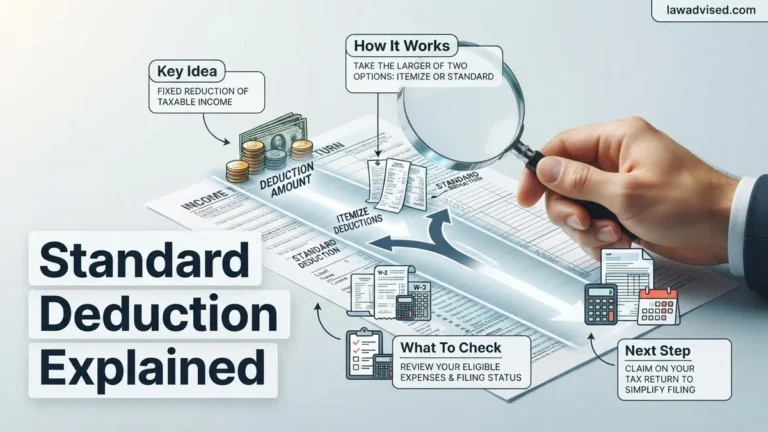
- Line 2 (Standard Deduction or Itemized Deductions): For 2026, take the standard deduction. If you are single, subtract your standard deduction amount to lower your taxable baseline.
- Line 3 (Subtract Line 2 from Line 1): This gives you your taxable income baseline.
- Line 4 (Tax Computation): Apply the 2026 federal income tax brackets to your taxable income to find your base income tax.
Computing Self-Employment Tax (Line 9 Breakdown)
Next, you must calculate your self-employment tax on net earnings, which covers Social Security and Medicare. If your net self-employment income is $90,000, multiply that figure by 92.35 percent to find your net earnings subject to self-employment tax ($83,115).
- Multiply $83,115 by 15.3 percent, which equals roughly $12,717 in total self-employment tax.
- Divide that self-employment tax figure in half ($6,358) and write it down as an adjustment to income on Line 6.
- Transfer the total self-employment tax of $12,717 to Line 9 of the worksheet to combine it with your income tax liability.
How to Calculate Self-Employment Tax and Deductions Properly
Failing to account for self-employment tax is the single biggest trap for 2026 freelancers using the estimated tax worksheet. Regular employees split Social Security and Medicare taxes with their employers, but independent contractors must pay both halves through Schedule SE. According to Internal Revenue Service guidelines, this self-employment tax rate sits at a flat 15.3 percent on net earnings up to the annual wage base limit.
Step-by-Step Self-Employment Calculation
- Multiply your projected net self-employment income by 92.35 percent to find your net earnings subject to tax.
- Multiply that adjusted figure by 15.3 percent to determine your total estimated self-employment tax for 2026.
- Take half of that calculated self-employment tax figure and note it down as an above-the-line deduction.
- Subtract that deduction from your gross adjusted total before running it through the standard income tax bracket rates.
Ignoring this above-the-line deduction artificially inflates your final tax liability on the worksheet. Tax professionals emphasize that missing this deduction causes thousands of independent workers to overpay every single quarterly payment cycle.
What If Your Income Changes and the Initial Estimate Fails
Income rarely stays flat throughout an entire 2026 tax year. Land a massive new client in the third quarter or suffer a sudden revenue drop, and your initial IRS Form 1040-ES calculations become entirely obsolete. If your revenue spikes unexpectedly, sticking to your original worksheet numbers triggers hefty underpayment penalties by the time April 2027 arrives.
Adjusting Mid-Year Projections
- Revisit the estimated tax worksheet at the end of every single quarter to plug in your actual year-to-date earnings.
- Recalculate your expected annual adjusted gross income using the annualized income installment method if your earnings are seasonal.
- File updated, higher quarterly voucher payments for the remaining periods to immediately offset any previous underpayment gaps.
- Submit a formal adjustment if your income plummeted, ensuring you do not lock up necessary operating cash flow with the federal government.
Financial analysts report that adjusting your withholdings or quarterly payments immediately prevents compounding penalties. Do not wait until the final fourth-quarter payment deadline to fix discrepancies caused by major income fluctuations.
What If It Still Doesn’t Work?
If manual calculations on the 2026 estimated tax worksheet still yield confusing results or conflicting figures, utilize these verified fallback steps to stay compliant:
- Switch immediately to IRS Direct Pay or the official Electronic Federal Tax Payment System to verify past payment histories and prevent double-paying.
- Utilize certified tax software approved by the IRS Free File program to auto-populate the worksheet based on secure bank feeds.
- Consult a certified public accountant or an enrolled agent to audit your quarterly projections before the next payment deadline arrives.
- Expect to invest between $200 and $600 for professional quarterly tax preparation and advisory services from a licensed CPA.
- Contact the dedicated IRS business and specialty tax line at 1-800-829-4933 for direct federal guidance on complex income scenarios.
Conclusion
Mastering the estimated tax worksheet prevents painful IRS penalties and unexpected cash flow crunches throughout the 2026 fiscal year. By accurately projecting your net earnings, factoring in self-employment taxes, and adjusting mid-year for income shifts, you maintain total financial control over your business. According to verified research and tax expert sources, proactive quarterly planning reduces year-end audit risks significantly. Your immediate actionable next step is to pull your latest bank statements and complete Form 1040-ES before the upcoming quarterly deadline.
❓ Frequently Asked Questions
How do I calculate adjusted gross income (AGI) on the estimated tax worksheet?
Start by reviewing your expected total income for the year, including wages, self-employment earnings, investments, and business revenue. Subtract any above-the-line deductions, such as self-employed health insurance or retirement contributions, to arrive at your estimated AGI.
Can I use the safe harbor rule to avoid penalties?
Yes, you can generally avoid underpayment penalties if your total withholding and estimated tax payments equal at least 90% of your current year tax liability or 100% of your prior year tax liability (110% if your AGI exceeds $150,000).
What is the difference between line 1 (adjusted gross income) and line 2 (deductions)?
Line 1 captures your total projected earnings before standard or itemized deductions. Line 2 represents the standard deduction or itemized deductions you plan to take, which are subtracted from your income to determine taxable income.
How do I factor in self-employment tax on the worksheet?
Self-employment tax covers Social Security and Medicare taxes and is calculated separately using Schedule SE or the specific lines provided in the Form 1040-ES instructions. You also get to deduct half of your self-employment tax as an adjustment to income.
What should I do if my quarterly income fluctuates significantly?
If your income is seasonal or uneven, you can use the annualized income installment method on Form 2210 to calculate your payments for each period rather than dividing your annual estimate evenly by four.
Where should I mail my estimated tax payments once calculated?
Payment addresses vary depending on your state of residence and whether you include a payment voucher from Form 1040-ES. Alternatively, you can pay electronically using the IRS Direct Pay system or the EFTPS network.

Ismail Hossain is the founder of Law Advised. He is an Divorce, Separation, marriage lawyer. Follow him.