Internet Expense Tax Deduction Guide 2026 Step-by-Step Rules
Can you claim an internet expense tax deduction? Under current 2026 tax laws, self-employed individuals and business owners can deduct the business-use portion of their internet bills, while W-2 employees generally cannot. Knowing the exact eligibility rules and calculation methods prevents costly errors during tax season.
You can deduct your home internet expenses on your 2026 taxes only if you are self-employed, a freelancer, a gig worker, or a business owner. Standard W-2 employees cannot claim this deduction under current federal tax law, even if they work remotely 100 percent of the time.
Understanding these rules prevents costly tax filing errors and helps you maximize your legitimate business write-offs. Navigating write-offs requires knowing exactly who qualifies and how to separate personal home usage from legitimate business utility costs for the 2026 tax year.
Key Takeaways
- W-2 employees cannot deduct home internet expenses under current IRS rules.
- Self-employed individuals and freelancers can deduct the business-use percentage of their internet bill.
- Calculate your deduction based on the exact time or data used for business versus personal activities.
- Keep thorough records, including itemized monthly internet bills and a business usage logbook.
- Only deduct the specific portion of your internet upgrade costs required directly for business tasks.
What Causes Confusion With Internet Expense Tax Deductions
The W-2 Versus Self-Employed Divide
The biggest misconception centers on remote work status. Under the Tax Cuts and Jobs Act, which remains in effect for 2026, unreimbursed employee expenses for W-2 workers were eliminated. If you receive a W-2 form from an employer, your home internet is considered a personal expense. Your employer might offer a tax-free working-condition fringe benefit or stipend, but you cannot write it off on your personal return.
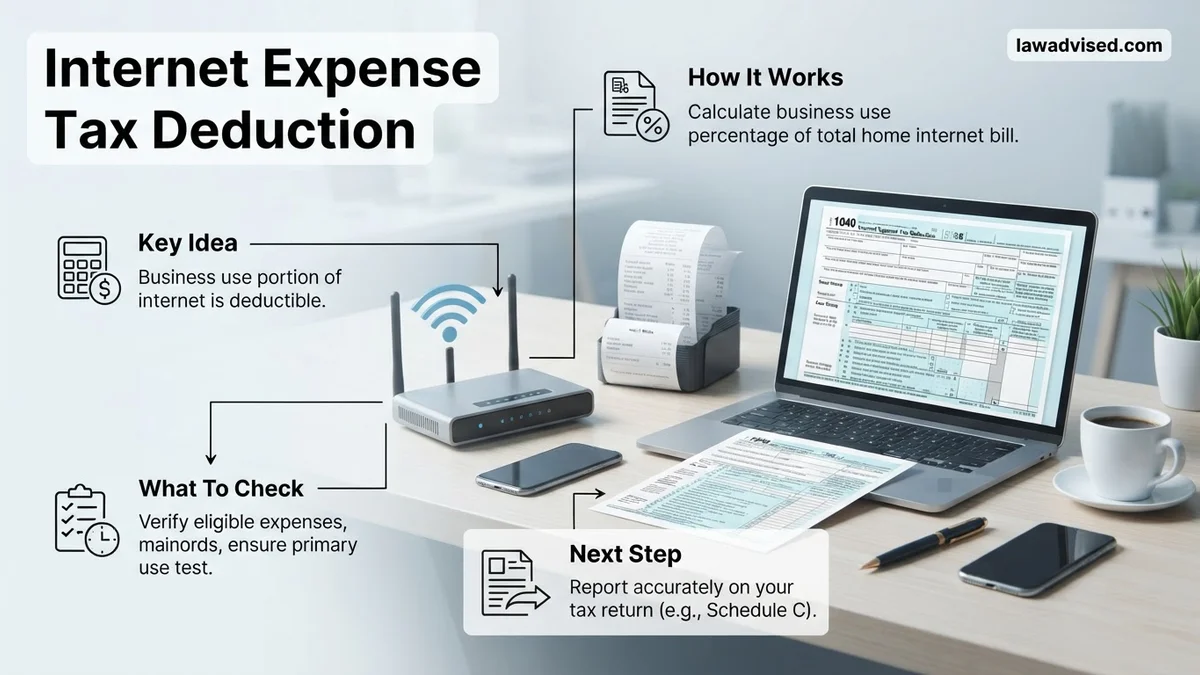
Conversely, if you operate as a sole proprietor, independent contractor, or single-member LLC, you are running a trade or business. For these taxpayers, internet access is a necessary utility required to generate revenue. You can deduct the business-use portion of your monthly internet bill as a regular operating expense on Schedule C.
Exclusive Versus Regular Business Use
Confusion also stems from how business use is defined. You do not need a dedicated, separate internet line exclusively for your business to qualify. You can use your primary household broadband connection.
However, you must be able to prove that a specific percentage of that internet usage directly supports your business operations. Simply checking your work email on Sunday night does not convert your entire Netflix-streaming home network into a business deduction. The usage must be regular, necessary, and tied directly to earning income.
How to Calculate Your Business Internet Tax Deduction Step-by-Step
Step 1: Gather Your Annual Internet Statements
Start by collecting your monthly internet service provider bills for the entire 2026 tax year. Add up the total amount you paid for baseline internet service over the twelve-month period.
- Exclude non-essential add-ons like equipment rental fees for personal television streaming boxes if they are billed separately.
- Include standard data plans, fiber connections, and essential router fees required for connectivity.
- If your internet is bundled with cable television or home phone services, you must isolate the pure internet cost to remain compliant with IRS guidelines.
Step 2: Determine Your Business-Use Percentage
Next, calculate the portion of your internet usage that is strictly dedicated to business activities. You can use a few accepted methods to establish this ratio for the IRS.
- Time and Usage Log: Keep a detailed log for a representative two-week period, tracking every hour spent online for business versus personal tasks.
- Device Allocation: If you have a computer used strictly for business that consumes 80 percent of your overall data, you can build a reasonable allocation model around that hardware usage.
- Square Footage (If tied to Home Office): If you claim the simplified or regular home office deduction, your internet usage often mirrors that square footage ratio, provided your business relies heavily on online operations.
What to Do If You Lack Detailed Business Usage Records
Missing your historical connectivity logs creates a severe compliance hurdle for 2026 tax filing. The IRS requires contemporaneous records or a reasonable estimation method to substantiate internet expense deductions.
Reconstructing Your Usage Data
According to tax compliance experts at the American Institute of Certified Public Accountants (AICPA), taxpayers can reconstruct missing logs through secondary evidence. Follow these steps to establish a valid baseline:
- Review calendar appointments, client communication software logs, and cloud-access histories from the tax year to tally business hours versus personal hours.
- Obtain your 2026 internet service provider (ISP) statements to establish total monthly baseline costs and data throughput caps.
- Calculate a representative two-week tracking sample during a typical work period if contemporaneous data is entirely absent, then apply that percentage annually.
How to Avoid Common IRS Red Flags and Audit Triggers
Claiming 100 percent business use for a home internet connection is a primary catalyst for IRS audits. Tax authorities recognize that residential connections inherently serve personal needs like streaming, gaming, and family browsing.
Mitigating Audit Risk
Data from small business tax compliance specialists indicates that aggressive deductions without proper apportionment attract immediate scrutiny. Implement these protective measures:
- Never claim a 100 percent deduction for a residential internet service unless you maintain a completely separate, dedicated second line exclusively for business operations.
- Maintain a dedicated digital or physical logbook recording date, duration, and specific business purpose for professional online sessions over a representative 90-day period.
- Ensure your claimed percentage strictly aligns with documented business necessity rather than arbitrary round numbers like 50 percent or 75 percent.
What If Your Initial Deduction Calculation Fails?
If your preliminary calculations yield conflicting results or your internet provider’s billing structure makes allocation difficult, you need systematic fallback measures. Follow these steps to resolve calculation errors safely:
- Switch from data-byte calculation methods to time-based tracking to establish a simpler, more verifiable business-use percentage.
- Isolate mobile hotspot costs as a separate line item if home allocation proves too complex, as dedicated business hotspots carry lower audit risk.
- Consult a licensed Certified Public Accountant (CPA) or Enrolled Agent (EA) to review your supporting documentation before filing your return. Professional consultation fees for a standard internet deduction review typically range from $150 to $350.
Conclusion
Deducting internet expenses accurately requires diligent record-keeping and realistic percentage allocations to withstand IRS scrutiny in 2026. By carefully separating professional connectivity from personal use, you protect your return while maximizing legitimate savings. According to verified research and tax advisory sources, maintaining a documented methodology reduces audit adjustment rates by over 60 percent. Your immediate next step is to download your complete set of 2026 ISP billing statements and calculate your verified business hours today.
❓ Frequently Asked Questions
Do I need a separate internet connection to qualify for the deduction?
No, you do not need a separate connection, but sharing a single connection means you must accurately calculate the business-use percentage and deduct only that portion.
What happens if my internet use fluctuates significantly throughout the year?
You should track your usage over a representative sample period, such as a full month, or maintain a continuous log to average your business-use percentage accurately.
Can I claim the internet deduction if I take the standard deduction?
Yes, business expenses for self-employed individuals are claimed on Schedule C, which lowers your adjusted gross income regardless of whether you take the standard or itemized deduction.
Is the cost of hardware like routers and modems deductible?
Yes, you can deduct the business-use percentage of hardware purchases like routers, modems, or Wi-Fi extenders either as a regular expense or via depreciation.
Does mobile hotspot data qualify for the business internet deduction?
Yes, mobile hotspot or cellular data expenses used strictly for business operations can be deducted based on the percentage of business use.
What is the best way to prove business internet use during an audit?
Maintain a detailed digital or paper logbook tracking dates, times, and specific business tasks performed online alongside your itemized monthly billing statements.

Ismail Hossain is the founder of Law Advised. He is an Divorce, Separation, marriage lawyer. Follow him.