Phone Expense Tax Deduction Expert Guide for 2026
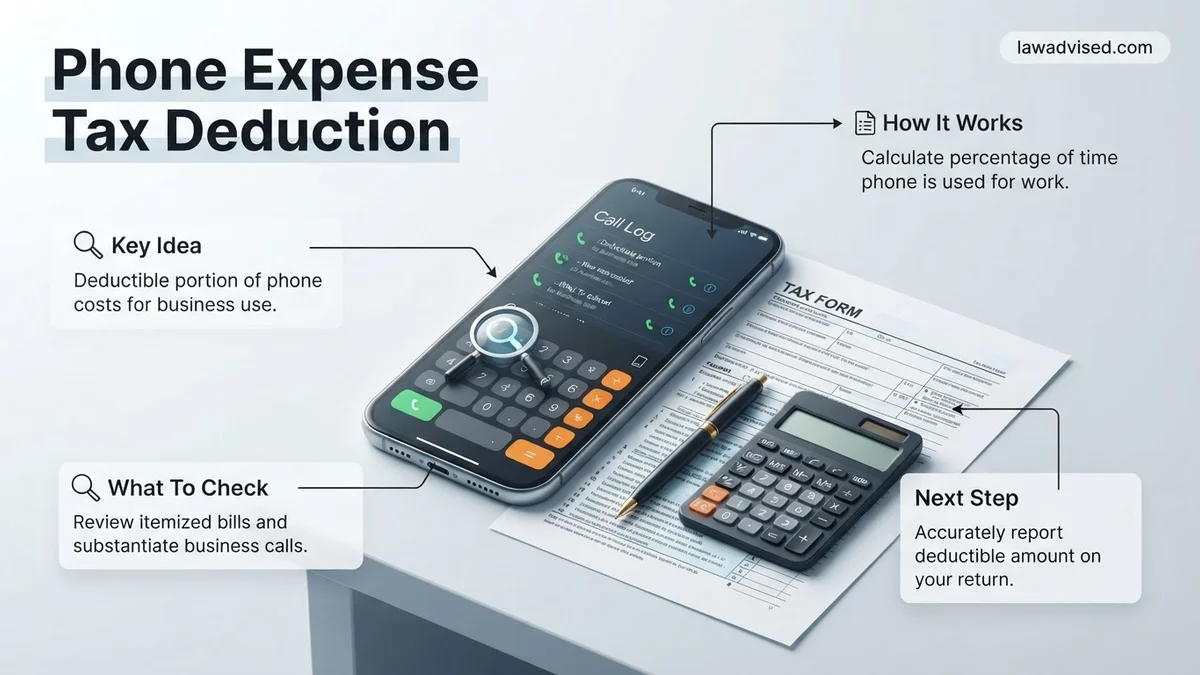
Claiming a phone expense tax deduction depends heavily on your employment status, with self-employed individuals having much broader write-off capabilities than W-2 employees. You can deduct the specific percentage of your phone bill that is used strictly for business purposes, provided you maintain accurate logs.
Yes, you can deduct your cell phone expenses on your taxes, but the exact amount you can claim depends entirely on your employment status and how strictly you use the device for business. If you are self-employed or a 1099 contractor in 2026, you can write off the portion of your phone bill that directly supports your business operations. However, if you are a W-2 employee, federal tax rules generally prevent you from deducting unreimbursed employee expenses.
Getting this deduction right matters because the IRS heavily scrutinizes mixed-use electronics. Claiming 100% of a personal cell phone bill without proper documentation is a fast track to an audit. This guide breaks down the exact eligibility rules, how to calculate your legitimate business percentage, and the steps required to claim your deduction safely on your 2026 tax return.
Key Takeaways
- Self-employed individuals and freelancers can deduct the business-use percentage of their monthly phone bills.
- W-2 employees can no longer claim unreimbursed employee business expenses under current tax laws.
- Calculate your deduction by tracking business calls, data usage, and total phone expenses over a representative period.
- Maintain itemized phone bills and a detailed call log to support your deduction during an audit.
- If you use a second dedicated business phone, 100% of that plan’s cost is tax-deductible.
What Causes Eligibility Confusion for Phone Expense Tax Deductions
The W-2 Versus 1099 Divide
Your employment status is the primary gatekeeper for this tax deduction. Under current tax law, W-2 employees cannot deduct unreimbursed business expenses, including cell phone bills, even if your boss requires you to use your personal device for work. If your employer requires a phone, they must either reimburse you tax-free or provide a company phone. Conversely, 1099 contractors, freelancers, and sole proprietors enjoy full eligibility to deduct the business-related percentage of their monthly mobile expenses.
The Mixed-Use Dilemma
Most people use the exact same smartphone for scrolling social media, calling family, and managing client accounts. This dual-purpose reality creates intense confusion about what is actually deductible. You cannot write off your entire monthly bill just because you sent three work emails on a Sunday. The IRS requires you to separate personal use from business use clearly. Only the specific portion used for generating income qualifies for the write-off.
- W-2 employees cannot claim out-of-pocket phone costs.
- Self-employed workers can deduct ordinary and necessary business communication costs.
- Personal usage must be strictly separated from professional usage.
How to Calculate and Claim Your Phone Expense Tax Deduction Step-by-Step
Step 1: Audit Your Usage and Choose a Calculation Method
To claim the deduction, you must calculate your business-to-personal usage ratio. You have two main approaches to determine this number for your 2026 taxes. The log method requires you to track every single call, text, and data session over a representative month, typically a 30-day period. The time-based method calculates the average number of hours per week you use the phone strictly for business tasks versus total waking hours of use.
Step 2: Apply the Percentage to Eligible Expenses
Once you determine your business percentage, apply it to all eligible costs. If your phone is used 40% for business, you can deduct 40% of your monthly service plan, local taxes, and long-distance fees. Furthermore, if you purchased a new smartphone outright in 2026 specifically for business operations, you can either deduct that cost using Section 179 expensing or depreciate the asset over its useful life based on that exact same 40% business-use threshold.
- Track your calls, texts, and data usage for a representative sample period.
- Calculate your exact business-use percentage (for example, 35%).
- Multiply your total annual phone bills and eligible hardware costs by that percentage.
- Keep itemized carrier statements alongside your logs to substantiate your claim.
What to Do If Your Mixed-Use Phone Records Are Incomplete
Missing or incomplete call logs and carrier statements present a major risk during a tax audit. Without verifiable data, the IRS or relevant tax authority can disallow your mixed-use deduction entirely. Experts recommend acting immediately to reconstruct your timeline if your records have gaps for the 2026 tax year.
Reconstructing Call Logs Retroactively
According to compliance specialists, taxpayers can often retrieve historical data directly from service providers or device operating systems. Follow these procedural steps to rebuild missing logs:
- Log into your cellular provider portal to download itemized billing statements covering the exact gap in your records.
- Export local call history and screen time data directly from your smartphone settings menu.
- Cross-reference client email timestamps and messaging apps to verify business communication dates.
- Compile the reconstructed data into a single, unified spreadsheet categorized by business versus personal use.
Applying Conservative Estimates
If exact records are permanently lost, tax regulations permit a reasonable statistical sampling method rather than a complete log. However, experts advise erring on the side of caution. Claiming a lower business-use percentage based on conservative estimates reduces audit triggers while still securing a legitimate tax break for 2026.
Proven Strategies to Maximize Business Phone Deductions Safely
Maximizing your phone expense tax deduction requires a proactive approach that satisfies strict regulatory standards. Industry studies show that dedicated business tracking tools significantly reduce audit adjustments. Implementing these strategies ensures you claim every allowable dollar without raising red flags.
Using Dedicated Tracking Software
Automated software solutions eliminate human error in logging business hours and data consumption. Consider these tactical steps for software integration:
- Select an IRS-compliant mileage and expense tracking application that also logs digital communication metrics.
- Sync the application with all business devices used throughout the 2026 tax year.
- Export monthly summary reports automatically to your digital accounting vault.
- Review quarterly reports to ensure the tracked business-use ratio aligns with your actual operational habits.
Separating Business and Personal Hardware
The safest way to maximize deductions is removing mixed-use ambiguity altogether. Purchasing a dedicated business smartphone ensures that 100 percent of the hardware cost, service plan, and accessory expenses remain fully deductible under current business expense guidelines.
What If It Still Doesn’t Work?
If your documentation remains disputed or your self-reconstructed records fail initial review, stricter remediation steps become necessary. Certified Public Accountants (CPAs) and Enrolled Agents specialize in resolving complex telecommunication deduction disputes with tax authorities.
- Cease self-amendments immediately to avoid creating conflicting documentation trails for the 2026 tax year.
- Schedule a formal consultation with a licensed tax professional who has specific expertise in remote worker and sole proprietor audits.
- Gather all available bank statements, carrier bills, and client contracts for professional forensic review.
- Prepare for professional fees, which typically range from $250 to $600 per hour for specialized audit representation and record reconstruction services.
Conclusion
Navigating the phone expense tax deduction for 2026 demands meticulous record-keeping and a clear distinction between business and personal usage. Failing to maintain compliant logs can result in disallowed deductions and costly penalties during an audit. According to verified research and expert tax sources, implementing automated tracking tools and strict contemporaneous logs remains the single most effective safeguard. Your immediate next step is to audit your current phone records and implement a digital tracking solution today.
❓ Frequently Asked Questions
What is the difference between a W-2 employee and a 1099 contractor regarding phone deductions?
W-2 employees are barred from claiming miscellaneous itemized deductions for work tools like cell phones unless their employer provides a taxable reimbursement. Conversely, 1099 contractors and sole proprietors treat phone bills as standard business operating expenses on Schedule C.
How should I handle a phone that is used for both personal and business reasons?
You must establish a reasonable method for separating personal and business use, such as analyzing itemized billing records for a typical month. You can only deduct the exact percentage attributable to generating business income.
Is it better to get a second phone dedicated solely to business?
Having a separate business phone simplifies tax preparation significantly because you can deduct 100% of the service plan and hardware costs without needing to calculate personal-use percentages.
What happens if my employer reimburses part of my cell phone bill?
If your employer provides a tax-free working condition fringe benefit or partial reimbursement, you can only deduct any out-of-pocket business expenses that exceed that reimbursement amount (if you are self-employed).
Can I deduct mobile internet or hotspot expenses used for work?
Yes, any mobile data or hotspot usage dedicated to business operations qualifies for the deduction, calculated using your standard business-use percentage.
What specific documentation will protect me during an IRS audit?
To withstand an audit, you need copies of your monthly cell phone bills showing business versus personal calls, a written log tracking business purposes, and proof of payment from a business bank account.

Ismail Hossain is the founder of Law Advised. He is an Divorce, Separation, marriage lawyer. Follow him.