Knife Laws in Arkansas 2027 Expert Legal Guide
Navigating knife laws in Arkansas can be confusing due to specific legal definitions and historical changes regarding blade lengths. Arkansas generally permits the open and concealed carry of most knives, but strict regulations still apply in certain public locations and schools. Understanding these rules prevents accidental legal violations and ensures safe, compliant carry.
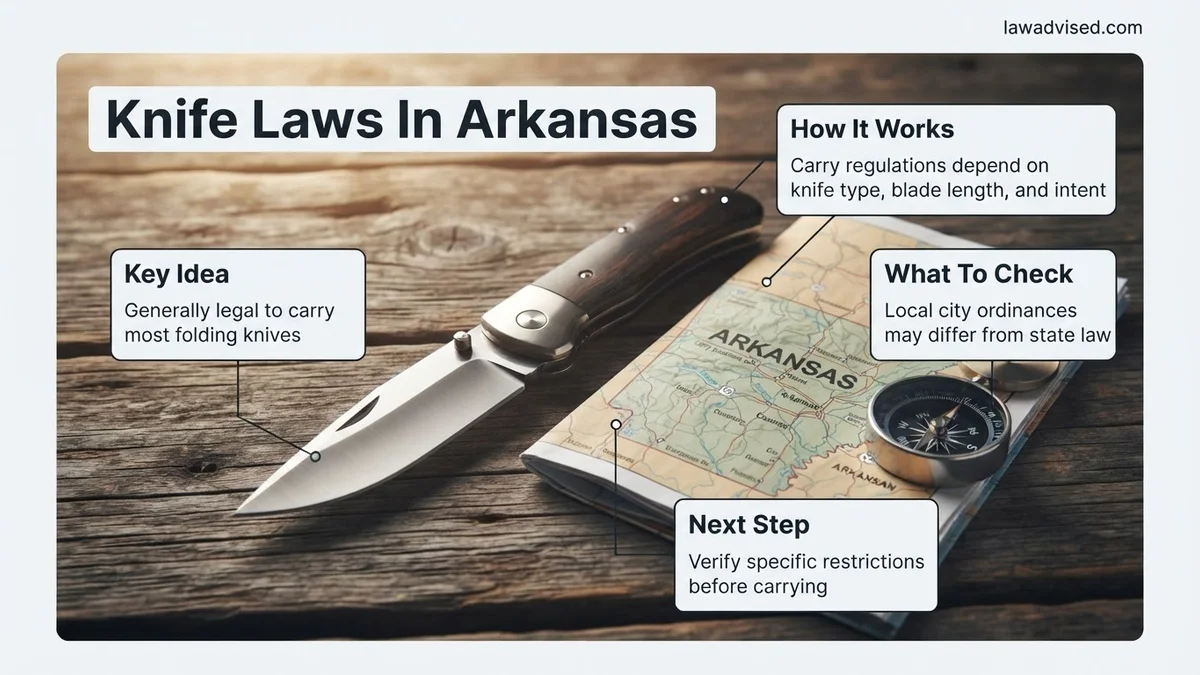
Arkansas stands as one of the most permissive states in the country for carrying a knife. As of 2027, you can legally carry almost any pocketknife, hunting knife, or utility blade openly or concealed without a permit. The state has effectively eliminated blanket blade length restrictions for everyday carry tools under standard state statutes.
However, navigating Arkansas knife laws requires understanding the critical distinction between standard pocket tools and restricted dangerous weapons. While you enjoy broad freedom to carry your preferred gear, carrying certain items with the intent to employ them as an unlawful weapon against another person remains strictly illegal. Knowing these boundaries keeps you compliant.
Key Takeaways
- Arkansas allows the open carry of most standard pocket knives without a permit.
- Concealed carry of standard pocket knives is legal throughout the state.
- Specific dangerous or prohibited weapons remain restricted under state law.
- Carrying any knife onto school or university property is strictly illegal.
- Intent to use a knife as a weapon during a crime drastically increases penalties.
What Causes Legal Confusion Regarding Knife Laws in Arkansas
The primary source of confusion stems from overlapping local ordinances and outdated internet rumors about maximum blade lengths. Many knife owners mistakenly believe Arkansas still enforces a strict three-inch or three-and-a-half-inch limit on concealed blades.
The Myth of Blade Length Limits
State law does not impose a maximum length restriction for standard pocketknives, folding knives, or fixed-blade knives carried for daily utility or protection. You can legally carry a large bowie knife or a compact folder. The confusion usually arises because older municipal codes historically tried to restrict blade sizes before state preemption laws standardized knife regulations across Arkansas.
Intent versus Possession
Arkansas statute heavily emphasizes your intent when carrying a blade. The legal framework differentiates between:
- Ordinary Pocketknives: Generally exempted from weapon classifications when carried for normal daily tasks, work, or recreation.
- Illegal Weapons: Items carried with a deliberate purpose to threaten, intimidate, or unlawfully harm another individual.
How to Comply with Arkansas Open and Concealed Carry Rules
Carrying a knife in Arkansas in 2027 is straightforward thanks to the state’s constitutional carry framework. Whether you prefer to keep your blade tucked away in your pocket or strapped visibly to your belt, the legal thresholds are remarkably uniform.
Open Carry Regulations
Openly displaying a knife on your person is fully legal across most public spaces in Arkansas. You do not need a special permit, license, or background check to walk down the street with a sheath knife on your hip. Law enforcement officers cannot stop you solely for openly carrying a standard utility or hunting blade.
Concealed Carry Regulations
Concealing a knife under your jacket, inside a waistband, or within a backpack is also completely legal for law enforcement-abiding citizens. Arkansas does not require a concealed handgun carry license (CHCL) to conceal a knife. As long as you are not prohibited from possessing weapons due to a felony conviction, you can carry concealed anywhere general carry is permitted.
Restricted Locations to Avoid
Even with permissive carry laws, certain sensitive zones strictly prohibit all knives, regardless of your carry method or blade length:
- Schools and Universities: K-12 campuses and college grounds prohibit unauthorized knives, especially larger fixed blades or tactical gear.
- Courthouses and Government Buildings: Security checkpoints routinely confiscate all pocketknives and multi-tools.
- Secure Areas of Airports: Federal Transportation Security Administration (TSA) rules override state law at airport checkpoints.
What to Avoid: Prohibited Blades and Restricted Locations
Despite Arkansas boasting some of the most permissive knife statutes in the United States, specific prohibitions remain heavily enforced in 2027. Legal compliance requires understanding the exact boundaries of where and what you can carry without facing criminal prosecution.
Prohibited Blades and Intent
While folding knives, fixed blades, and bowies are generally legal, the law strictly targets weapons carried with the intent to commit a criminal offense. Arkansas Code Annotated § 5-73-120 penalizes the carrying of a weapon with a purpose to employ it unlawfully against another person. Furthermore, specialized devices like ballistic knives—which fire the blade via a spring mechanism—face severe restrictions or outright bans under federal and state parallel statutes.
Restricted Locations
Even with constitutional or open carry rights, certain zones maintain absolute bans on all edged weapons. According to 2027 state statutes, carrying any knife with a blade over three inches into these locations constitutes a felony:
- Public and private school campuses, including colleges and universities.
- Courthouses, courtrooms, and government administration buildings.
- Secure areas of airports and commercial aviation facilities.
- Polling places during election cycles.
What If Local Ordinances Conflict with State Law
Arkansas enacted strict preemption laws to prevent a patchwork of municipal regulations across different cities and counties. However, local municipalities occasionally attempt to enforce legacy ordinances that contradict state statute, creating confusion for carriers in 2027.
Understanding State Preemption
State law explicitly grants the Arkansas General Assembly sole authority to regulate the manufacture, sale, transfer, and possession of knives. Municipalities cannot enact ordinances that are stricter than state law regarding blade length or carry methods. If a local city ordinance bans a knife that state law permits, the state statute overrides the local rule.
Resolving Conflicting Citations
If a law enforcement officer issues a citation based on an outdated local ordinance, you must follow specific steps to protect your legal standing:
- Do not argue or resist the officer physically during the stop, as compliance prevents additional obstruction charges.
- Document the exact municipal code cited by the officer on the ticket or police report.
- Consult legal counsel immediately to file a motion to dismiss based on state preemption statutes.
- Request administrative records from the municipality to prove the local ordinance violates state preemption rules.
- Attend all mandatory court appearances with your attorney to ensure the case is formally expunged.
What If It Still Doesn’t Work?
If your legal defense or administrative challenge regarding an unfair knife citation fails at the local municipal level, immediate escalation is necessary. Utilize these verified fallback steps to protect your rights:
- Hire a specialized Second Amendment or criminal defense attorney licensed in Arkansas to challenge the lower court’s interpretation.
- File an appeal with the Arkansas Court of Appeals if a lower court erroneously upholds an invalid local ordinance.
- Request a formal declaratory judgment from a circuit court to permanently enjoin the municipality from enforcing illegal blade bans.
- Prepare for potential legal costs ranging from $2,500 for basic district court representation to over $10,000 for appellate litigation.
- Contact state-level gun and knife rights advocacy organizations for Amicus Curiae support during higher court proceedings.
Conclusion
Navigating Arkansas knife laws in 2027 requires balancing broad state freedoms against strict location-based prohibitions and lingering municipal errors. When facing legal ambiguities or contesting an improper citation, proactive legal defense is essential. According to verified research and constitutional law experts, consulting a qualified attorney remains the most reliable method to protect your rights and property against unlawful enforcement actions.
❓ Frequently Asked Questions
What types of knives are completely illegal to own or carry in Arkansas?
Arkansas law restricts certain dangerous or unusual weapons categorized as prohibited items when carried with unlawful intent. Generally, standard pocket knives, hunting knives, and utility blades are fully legal to possess and carry.
Can cities in Arkansas pass their own stricter knife laws?
Arkansas has state preemption laws regarding knives, meaning local municipalities are generally restricted from creating conflicting ordinances about blade lengths or carry methods, though some local rules may persist in public parks or government facilities.
What are the rules for carrying a knife while driving a car in Arkansas?
You can legally transport any legal knife inside your vehicle in Arkansas, either openly displayed or concealed in a glove box, console, or bag, without needing a special permit.
Are there age restrictions for purchasing or carrying a knife in Arkansas?
Minors may face restrictions regarding the purchase or public carry of certain sharp instruments or utility knives without parental supervision or legitimate work/recreational purposes.
What happens if I am caught carrying a knife in a restricted government building?
Carrying a knife into courthouses, government offices, or secure public facilities typically results in criminal misdemeanor or felony charges, depending on the specific location and posted security notices.
How does intent affect knife laws in Arkansas?
Carrying a knife is generally legal, but possessing any sharp object with the explicit intent to employ it as a weapon against another person instantly elevates the situation to a criminal offense.

Ismail Hossain is the founder of Law Advised. He is an Divorce, Separation, marriage lawyer. Follow him.