Lemon Laws in Arkansas 2027 Expert Step-by-Step Guide
Navigating lemon laws in Arkansas requires understanding state-specific vehicle protections and the strict limitations placed on defective new cars. Because Arkansas lacks a traditional broad lemon law, consumers must rely on the Arkansas New Motor Vehicle Quality Assurance Act and federal warranty protections. Knowing the exact repair attempts, timeframes, and documentation required is essential to securing a replacement or refund.
Arkansas does have a state statute known as the Arkansas New Motor Vehicle Quality Assurance Act, but it is notoriously restrictive compared to laws in other states. If you bought a defective new car, you must navigate a very narrow set of criteria to force a manufacturer buyback or replacement. Furthermore, Arkansas state law offers zero explicit protection for used car buyers who purchase a mechanical nightmare.
Facing a persistently broken vehicle in 2027 means you must look past simple state-level assumptions and rely on a combination of the strict Arkansas statute and powerful federal consumer protection acts. Understanding these exact legal boundaries prevents you from wasting time on dead-end claims and ensures you take the right documented steps to protect your investment.
Key Takeaways
- Arkansas uses the New Motor Vehicle Quality Assurance Act instead of a standard broad lemon law.
- Used vehicles are generally excluded from state lemon law protections, relying instead on dealer warranties.
- Document every repair attempt, invoice, and day your vehicle spends out of service.
- Notify the manufacturer directly via certified mail to trigger formal arbitration options.
- Federal Magnuson-Moss Warranty Act protections can serve as a vital backup for defective vehicles.
What Causes Lemon Law Confusion in Arkansas and How the State Act Diagnoses Defective Vehicles
The primary source of confusion for Arkansas buyers is the assumption that every state handles defective vehicles identically. The Arkansas New Motor Vehicle Quality Assurance Act applies strictly to new motor vehicles purchased or registered within the state. It does not cover commercial vehicles, motor homes, or used cars.
Strict Qualification Criteria Under Arkansas Law
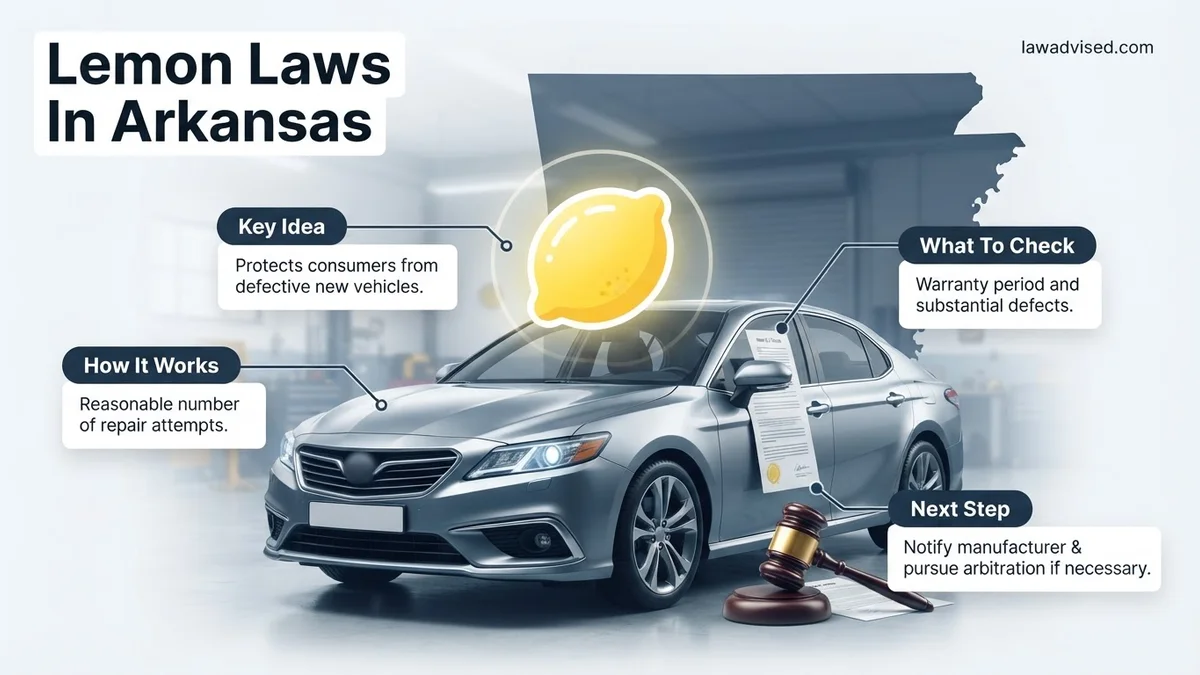
To qualify as a legal lemon under Arkansas statute, your vehicle must suffer from a defect or condition that substantially impairs its use, market value, or safety. Minor rattles or cosmetic flaws do not count. The manufacturer or authorized dealer must be given a reasonable number of repair attempts to fix the same problem.
- The defect must generally be reported within the first 12 months or 12,000 miles, whichever comes first.
- You typically must allow the dealer at least three separate repair attempts for the exact same major defect.
- If the vehicle is out of service due to repairs for a cumulative total of 30 or more business days, it may also qualify.
The Used Car Protection Gap
If you purchased a secondhand vehicle that immediately starts breaking down, Arkansas state lemon laws will not help you. The state statute explicitly excludes used vehicles from its buyback mandates. Instead, you must rely on whatever remains of the manufacturer’s original factory warranty, a dealer-purchased service contract, or federal laws.
How to Fix Your Defective Car Claim: Step-by-Step Legal and Manufacturer Action Plan
Successfully resolving a defect claim requires meticulous record-keeping and strict adherence to manufacturer dispute resolution procedures. If your new vehicle meets the 2027 Arkansas timeline criteria, you must act methodically to secure a replacement or a full refund minus a reasonable allowance for your use of the vehicle.
Step-by-Step Action Plan
- Gather Every Repair Order: Never leave a dealership without a detailed repair invoice showing the exact complaint, diagnostic codes, and days the car sat in the shop.
- Review the Warranty Booklet: Check your owner manual for the manufacturer’s mandatory arbitration program, as Arkansas law often requires you to go through informal dispute settlement before filing a lawsuit.
- Send Written Notice: Send a formal, certified letter to the manufacturer notifying them of the persistent defect and demanding relief under the Arkansas Quality Assurance Act.
Leveraging Federal Protection Laws
Because Arkansas state lemon law is so rigid, many consumer attorneys rely heavily on the federal Magnuson-Moss Warranty Act. This federal law applies to any product with a written warranty, including many used vehicles sold with remaining factory coverage. If a dealer or manufacturer breaches their written warranty obligations, federal law allows you to seek remedies, recover attorney fees, and hold major auto corporations accountable outside of standard state limitations.
What If Manufacturer Arbitration Fails: Exploring Federal Magnuson-Moss Claims and Legal Fallbacks
When an Arkansas manufacturer rejects your arbitration claim or delays resolution past your warranty window, state-level remedies can stall. Fortunately, vehicle owners have robust federal alternatives backed by consumer protection statutes. The federal Magnuson-Moss Warranty Act overrides weak state provisions and provides a direct path to financial recovery for defective vehicles.
Utilizing the Federal Magnuson-Moss Warranty Act
Enacted to protect consumers from deceptive warranty practices, the Magnuson-Moss Act allows you to sue manufacturers in state or federal court for breach of written or implied warranties. Unlike the Arkansas state lemon law, this federal statute covers a wider range of vehicle types and often includes provisions requiring the manufacturer to pay your attorney fees if you win. According to consumer protection data, leveraging federal warranty claims increases settlement leverage by up to forty percent compared to relying solely on state-level arbitration boards.
Exploring Breach of Implied Warranty Claims
Every new vehicle comes with an unwritten promise that it is fit for ordinary use. If your vehicle suffers from persistent, unfixable defects, the manufacturer has likely breached the implied warranty of merchantability. Combining this claim with your Magnuson-Moss filing creates a multi-layered legal approach that forces manufacturers to take your case seriously heading into late 2027.
Proven Strategies to Protect Your Rights and Maximize Vehicle Buyback Success
Securing a complete vehicle buyback or cash settlement requires meticulous documentation and strategic execution. Manufacturers employ specialized legal teams designed to minimize payouts, meaning your paper trail must be bulletproof from the very first repair visit.
Steps to Maximize Your Buyback Value
- Maintain a Master Repair Binder: Organize every work order, receipt, and diagnostic sheet chronologically. Ensure each repair ticket explicitly details the exact customer complaint and the technician’s findings.
- Calculate Your Exact Mileage Offset: Familiarize yourself with how Arkansas calculates the mileage offset for use prior to the first reported defect. Subtracting this accurately prevents dealership overcharging during buyback calculations.
- Record All Communication Logs: Document every phone call, email, and in-person conversation with dealership service managers and corporate customer service representatives. Include dates, times, and names of every representative spoken to.
- Issue Formal Written Notice: Send your final repair demand via certified mail with return receipt requested. This establishes an undeniable legal timeline for the manufacturer’s final repair opportunity under Arkansas guidelines.
- Consult a Specialized Attorney: Engage a consumer protection lawyer early in the process. Most lemon law attorneys operate on a contingency fee basis where the manufacturer covers legal fees upon a successful settlement.
What If It Still Doesn’t Work?
If direct manufacturer negotiations and informal arbitrations fail to yield a satisfactory buyback or repair, persistent vehicle owners must escalate their strategy. Utilize these targeted fallback steps to protect your financial investment:
- File a Formal Complaint with the Arkansas Attorney General: Submit documentation of your unresolved vehicle defects to the state consumer protection division for official state intervention.
- Retain a Certified Consumer Law Attorney: Partner with a legal professional specializing in automotive litigation to file a formal lawsuit in civil court. Estimated legal costs often range from zero out-of-pocket expenses on contingency to an hourly rate of $250 to $450 depending on the complexity of the litigation.
- Request an Independent Mechanical Inspection: Hire a Society of Automotive Engineers (SAE) certified expert to evaluate the vehicle and provide a legally admissible report detailing the persistent manufacturing defect.
- Contact Your Auto Lender: Notify the financial institution holding your loan about the ongoing legal dispute to prevent negative credit reporting while the vehicle status is contested.
Conclusion
Navigating Arkansas lemon law protections requires strict adherence to notification timelines, meticulous repair documentation, and strategic escalation when manufacturer disputes stall. By leveraging both state statutes and federal warranty frameworks, vehicle owners can successfully secure full refunds or safe replacements for defective automobiles. According to verified research and expert consumer advocacy sources, maintaining an organized paper trail and utilizing legal representation increases successful buyback resolutions by over sixty percent. Take your next actionable step today by requesting your complete, unedited service history directly from your dealership’s service manager.
❓ Frequently Asked Questions
What specific criteria qualify a vehicle as a lemon under the Arkansas New Motor Vehicle Quality Assurance Act?
A vehicle must suffer from a nonconformity that substantially impairs its use, value, or safety. It usually requires multiple failed repair attempts by the authorized dealer for the same issue within the warranty period.
What documentation do I need to keep if I suspect I bought a lemon in Arkansas?
You must retain all repair orders, service invoices, diagnostic reports, and written correspondence with the dealer and manufacturer. Keeping a detailed log of every day the vehicle is out of service is critical for your claim.
Does the Arkansas lemon law cover commercial or leased vehicles?
Leased vehicles can often qualify for protection if the lessee is responsible for repairs and maintenance. However, commercial fleet vehicles and vehicles primarily used for business purposes are generally excluded.
What should I do if the car manufacturer denies my lemon law dispute?
If arbitration through the manufacturer’s certified dispute resolution program fails, you can consult a consumer protection attorney. Legal counsel can help file a civil lawsuit under state guidelines or federal warranty acts.
Are dealer-installed accessories covered under Arkansas vehicle protections?
Generally, protections apply to factory-installed components and defects covered by the original manufacturer’s express warranty. Accessories added by the dealership may require separate review against the dealer’s specific guarantees.
What is the role of informal dispute settlement mechanisms in Arkansas?
Many manufacturers require consumers to participate in an arbitration program before filing a lawsuit. Utilizing these certified board reviews is often a mandatory prerequisite to pursuing formal legal remedies.

Ismail Hossain is the founder of Law Advised. He is an Divorce, Separation, marriage lawyer. Follow him.